

INTRODUCTION
Professional pickleball is more visible than ever.
Matches are streamed, highlights circulate daily, and elite players shape how the sport is perceived. Naturally, many recreational players look at the pro game and assume it represents the ideal version of how pickleball should be played.
That assumption is understandable.
It is also one of the most common reasons players stall.
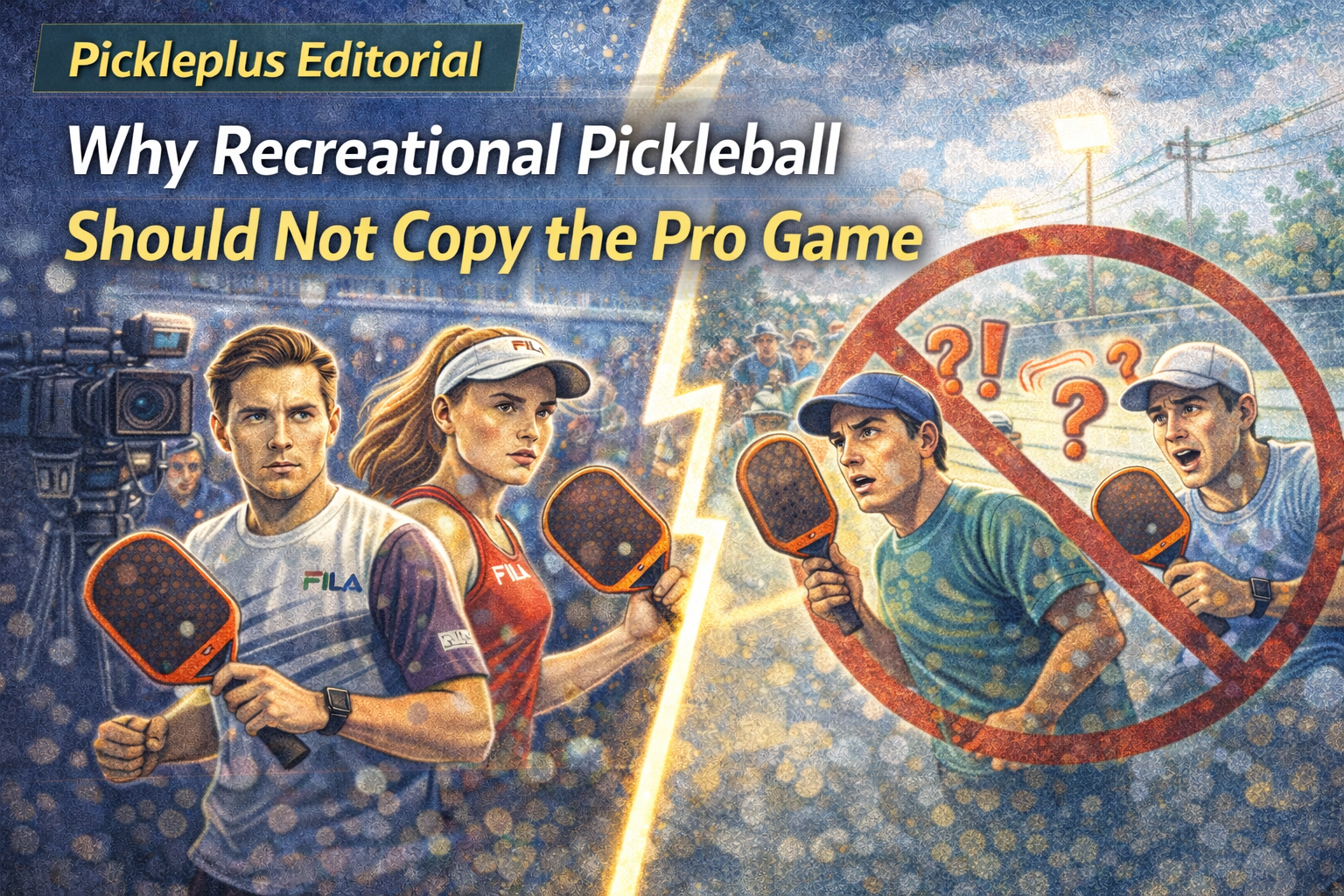
Recreational pickleball should not copy the pro game—not because professionals are wrong, but because they are operating under entirely different conditions.
THE CORE MISUNDERSTANDING
Most players believe the pro game is simply a higher-quality version of their own.
In reality, it is a different optimisation problem.
Professional players optimise for:
- Rankings and seeding
- Long-term point accumulation
- Stable partnerships
- Known opponents and predictable environments
Recreational players optimise for:
- Immediate wins
- Social dynamics
- Constantly changing partners
- Irregular competition formats
When the optimisation goals differ, copying behaviour creates friction instead of improvement.
WHY PRO STRATEGY BREAKS DOWN AT RECREATIONAL LEVELS
Professional pickleball rewards patience because the cost of errors is high and evenly distributed.
At the recreational level:
- Opponents are inconsistent
- Errors are less punished
- Match quality varies widely
As a result, pro-style patience often turns into passivity, while pro-style aggression turns into unforced errors.
The strategy is not wrong.
The context is.
PARTNERSHIP STABILITY CHANGES EVERYTHING
At the professional level, partnerships are intentional and rehearsed.
Players understand each other’s tendencies, preferred patterns, and tolerance for risk. This shared understanding allows them to play with narrower margins and higher trust.
Most recreational players rotate partners constantly.
Without shared context, copying pro-level patterns increases confusion, hesitation, and miscommunication. What looks smooth on tour becomes fragile in open play.
WHY PRO SHOT SELECTION IS OFTEN MISREAD
Elite players hit fewer spectacular shots than people realise.
They:
- Reset more than they attack
- Accept neutral balls patiently
- Wait for statistically favourable openings
Viewers remember highlights, not defaults.
Recreational players often copy the highlights without understanding the underlying decision discipline. This leads to forced plays that professionals themselves avoid most of the time.
INCENTIVES SHAPE BEHAVIOUR
Professional players are paid to win across seasons, not sessions.
They manage energy, reduce volatility, and protect longevity. These incentives reward restraint.
Recreational players often face the opposite pressure. Games are short, opponents change quickly, and social dynamics reward visible effort.
Copying professional restraint without professional incentives often feels unsatisfying and unsustainable.
WHY WATCHING PROS IS STILL VALUABLE
This is not an argument against watching elite pickleball.
Professional players such as Ben Johns demonstrate what pickleball looks like when:
- Decision quality is refined
- Systems support consistency
- Structure removes chaos
The mistake is imitation without translation.
Pros show what is possible under aligned conditions, not what should be copied directly in misaligned ones.
WHAT RECREATIONAL PLAYERS SHOULD COPY INSTEAD
Recreational players benefit most from copying principles, not patterns.
Those principles include:
- Margin over flash
- Patience before aggression
- Decision discipline under pressure
- Acceptance of neutral phases
How those principles express themselves must adapt to the environment.
WHY THIS MATTERS FOR LONG-TERM PROGRESS
Players who copy the pro game too literally often:
- Plateau earlier
- Become frustrated with inconsistency
- Misdiagnose their own weaknesses
Players who adapt pro principles to recreational reality improve more steadily and enjoy the process longer.
Progress depends on alignment, not aspiration.
FINAL THOUGHT
Professional pickleball is not a template.
It is a case study of what happens when structure, incentives, and clarity align.
Recreational players do not need to play like professionals. They need environments and decisions that make sense for where they are.
The fastest way to stall is to imitate the wrong version of the game.
The fastest way to improve is to understand why that version works—and adapt accordingly.
CONTINUATION PATHS
Players who feel conflicted between what they watch and what they experience often benefit from tools that help contextualise their own stage, environment, and goals.
Pickleplus exists to help players understand identity, participation, and progression over time:
https://pickleplus.io
For coaches, translating elite principles into appropriate developmental stages requires longitudinal insight rather than surface imitation.
Tools like Pointflow were built to support that translation across weeks and months:
https://pointflow.pickleplus.io
Some players prefer competitive environments that already separate recreational and performance incentives clearly.
Events such as the Frenship Cup (Singapore, 28 February 2026) reflect that structured approach:
https://docs.google.com/forms/d/e/1FAIpQLSeC3UWkUPVJ0i9IbP0uHwLs1yZsMrnT-obEhw9q3iqJbwdaZQ/viewform