

INTRODUCTION
Most pickleball players expect progress to feel obvious.
Cleaner shots.
More wins.
Immediate confirmation that training is working.
But real improvement rarely announces itself.
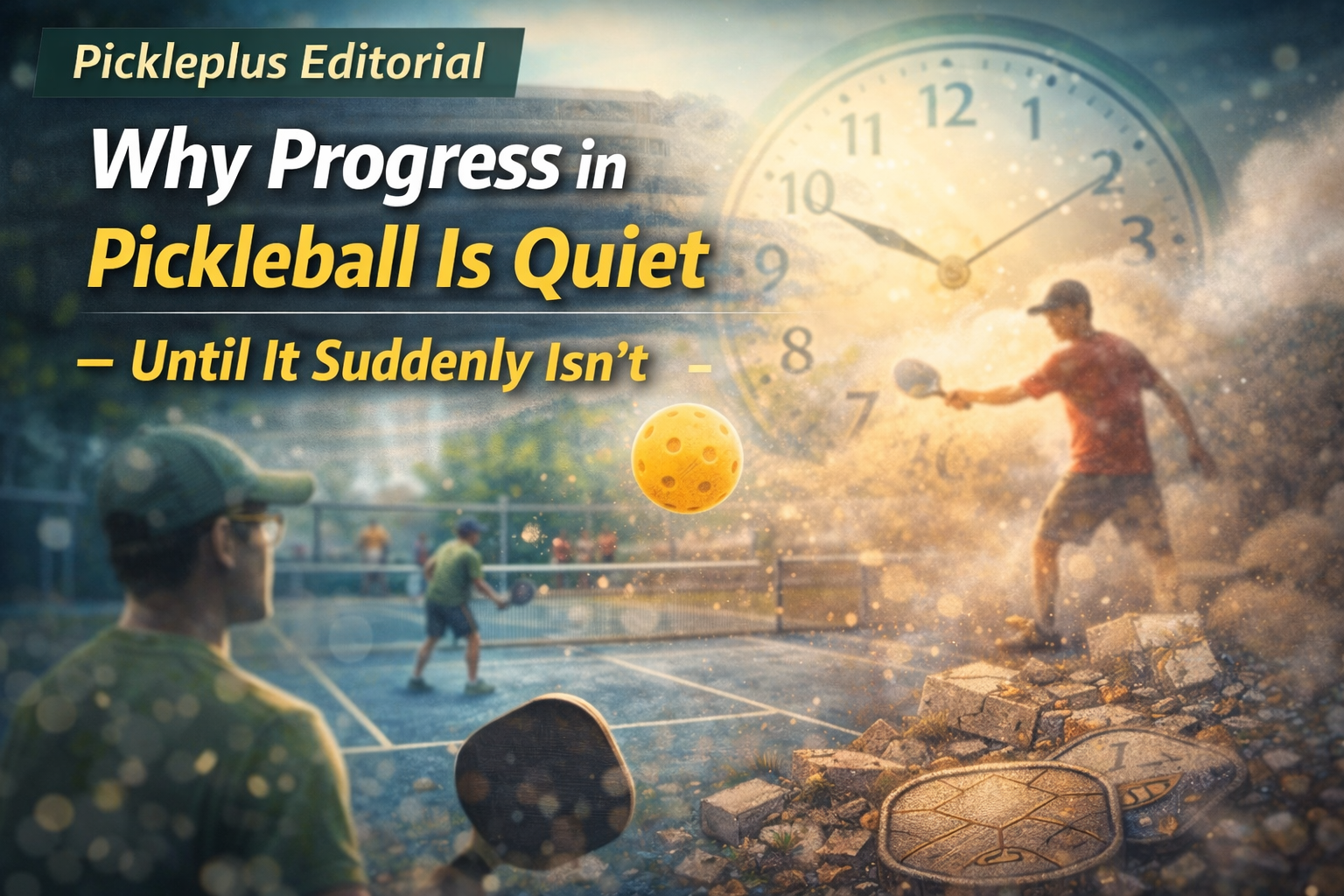
Instead, progress in pickleball is usually quiet, incremental, and almost invisible — right up until the moment it suddenly isn’t.
This misunderstanding is one of the main reasons players lose patience at exactly the wrong time.
WHY PROGRESS FEELS SLOW EVEN WHEN IT IS HAPPENING
Improvement does not show up evenly across a match.
Early on, players notice progress because everything is new. Later, gains become more specific and harder to spot.
Common experiences:
- Rallies feel longer but scores don’t change
- You read the game better but still miss shots
- Losses feel closer, not fewer
None of this looks like progress on the surface.
In reality, it often means your understanding is moving ahead of your execution — a necessary but uncomfortable phase.
THE QUIET PHASE MOST PLAYERS DON’T EXPECT
The quiet phase happens when:
- Old habits are breaking
- New decisions are being tested
- Timing is inconsistent
- Confidence feels fragile
This phase is mentally difficult because performance temporarily feels worse, even though the foundation is improving.
Many players misinterpret this as regression.
It isn’t.
It’s recalibration.
WHY PROGRESS SHOWS UP ALL AT ONCE
Progress compounds quietly.
Then one day:
- You react instead of think
- You reset instinctively under pressure
- You stay in rallies that used to break you
From the outside, it looks sudden.
From the inside, it feels confusing — because you can’t point to the exact moment things changed.
That’s because the work was done earlier, when nothing seemed to be happening.
THE MISTAKE THAT INTERRUPTS QUIET PROGRESS
Most players interrupt progress by changing direction too early.
They:
- Switch focus every session
- Abandon adjustments mid-process
- Chase new advice when results don’t show
This resets the learning cycle repeatedly.
Quiet progress requires staying with the same problem long enough for the solution to stabilise.
That patience is rare — and valuable.
WHY WEEKENDS OF PLAY CAN BE MISLEADING
After a busy weekend of games, players often evaluate themselves too harshly.
They remember:
- The missed shots
- The games they should have won
- The one bad moment
They forget:
- Better decision-making
- Improved positioning
- Longer rallies under pressure
Progress often shows up first in how you lose, not how you win.
WHAT ACTUAL PROGRESS LOOKS LIKE (BEFORE IT FEELS GOOD)
Signs that progress is happening quietly:
- You recognise mistakes earlier
- You recover faster after errors
- You choose better shots even when execution fails
- You feel challenged instead of overwhelmed
These are not highlights.
They are indicators.
WHY THIS MATTERS AT THE START OF A WEEK
Monday is when players decide:
- What to focus on
- Whether last week “worked”
- If it’s time to change direction
Misreading quiet progress leads to unnecessary resets.
Understanding it allows:
- Better weekly focus
- Fewer emotional swings
- More consistent development
Progress rarely rewards urgency.
It rewards continuity.
FINAL THOUGHT
Most pickleball improvement happens when nothing exciting seems to be happening.
That doesn’t mean you’re stuck.
It usually means the work is settling into place.
If you stay long enough, progress eventually stops being quiet.
And when it does, it rarely feels accidental.
CONTINUATION PATHS
Players who begin noticing these quieter signals often want a clearer way to reflect on how their game is actually changing over time, beyond wins and losses.
Pickleplus exists to help players make sense of participation, consistency, and long-term development:
https://pickleplus.io
For coaches, quiet progress is often difficult to articulate without structure or history.
Tools like Pointflow were built to surface patterns that only appear across weeks and months, not single sessions:
https://pointflow.pickleplus.io
Some players prefer to test quiet improvements in structured environments rather than casual play.
Events such as the Frenship Cup (Singapore, 28 February 2026) offer that context:
https://docs.google.com/forms/d/e/1FAIpQLSeC3UWkUPVJ0i9IbP0uHwLs1yZsMrnT-obEhw9q3iqJbwdaZQ/viewform