

INTRODUCTION
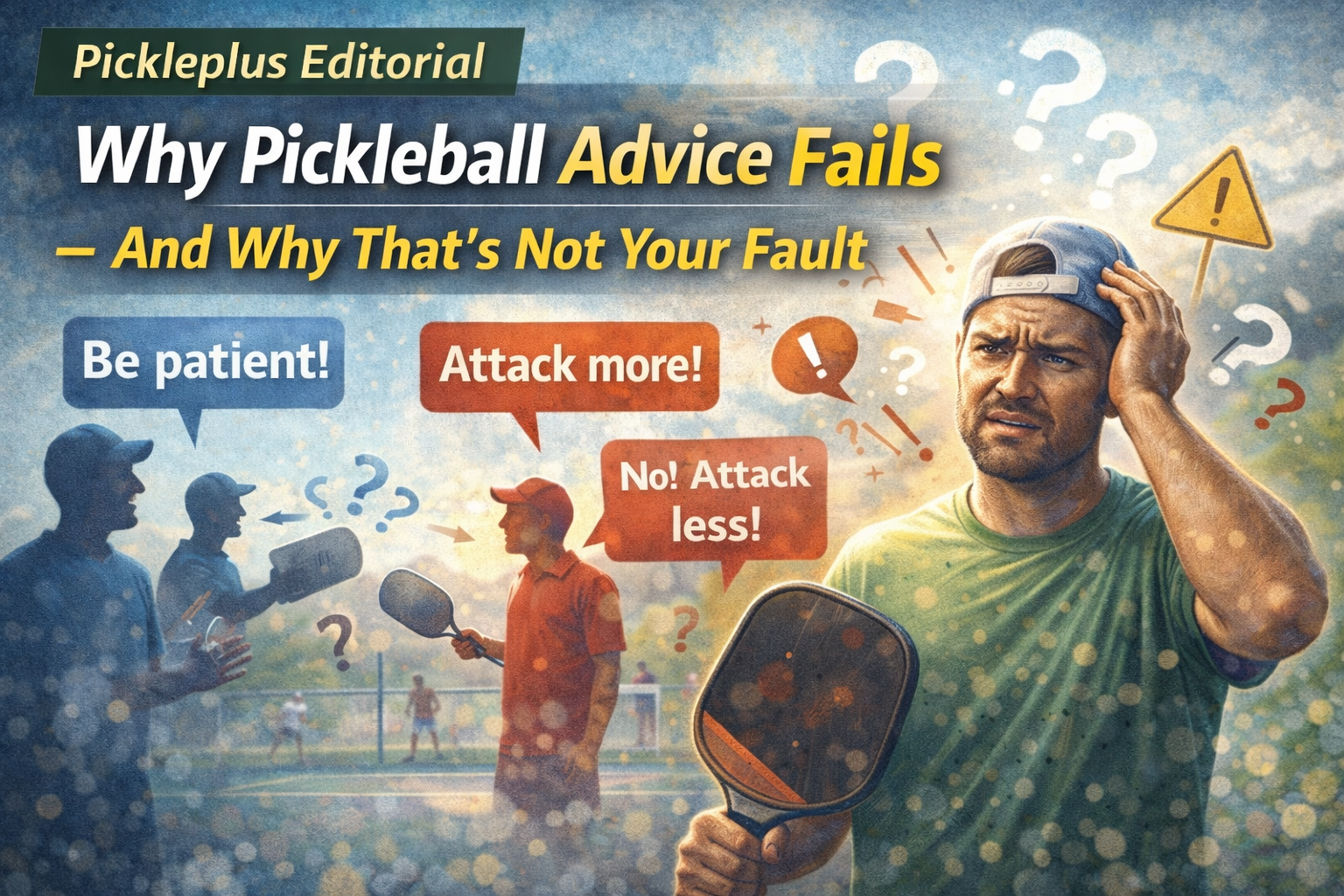
Most pickleball players aren’t short on advice.
They’re overwhelmed by it.
Everywhere you look:
- Keep the ball low
- Reset more
- Be patient
- Attack the right ball
- Don’t attack that ball
None of it is wrong.
Yet much of it doesn’t work.
This disconnect leaves players frustrated, doubting themselves, and wondering why improvement feels harder than it should.
The problem is not effort.
It’s not intelligence.
And it’s not discipline.
The problem is that most pickleball advice fails because it arrives without context.
THE MYTH: GOOD ADVICE SHOULD WORK FOR EVERYONE
Most advice is framed as universal truth.
But pickleball players are not interchangeable.
They differ by:
- Stage of development
- Role (social, league, competitive)
- Decision-making speed
- Emotional bandwidth
- Physical capability
Advice that accelerates one player can stall another.
When guidance ignores context, it becomes noise.
WHY ADVICE FEELS CONTRADICTORY
Players often hear opposite instructions within the same week.
That happens because:
- One coach is correcting mechanics
- Another is managing risk
- A third is optimising tactics
Each piece of advice is valid — in isolation.
Without knowing which problem you are solving right now, advice overlaps and conflicts.
This creates the illusion that improvement is chaotic, when it’s actually misaligned.
THE REAL REASON ADVICE FAILS: TIMING
The same advice has very different effects at different stages.
For example:
- “Be patient” helps beginners who rush points
- “Be patient” stalls intermediates who avoid initiative
- “Be patient” refines advanced players who understand tempo
Advice doesn’t fail because it’s wrong.
It fails because it’s delivered too early, too late, or too broadly.
WHY PLAYERS BLAME THEMSELVES INSTEAD OF THE SYSTEM
When advice doesn’t work, players usually assume:
- They didn’t try hard enough
- They misunderstood
- They lack talent
Rarely do they question whether the advice was appropriate for their current stage.
This internalisation is damaging.
Players don’t need more discipline.
They need better alignment.
HOW TOO MUCH ADVICE SLOWS IMPROVEMENT
When advice stacks without prioritisation, players:
- Think too much mid-point
- Abandon adjustments prematurely
- Switch focus session to session
This constant resetting interrupts learning cycles.
Improvement requires staying with one adjustment long enough for it to stabilise.
Noise prevents that.
WHY COACHES AND CONTENT CREATORS AREN’T THE PROBLEM
Most advice-givers are well-intentioned.
But:
- Short-form content removes nuance
- Group coaching requires generalisation
- Social media rewards certainty, not context
The system incentivises volume, not precision.
Players are left to filter without a framework.
WHAT ACTUALLY MAKES ADVICE USEFUL
Advice starts working when three things are clear:
- What problem you are solving right now
- What stage you are currently in
- What success looks like this week, not eventually
When advice is anchored to a specific moment, it becomes actionable.
Without that anchor, even good advice floats past.
HOW TO LISTEN TO ADVICE WITHOUT GETTING LOST
Players who improve consistently don’t ignore advice.
They filter it.
They ask:
- Does this apply to my current stage?
- Is this about decision-making or execution?
- Am I meant to use this now or later?
This reframing turns advice from instruction into input.
WHY THIS MATTERS FOR LONG-TERM PROGRESS
Advice overload is one of the main reasons players plateau.
Not because they stop learning — but because they never let learning settle.
Clarity accelerates improvement.
Noise delays it.
The difference is not intelligence.
It’s structure.
FINAL THOUGHT
If pickleball advice has ever made you feel confused, inconsistent, or behind, that isn’t a personal failure.
It’s a system problem.
Advice works when it meets the right player at the right time, for the right reason.
Without that alignment, even the best guidance falls flat.
CONTINUATION PATHS
Players who begin filtering advice more intentionally often want a clearer way to understand their own stage of development and how it evolves over time.
Pickleplus exists to help players contextualise participation, progression, and identity across different phases of play:
https://pickleplus.io
For coaches, advice only becomes effective when it can be tied to patterns observed over weeks rather than isolated sessions.
Tools like Pointflow were designed to surface those longer-term signals:
https://pointflow.pickleplus.io
Some players prefer to test advice in structured environments where context is clearer than in open play.
Events such as the Frenship Cup (Singapore, 28 February 2026) are designed with that intent:
https://docs.google.com/forms/d/e/1FAIpQLSeC3UWkUPVJ0i9IbP0uHwLs1yZsMrnT-obEhw9q3iqJbwdaZQ/viewform