

INTRODUCTION
Most pickleball players don’t struggle because they lack effort.
They struggle because they’re working on too many things at once.
Every session becomes a new priority.
Every video introduces a new fix.
Every loss triggers a new adjustment.
Eventually, everything feels important — which means nothing actually is.
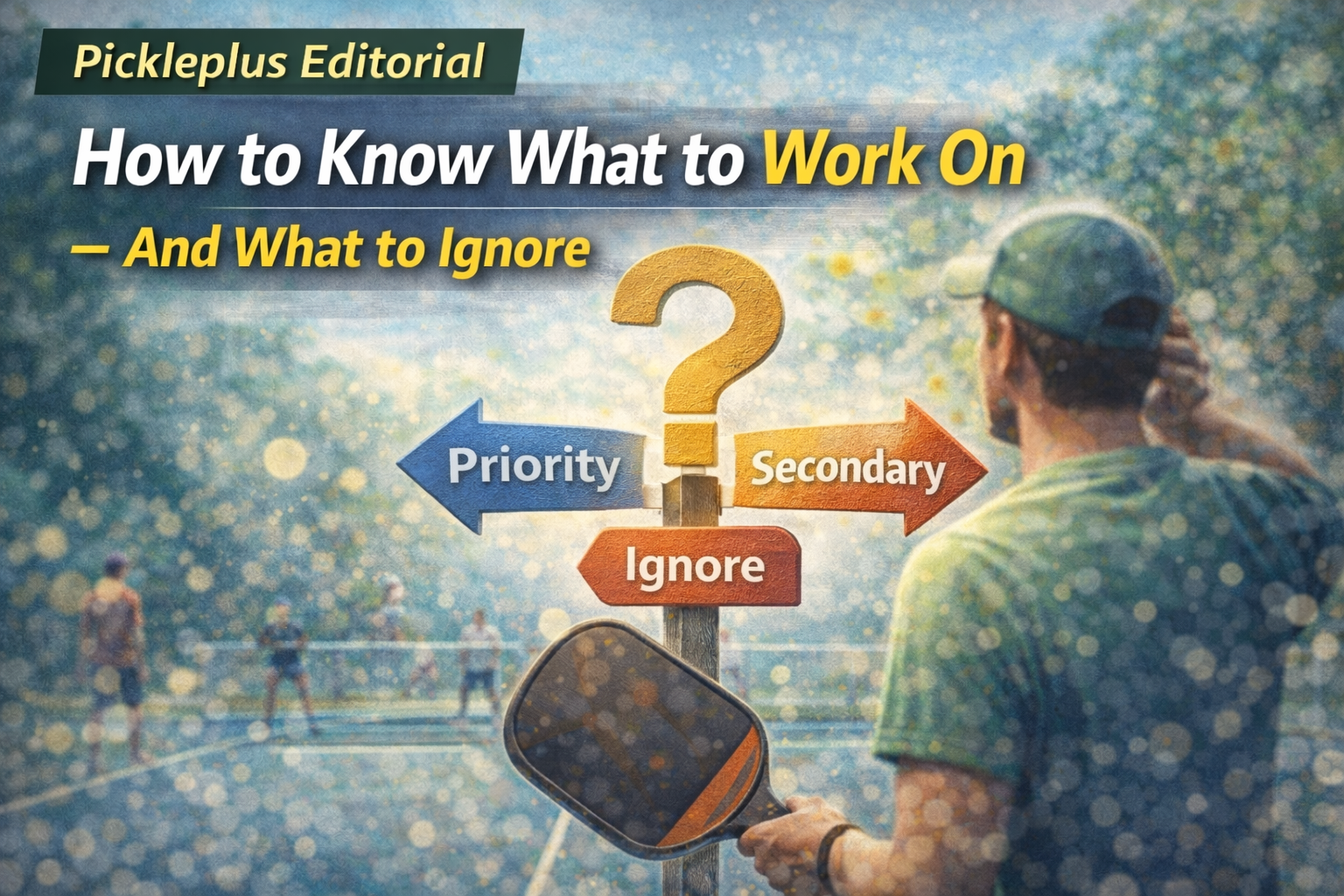
Progress begins not when you add more, but when you decide what to ignore.
WHY “WORK HARDER” IS RARELY THE ANSWER
When players feel stuck, their instinct is to increase volume.
More games.
More drills.
More feedback.
But without focus, volume amplifies confusion.
Effort only compounds when it is applied to the right problem. Otherwise, it simply creates fatigue.
The question isn’t:
“Am I doing enough?”
It’s:
“Am I doing the right thing right now?”
THE REAL SKILL: PROBLEM IDENTIFICATION
Players who improve consistently are not better at execution first.
They are better at diagnosis.
They can answer:
- Why did I lose that point?
- Was that a decision error or an execution error?
- Does this happen often or only under pressure?
Without diagnosis, practice becomes guesswork.
THE MOST COMMON FOCUS MISTAKE
Most players try to fix symptoms instead of causes.
Examples:
- Missing volleys → change grip
- Losing points at the net → hit harder
- Feeling rushed → slow everything down
Sometimes those help. Often they don’t.
Because the underlying issue may be:
- Poor positioning
- Late recognition
- Fatigue
- Decision hesitation
Fixing the wrong layer creates temporary relief, not progress.
HOW TO DECIDE WHAT ACTUALLY DESERVES YOUR ATTENTION
A useful focus passes three tests.
1. It shows up repeatedly
If an issue appears once, ignore it.
If it appears every session, it matters.
Patterns deserve attention. Moments do not.
2. It affects multiple parts of your game
Good focus areas are leverage points.
For example:
- Footwork affects groundstrokes, volleys, and recovery
- Shot selection affects errors, confidence, and stamina
If fixing one thing improves many situations, it’s a good priority.
3. It is within your control
External factors feel important, but they don’t accelerate improvement.
You can’t control:
- Opponent level
- Partner decisions
- Weather or court conditions
You can control:
- Shot tolerance
- Decision clarity
- Recovery between points
Productive focus lives here.
WHY IGNORING THINGS IS PART OF IMPROVEMENT
Ignoring advice is not arrogance.
It’s discipline.
Every phase of development requires saying:
“Not now.”
This doesn’t mean the advice is wrong.
It means it’s out of sequence.
Players stall when they try to solve tomorrow’s problems today.
HOW LONG TO STAY WITH ONE FOCUS
Most players abandon adjustments too early.
A reasonable guideline:
- Short-term discomfort: expected
- Short-term inconsistency: normal
- Short-term results: unreliable
If you change focus every session, nothing stabilises.
Staying with one priority for several weeks is not stubbornness.
It’s how learning actually settles.
WHAT PROGRESS LOOKS LIKE WHEN FOCUS IS RIGHT
When focus is aligned, players notice:
- Fewer mental reminders mid-point
- Faster recovery after mistakes
- Better decisions even when execution fails
- Clearer confidence, not louder confidence
Progress feels quieter — but steadier.
WHY THIS MATTERS AFTER ADVICE FAILS
Advice overload creates urgency.
Urgency destroys prioritisation.
This is why filtering matters more than consuming.
Players who progress long-term are not those who know the most —
but those who know what to work on, and what to leave alone.
FINAL THOUGHT
You don’t need better advice.
You need fewer priorities.
When you choose the right thing to work on, improvement doesn’t require force.
It simply accumulates.
And everything else can wait.
CONTINUATION PATHS
Players who reach this point often want a clearer way to reflect on patterns over time, rather than relying on memory after each session.
Pickleplus exists to help players track participation, consistency, and development across weeks and months:
https://pickleplus.io
For coaches, identifying the right focus is often easier when trends are visible across sessions rather than inferred from single games.
Tools like Pointflow were built to support that longer-term clarity:
https://pointflow.pickleplus.io
Some players prefer to test focused adjustments in structured environments rather than casual play, where priorities blur.
Events such as the Frenship Cup (Singapore, 28 February 2026) provide that context:
https://docs.google.com/forms/d/e/1FAIpQLSeC3UWkUPVJ0i9IbP0uHwLs1yZsMrnT-obEhw9q3iqJbwdaZQ/viewform