

INTRODUCTION
Most pickleball ecosystems don’t fail loudly.
They fade.
Courts still look busy.
Sessions still run.
Tournaments still happen.
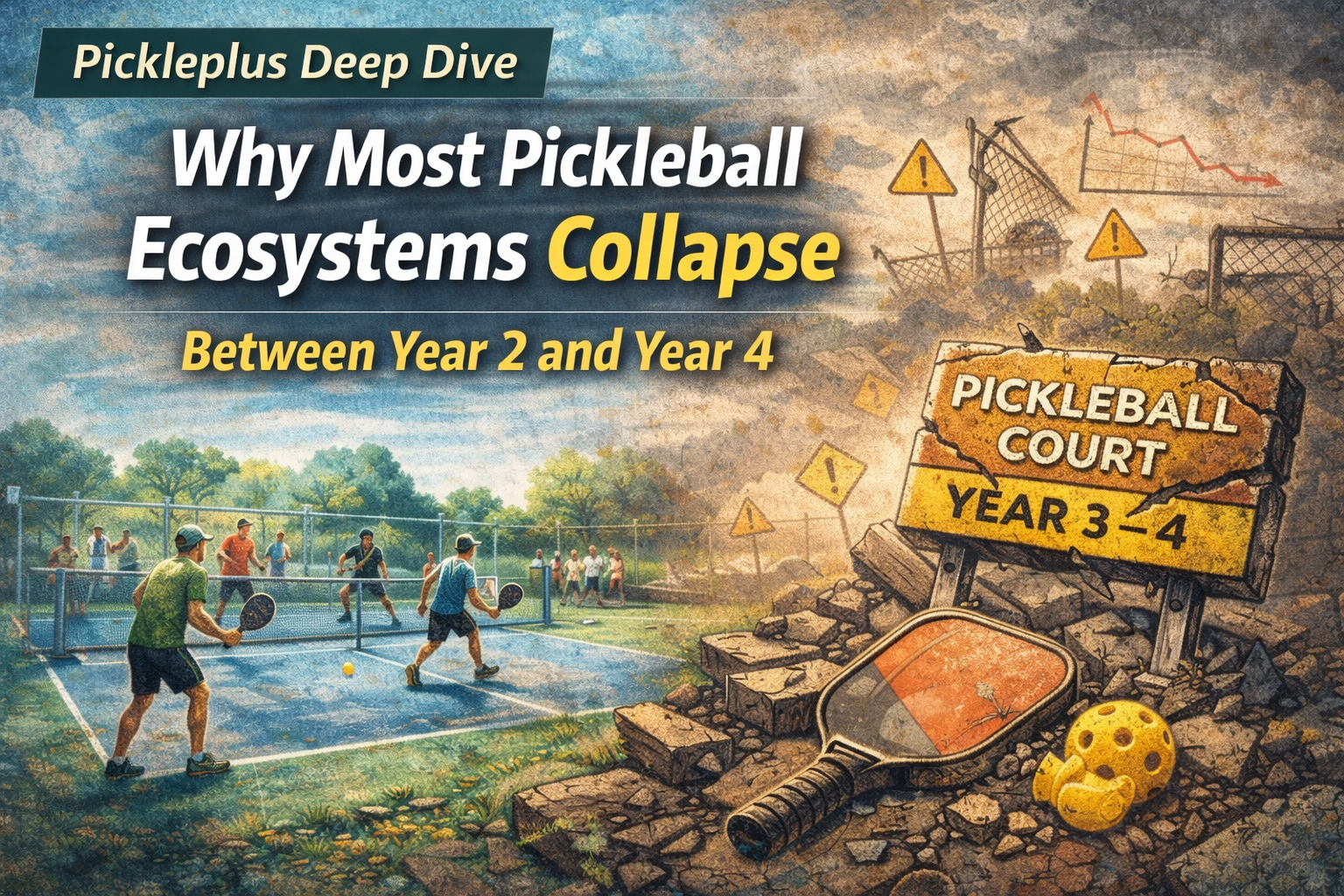
But beneath the surface, something critical breaks between year two and year four — a phase where novelty disappears and structure is finally tested.
This is not a pickleball-specific problem.
It is a classic ecosystem problem.
And pickleball is now old enough to experience it at scale.
WHY YEAR ONE ALWAYS LOOKS LIKE SUCCESS
Year one benefits from powerful tailwinds:
- Novelty and curiosity
- Media attention
- Early adopters willing to tolerate chaos
- Low expectations
Almost any format works in year one.
Open play feels vibrant.
Ad-hoc leagues feel exciting.
Social energy compensates for missing structure.
This creates a dangerous illusion:
“What we’re doing is working.”
In reality, year one is not proof of sustainability.
It is proof of interest.
YEAR TWO: WHEN CRACKS FIRST APPEAR
By year two, the ecosystem begins to change.
Player profiles diverge:
- Beginners improve rapidly, then slow
- Regulars form fixed groups
- Competitive players want more structure
Common symptoms emerge:
- Complaints about mismatched games
- Coaches repeating the same beginner cycles
- Drop-off among intermediate players
- Subtle tension around ratings and placement
Nothing feels broken enough to act on — yet.
This is where most ecosystems hesitate instead of redesign.
YEAR THREE: THE SILENT CHURN PHASE
Year three is the most dangerous phase.
Because the ecosystem still looks active.
But beneath the surface:
- New players replace quietly exiting ones
- Core groups shrink without being noticed
- Session attendance becomes less predictable
- Coaching revenue plateaus
This is replacement churn, not growth.
The ecosystem survives — but stops compounding.
At this stage, many operators blame:
- Player commitment
- Market maturity
- Competition
Rarely do they question the system itself.
YEAR FOUR: SYSTEMS OR STAGNATION
By year four, the ecosystem reaches a fork.
Either:
- Structure has evolved to support complexity
- Or the system hardens into something brittle
Signs of stagnation:
- Same players, same formats, same outcomes
- Tournaments struggle to fill brackets
- Coaches burn out or leave
- Revenue flattens despite “busy” courts
The ecosystem doesn’t collapse overnight.
It simply stops going anywhere.
THE CORE REASON ECOSYSTEMS FAIL
Most pickleball ecosystems are built on activities, not pathways.
They offer:
- Courts
- Sessions
- Events
But they don’t offer:
- Clear progression
- Role differentiation
- Long-term player journeys
Without pathways:
- Players self-sort informally
- Friction increases
- Motivation decays
The system relies on goodwill — until goodwill runs out.
WHY RETENTION METRICS OFTEN LIE
Many ecosystems believe they’re retaining players because:
- Sessions remain full
- Revenue is stable
- Membership numbers look healthy
But these metrics hide critical questions:
- How long do players stay in the same stage?
- How many intermediate players progress?
- Who leaves quietly — and why?
Ecosystems fail not because players quit entirely, but because the wrong players stay while others disappear.
THE MISSING LAYER: ECOSYSTEM DESIGN
Sustainable ecosystems are designed, not accumulated.
They make room for:
- Different player stages
- Different motivations
- Different definitions of success
They deliberately separate:
- Social play from development
- Development from competition
- Competition from identity
Without this separation, everything collides — and players drift away from the friction.
WHY ASIA EXPOSES THIS FASTER
In markets like China and Southeast Asia:
- Time is scarce
- Value is questioned early
- Ambiguity is not tolerated
Ecosystems that rely on “it’ll sort itself out” fail quickly.
This isn’t a weakness.
It’s a stress test.
What survives these markets tends to survive anywhere.
WHAT ACTUALLY PREVENTS THE YEAR 2–4 COLLAPSE
Ecosystems that survive do three things consistently:
- They recognise player stages explicitly
Not everyone needs the same experience at the same time. - They design visible progression
Improvement is seen, not assumed. - They treat retention as a systems problem
Not a marketing or motivation issue.
Survival is not about growth speed.
It’s about structural honesty.
FINAL THOUGHT
Most pickleball ecosystems don’t fail because the sport loses appeal.
They fail because the system never evolves beyond its first version.
Year one rewards enthusiasm.
Year two exposes cracks.
Year three tests resilience.
Year four demands design.
The ecosystems that survive are not the loudest.
They are the ones that quietly make sense — for the longest time.
CONTINUATION PATHS
Players who notice these patterns often begin asking clearer questions about where they are in the ecosystem and what role they want pickleball to play long-term.
Pickleplus was built to help players and communities track progression, participation, and identity across stages:
https://pickleplus.io
For coaches and organisers, ecosystem failure is rarely visible in single sessions — it appears only over time.
Tools like Pointflow exist to surface long-term development and engagement patterns rather than short-term activity:
https://pointflow.pickleplus.io
Some players prefer to experience structured environments that reflect intentional ecosystem design rather than ad-hoc play.
Events such as the Frenship Cup (Singapore, 28 February 2026) are designed with that philosophy in mind:
https://docs.google.com/forms/d/e/1FAIpQLSeC3UWkUPVJ0uHwLs1yZsMrnT-obEhw9q3iqJbwdaZQ/viewform