

As traditional banking embraces digital currencies, the next transformation may reach far beyond finance—changing how athletes, coaches, clubs, tournaments and sports businesses operate.
November 3, 2026 | Waypoint Insights | Technology, Finance & Sports Business
The Future of Sports Might Be Shaped by What Happens Outside the Court
When one of the world’s largest banking institutions attracts 50,000 users to a new digital currency in just over a week, the obvious story is about the future of banking.
But there is another story worth examining.
What happens when the technologies transforming financial services begin reshaping the economics of sports?
For decades, the sports industry has focused heavily on participation, competition, sponsorship and broadcasting rights. Technology has largely been introduced to improve individual activities: booking courts, registering for tournaments, tracking performance or processing payments.
Yet the underlying systems connecting athletes, coaches, facilities, event organisers, sponsors and financial institutions remain remarkably fragmented.
The emergence of regulated stablecoins, artificial intelligence and digital identity infrastructure could eventually change that.
And developments in Hong Kong suggest that this transformation may be closer than many sports businesses realise.
HSBC’s RedCoin: Why 50,000 Users Matter
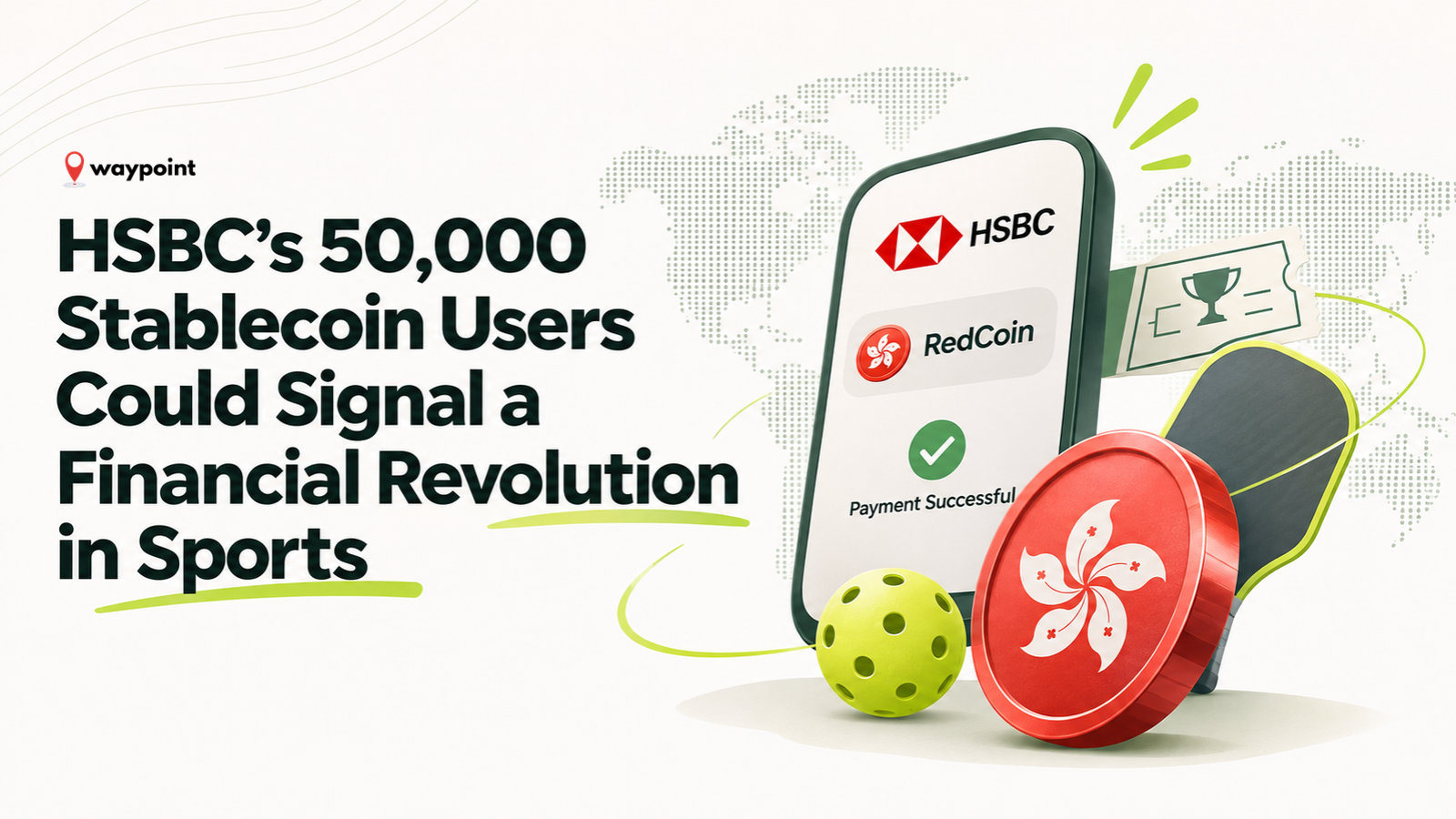
On November 2, 2026, HSBC revealed that its Hong Kong dollar-backed stablecoin, RedCoin, had attracted approximately 50,000 users following its launch on October 23.
Introduced through HSBC’s PayMe platform, RedCoin allows eligible users to transfer digital value and make payments through an existing financial application.
Unlike speculative cryptocurrencies whose prices can fluctuate dramatically, RedCoin is designed to maintain a stable value against the Hong Kong dollar.
The stablecoin operates on HSBC’s own distributed ledger infrastructure, under Hong Kong’s regulated stablecoin framework.
HSBC is also planning to expand RedCoin’s applications to tokenised investment products.
The significance extends beyond the number of early adopters.
Rather than asking consumers to embrace an unfamiliar cryptocurrency ecosystem, HSBC has introduced digital assets through financial infrastructure people already understand.
That distinction matters.
For emerging technologies to become mainstream, users generally need compelling reasons to adopt them. They should not have to become technology experts simply to benefit.
The same principle applies to sports.
A player should not need to understand blockchain architecture to register for a tournament, receive prize money or establish a verified sporting record.
A coach should not need to understand financial technology to receive payments from international students.
A facility operator should not need to understand artificial intelligence to make better commercial decisions.
Technology becomes transformative when its complexity disappears behind a useful experience.
The Sports Industry Has a Financial Infrastructure Problem
Consider a typical international pickleball tournament.
Players register from different countries. Organisers collect entry fees in different currencies. Coaches and officials require payment. Sponsors contribute funding. Prize money must be distributed. Facilities charge for court usage.
Behind what appears to be a straightforward sporting event lies a surprisingly complicated financial operation.
International transfers can involve processing delays, intermediary fees, currency conversion costs and administrative reconciliation.
Smaller organisers may rely on spreadsheets, messaging applications and separate payment services to manage everything.
For participants, the experience can be equally fragmented.
Their tournament history might exist on one platform, their coaching qualifications on another, their payment records elsewhere and their competitive rankings in yet another system.
Each service understands only a small part of the participant’s relationship with sport.
This fragmentation is not unique to pickleball.
It affects emerging sports, community leagues, independent academies, international training programmes and grassroots sporting organisations around the world.
The opportunity is not merely to introduce another payment method.
It is to rethink how sporting participation connects with financial activity.
From Stablecoins to a More Connected Sports Economy
Imagine an international tournament where players can register, pay entry fees and receive approved refunds through a unified digital platform.
Imagine coaches delivering training across different countries while managing bookings, invoicing and payments through the same environment.
Imagine facilities using integrated financial and participation records to understand their revenue, occupancy and customer retention.
Now imagine extending that infrastructure to sponsors, equipment manufacturers, event organisers and sporting communities.
The result could be something much larger than a tournament management application.
It could become a connected economic ecosystem built around sporting participation.
Stablecoins are one potential component of this future.
Because they are designed to maintain a relatively stable value, appropriately regulated stablecoins may offer advantages for certain digital payment and settlement applications.
However, their practical suitability depends on jurisdiction, licensing, supported payment networks, redemption arrangements and applicable financial regulations.
HSBC’s RedCoin, for example, currently operates within a controlled ecosystem. It should not be confused with a universally accessible international payment currency.
Nevertheless, its emergence illustrates how established financial institutions are beginning to integrate digital assets into everyday transactions.
For sports businesses, the broader implication is worth watching.
The next generation of sports platforms may need to understand money as effectively as they understand matches.
Where Artificial Intelligence Enters the Equation
Digital payments solve only part of the problem.
The greater opportunity emerges when financial transactions connect with participation data and artificial intelligence.
Consider a pickleball facility operating ten courts.
Its management team might know how much revenue the facility generates each month.
But does it know which programmes produce the strongest long-term customer retention?
Which coaching sessions create the greatest increase in repeat participation?
Which tournaments attract players who subsequently become regular customers?
Which membership structures maximise both accessibility and sustainable revenue?
And how should the facility adjust its programmes when demand changes?
Traditionally, answering these questions requires extensive manual analysis.
An AI-enabled sports operating platform could eventually combine booking records, programme participation, tournament activity and financial information to identify patterns and support better decisions.
For example, it might recommend introducing beginner programmes during underutilised hours, adjusting tournament schedules based on historical participation or identifying opportunities for sponsors to support growing communities.
This is where AI becomes commercially meaningful.
It is not simply about generating content or answering questions.
It is about helping sporting organisations understand their operations and make better decisions.
When combined with appropriate financial infrastructure, AI could also support invoicing, revenue forecasting, reconciliation and other administrative workflows.
Crucially, sensitive financial decisions would still require appropriate human oversight, data protection and regulatory safeguards.
Web3’s Potential: Ownership, Identity and Trust
Another important development involves digital identity.
Today, an athlete’s sporting history is frequently distributed across multiple organisations.
Tournament results may be recorded by one operator. Coaching certifications may be issued by another. Rankings may exist in several incompatible systems.
As athletes move between countries, clubs and competitive circuits, their records do not always follow them.
Web3 technologies, including verifiable digital credentials and distributed ledgers, offer potential approaches to addressing some of these challenges.
Imagine a player maintaining a portable sporting identity containing verified competition results, coaching qualifications, participation milestones and other relevant achievements.
With appropriate consent and privacy protections, that identity could help connect the player to training opportunities, competitions, sponsors and commercial services.
Not every sporting credential needs to be stored on a blockchain.
In many cases, conventional databases and established digital identity standards may be simpler, cheaper and more appropriate.
The real objective is not decentralisation for its own sake.
It is portability, interoperability and trust.
A sporting achievement should retain its credibility regardless of which organisation recorded it.
A coaching qualification should be verifiable without requiring an entirely new administrative process.
And participants should have meaningful control over how their information is shared.
These principles could become increasingly important as sporting ecosystems grow more international.
Could Sports Become a Gateway to Financial Services?
This raises a more ambitious question.
Could participation in sport eventually become a pathway into broader financial services?
Consider independent coaches, professional athletes and small sporting businesses.
Many operate across borders, receive irregular income or lack sophisticated administrative systems.
A connected sports platform could help them organise their commercial activity, maintain transaction records and develop a clearer picture of their financial operations.
Over time, those records might support access to appropriate third-party financial services.
A facility operator seeking expansion capital could potentially use verified operational data to demonstrate revenue performance and customer demand.
A sports equipment manufacturer might use transaction and distribution information to improve inventory financing.
An event organiser could provide sponsors with more transparent reporting on participation and commercial outcomes.
Athletes and coaches might benefit from easier access to suitable banking, payment and business services.
These are possibilities rather than established outcomes.
Financial eligibility, creditworthiness and investment suitability cannot be determined from sporting participation alone.
Any integration with lending, insurance or investment products would require licensed financial partners, appropriate consent and responsible assessment.
Nevertheless, the potential relationship between sports participation and financial infrastructure deserves greater attention.
Sports generates more than competition results.
It generates economic activity, commercial relationships and valuable operational information.
Much of that information remains disconnected from the systems that could help participants and businesses grow.
Why Emerging Sports Could Move Faster
Established sporting organisations often operate through complex legacy systems.
Large federations, professional leagues and established commercial structures may have substantial technology investments that are difficult to replace.
Emerging sports have a different opportunity.
Pickleball, for example, is expanding internationally while many of its institutional, commercial and digital structures are still developing.
Facilities, academies, independent tournaments, professional circuits and community organisations are experimenting with different operating models.
This creates fragmentation, but it also creates room for innovation.
Instead of reproducing the disconnected infrastructure of traditional sports, emerging sporting ecosystems could develop more integrated systems from the beginning.
A single platform could connect participation, player development, competitions, facilities and commercial opportunities.
Over time, suitable financial services could become another layer of that ecosystem.
The key is to build around the needs of participants and organisations rather than around individual technologies.
Players care about playing.
Coaches care about teaching and earning a sustainable income.
Facilities care about utilisation and profitability.
Sponsors care about reaching audiences and measuring results.
Technology should connect these objectives rather than complicate them.
Where Waypoint Fits Into This Future
At Waypoint, we believe the future of sports infrastructure extends beyond managing individual tournaments or facilities.
Our vision is to create a connected environment where players, coaches, organisers, facilities and sporting communities can participate, develop and grow.
Through areas such as player identity, competition management, rankings, coaching programmes, facility operations and community engagement, Waypoint is building toward a more integrated sporting ecosystem.
The relationship between sports, AI and emerging financial technologies is a natural extension of this direction.
Consider the possibilities.
A player’s verified sporting history could travel with them between participating organisations.
A facility could use operational intelligence to improve its programming and commercial performance.
A tournament organiser could manage participation, payments and reporting through connected workflows.
A sporting brand could better understand how its products and sponsorship activities contribute to community growth.
And, where appropriate partnerships and regulations permit, financial services could eventually connect to the economic activity taking place across the ecosystem.
These are opportunities we believe the sports industry should explore.
They are not announcements of a Waypoint stablecoin, cryptocurrency, lending product or investment service.
Our immediate priority remains building useful infrastructure that connects people and sporting activity.
The financial possibilities become more meaningful when that foundation is established.
We do not believe sports needs more disconnected applications. We believe it needs better-connected infrastructure.
The Bigger Opportunity: From Participation to Economic Value
For too long, the commercial conversation surrounding emerging sports has focused on a relatively narrow set of questions.
How many courts can be built?
How many tournaments can be organised?
How many players can be registered?
How much sponsorship can be secured?
These questions remain important.
But perhaps the next stage of industry development requires different questions.
How can sporting participation create sustainable economic opportunities?
How can technology reduce the administrative burden on smaller organisations?
How can verified data improve trust between participants, businesses and institutions?
How can AI help facilities and programmes become financially sustainable?
And how can emerging financial infrastructure make it easier for sporting communities to participate in the wider economy?
HSBC’s RedCoin milestone does not answer these questions.
But it provides another indication that financial infrastructure is evolving.
Digital assets are increasingly being explored by established institutions. AI is becoming part of business operations. Digital identity and programmable systems are creating new possibilities for connected services.
The sports industry should pay attention.
Not because every sports business needs cryptocurrency.
Not because every sporting achievement should become a token.
And certainly not because technology alone guarantees commercial success.
But because the organisations that understand how participation, data, intelligence and financial infrastructure fit together may be better positioned to build sustainable businesses.
The Next Ball Is Bigger Than the Game
The next major innovation in sport may not be a faster paddle, a better court surface or another tournament format.
It may be the infrastructure connecting everything that happens around the game.
The player who registers.
The coach who teaches.
The facility that operates.
The sponsor who invests.
The organiser who creates opportunities.
And the technology that helps all of them participate in a more connected economy.
HSBC’s 50,000 RedCoin users represent an early milestone in the adoption of regulated digital assets.
Whether that particular product achieves lasting mainstream adoption remains to be seen.
But the broader direction is increasingly difficult to ignore.
The future of sports will not be defined by participation alone. It will also depend on how effectively participation connects to opportunity, intelligence and economic value.
And that is a future worth building.
Discover the Future of Connected Sports with Waypoint
Sport is evolving. The infrastructure supporting it must evolve too.
Waypoint is building a connected sports ecosystem designed to bring together players, coaches, facilities, tournaments and sporting communities.
We believe the next generation of sports platforms should do more than record participation. They should help people develop, organisations operate more effectively and sporting communities create sustainable opportunities.
Whether you are an athlete, facility operator, tournament organiser, technology innovator, financial institution or potential strategic partner, we invite you to explore what a more connected sporting future could look like.
For players and coaches: Discover a more connected approach to participation, development and sporting identity.
For clubs, facilities and organisers: Explore how integrated operations, competition management and participation data can support sustainable growth.
For technology companies, financial institutions and investors: Connect with Waypoint to explore potential collaborations at the intersection of sports, AI, digital infrastructure and emerging financial technologies.
The future of sport is not just about playing the next game. It is about creating the opportunities that come after it.
Explore waypoint.fan Connect with our ecosystem. Help shape what comes next.
Waypoint — Connecting People, Sport and Opportunity.
Editorial note: This article discusses emerging technologies and potential applications within the sports industry. References to future financial services are conceptual and do not constitute an announcement of regulated financial products or services by Waypoint. Nothing in this article constitutes financial or investment advice.
Sources and References
- HSBC Hong Kong – HSBC RedCoin
https://www.hsbc.com.hk/stablecoins/ - HSBC Hong Kong – HSBC RedCoin Launch Announcement
https://www.about.hsbc.com.hk/news-and-media/hsbc-redcoin-launches-today - South China Morning Post – HSBC RedCoin Reaches 50,000 Users
https://www.scmp.com/business/banking-finance/article/3372972/hsbcs-redcoin-stablecoin-draws-50000-users-first-week-bank-deepens-local-tech-push - Hong Kong Monetary Authority – Licensed Stablecoin Issuers Register
https://www.hkma.gov.hk/eng/regulatory-resources/registers/register-of-licensed-stablecoin-issuers/ - Hong Kong Monetary Authority – Stablecoin Regulatory Regime
https://www.hkma.gov.hk/eng/key-functions/international-financial-centre/stablecoin-issuers/ - Hong Kong Monetary Authority – Hong Kong FinTech Week 2026
https://www.hkma.gov.hk/eng/news-and-media/press-releases/2026/11/20261102-3