
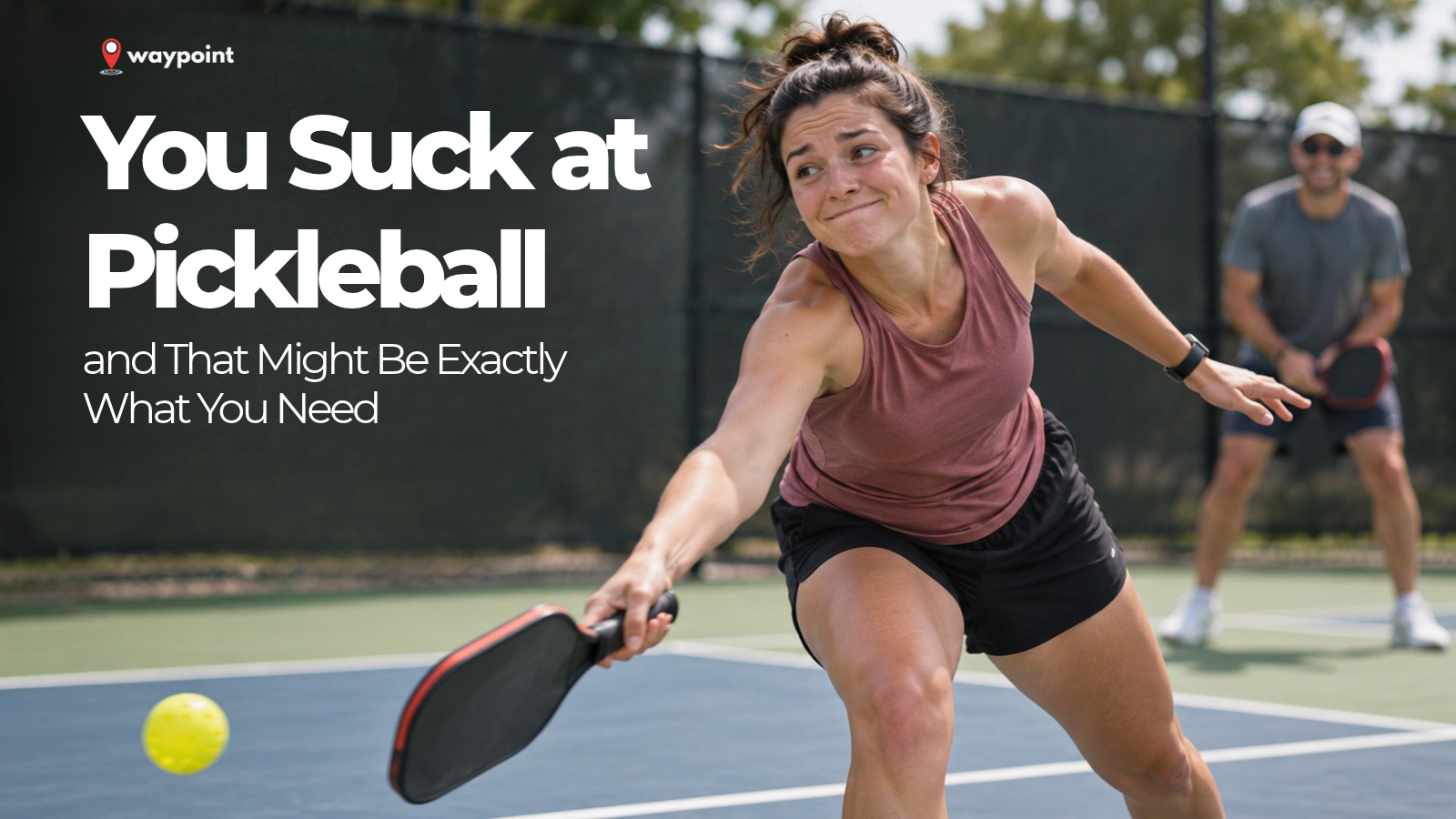

Maybe your third shot keeps going into the net. Maybe you finally hit a good dink, get excited, and immediately pop the next one up for someone to smash. Maybe you have been playing for months and still somehow forget where to stand.
Congratulations. You suck at pickleball. Or at least, you suck at some parts of pickleball, and that might be exactly what you need.
Getting better at a sport requires spending time doing things you cannot do yet. If every rally feels comfortable, every drill feels easy and every opponent plays at exactly your level, you may be having a great time, but you may also be removing one of the things that helps learning happen: challenge.
Being Good at Practice Isn’t Always the Same as Learning
There is a strange thing about learning a physical skill: the practice session where you look the best is not necessarily the session where you learn the most.
Motor-learning researchers have spent years studying this idea. The Challenge Point Framework argues that practice should create an appropriate amount of difficulty for the person doing it. In other words, the same drill can be uselessly easy for one player and completely overwhelming for another. The most useful level tends to sit somewhere in between.
Think about a beginner practising serves. At first, simply getting the ball into the service box might require their full attention. After a while, that same serve becomes comfortable. They could hit another 200 identical serves and look incredibly consistent, but consistency alone does not mean the drill is still challenging them.
So the target gets smaller. They try serving deeper. They alternate between locations or add pressure by keeping score. Suddenly, they start missing again. It can feel like they got worse, but they probably did not. They simply made the task harder.
There Is Such a Thing as the Right Amount of Struggle
This does not mean you should make everything as difficult as possible. If you are a beginner and someone is firing drives at you faster than you can even process them, you are probably not entering some magical accelerated-learning zone. You are mostly just getting hit with pickleballs.
Research suggests there can be a middle ground between too easy and too difficult. In one motor-learning study published in Human Movement Science, researchers gave participants the same postural-control task at four different difficulty levels. They found an inverted-U relationship between difficulty and learning: the easiest condition was not the most effective, but neither was the hardest. Participants at the second-highest difficulty level showed the strongest learning.
That does not give pickleball players a perfect formula for how difficult every drill should be, but the principle is useful. Practice should be challenging enough that you have something to solve without becoming so difficult that everything falls apart.
If you make every dink, make the target smaller. If you cannot keep a dink rally going for three shots, making the drill twice as complicated probably will not help. The goal is to find a level where you are still succeeding sometimes, but not automatically.
Mistakes Can Tell You What Needs to Change
Nobody enjoys hitting an easy ball directly into the net, but that mistake can still give you useful information. Were you late? Was your paddle too low? Did you swing too much? Were your feet in the wrong place, or did you simply choose the wrong shot?
Research into the role of errors in motor learning suggests that errors can contribute to learning because they give us information about the difference between what we intended to do and what actually happened. However, the researchers also make an important distinction: not every error is automatically useful.
Making random mistakes for two hours does not guarantee improvement. The useful part is noticing what happened, adjusting something and trying again. The goal is not to make as many mistakes as possible. It is to practice at a level that exposes what you still need to improve.
The Goal Isn’t to Suck Forever
Eventually, something funny starts happening. The serve that felt impossible becomes normal. You stop panicking every time someone speeds the ball up. You start reaching shots that used to fly straight past you, and your third shot still goes into the net sometimes, but now you actually understand why.
Then one day you play against someone new and realise that the thing you spent three months struggling with is no longer the thing you struggle with.
That is progress.
Once something becomes comfortable, you find another part of your game to work on. Researchers applying the Challenge Point Framework to sports practice describe practice as something that should change depending on the athlete’s ability and goal. Difficulty, motivation and how closely the practice resembles competition can all be adjusted as a player develops.
Improvement therefore does not mean reaching a point where everything feels easy. Often, it means the things that feel difficult keep changing.
But What Should You Actually Practice Next?
This is where a lot of players get stuck.
Knowing that you need to improve is easy. Knowing what to work on next is much harder, especially when there are hundreds of pickleball drills online telling you to practice everything from dinks and drops to footwork, serves, returns and speed-ups.
Doing random drills is not necessarily the same as following a progression.
That is one of the reasons we built the Player Pathway on Waypoint. Instead of giving players one giant library and expecting them to figure everything out themselves, the pathway organises practice around different stages of development: Foundation, Development, Competitive and Elite.
A newer player might need to build consistency with serves, returns, positioning and basic shot control before worrying about more advanced patterns. As those skills become more comfortable, the next stage introduces new challenges across areas such as third shots, dinks, volleys, doubles, footwork and fitness.
It follows the same basic idea behind the research: what challenges you should change as your ability changes.
You do not need to become perfect at Foundation before touching anything harder, and improvement is never completely linear. But having a pathway gives you somewhere to look when you reach that familiar point of thinking, okay… what am I supposed to practice now?
Because getting better is not just about practising more. It is also about making sure the thing you are practising still gives you something to learn.
Part of the Fun Is Realising You Got Better
There is also something genuinely satisfying about becoming capable of something you could not do before.
Research based on Self-Determination Theory has repeatedly linked feelings of competence with stronger motivation to stay physically active. A 2025 review in Psychology of Sport and Exercise found that supporting psychological needs such as competence can play an important role in physical activity behaviour.
That makes sense when you think about why improving at pickleball can become so satisfying. At first, you celebrate getting your serve in. Later, you celebrate winning a rally, finally hitting the shot your coach has been correcting for weeks, or beating someone who used to beat you easily.
Your definition of “good” keeps moving because you keep moving too. The satisfying part is being able to look back and realise that something you struggled with before now feels normal.
Stop Treating Every Mistake Like Proof That You’re Bad
This is probably the harder part.
A mistake can feel much bigger when everyone else on the court seems better than you. You miss three balls and suddenly you are no longer thinking about your paddle angle or footwork. You are thinking about whether you are simply bad at pickleball.
But being unable to do something today does not tell you much about whether you can learn to do it. It mostly tells you where you are right now.
Instead of judging every session by how impressive you looked, it can be more useful to ask what actually changed. Maybe you recognised why you were missing. Maybe you handled a shot slightly better than before. Maybe nothing changed yet, and that is fine too. Learning does not conveniently reveal itself after every one-hour session.
The point is to keep giving yourself opportunities to practice, adjust and come back.
How to Suck at Pickleball Productively
You do not need to deliberately play terribly. You just need to stop organising every practice around avoiding failure.
Play someone slightly better than you sometimes. Practice the shot you normally avoid during games. When a drill becomes comfortable, make it a little harder. If something feels completely impossible, simplify it until you can understand what you are actually trying to change.
And when you miss, try to figure out why instead of immediately treating the mistake as proof that you are not good enough.
That is the difference between useful challenge and frustration. Good practice should occasionally make you uncomfortable, but it should also give you enough success to recognise that you are moving somewhere.
So Yes, Go Suck at Pickleball
You do not need to look good every time you step onto a court. Missing, losing and looking awkward while trying something new are normal parts of learning a sport.
The important part is that the things you struggle with should change over time. Eventually, one weakness becomes something you barely think about anymore, and another takes its place.
That is not evidence that you are failing at pickleball. It is what getting better looks like.
So try something slightly harder than what you could do yesterday. And if you suck at it for a while, good. At least now you know what you can work on next.
Continue Your Journey
Want to figure out what to practice next? Explore the Player Pathway and Drill Library on Waypoint, with drills organised around different stages of your progression.
Our Official Links
Find our website and official social media channels here:
🔗 https://linktr.ee/waypoint.fan
Every Journey Starts With a Waypoint.