
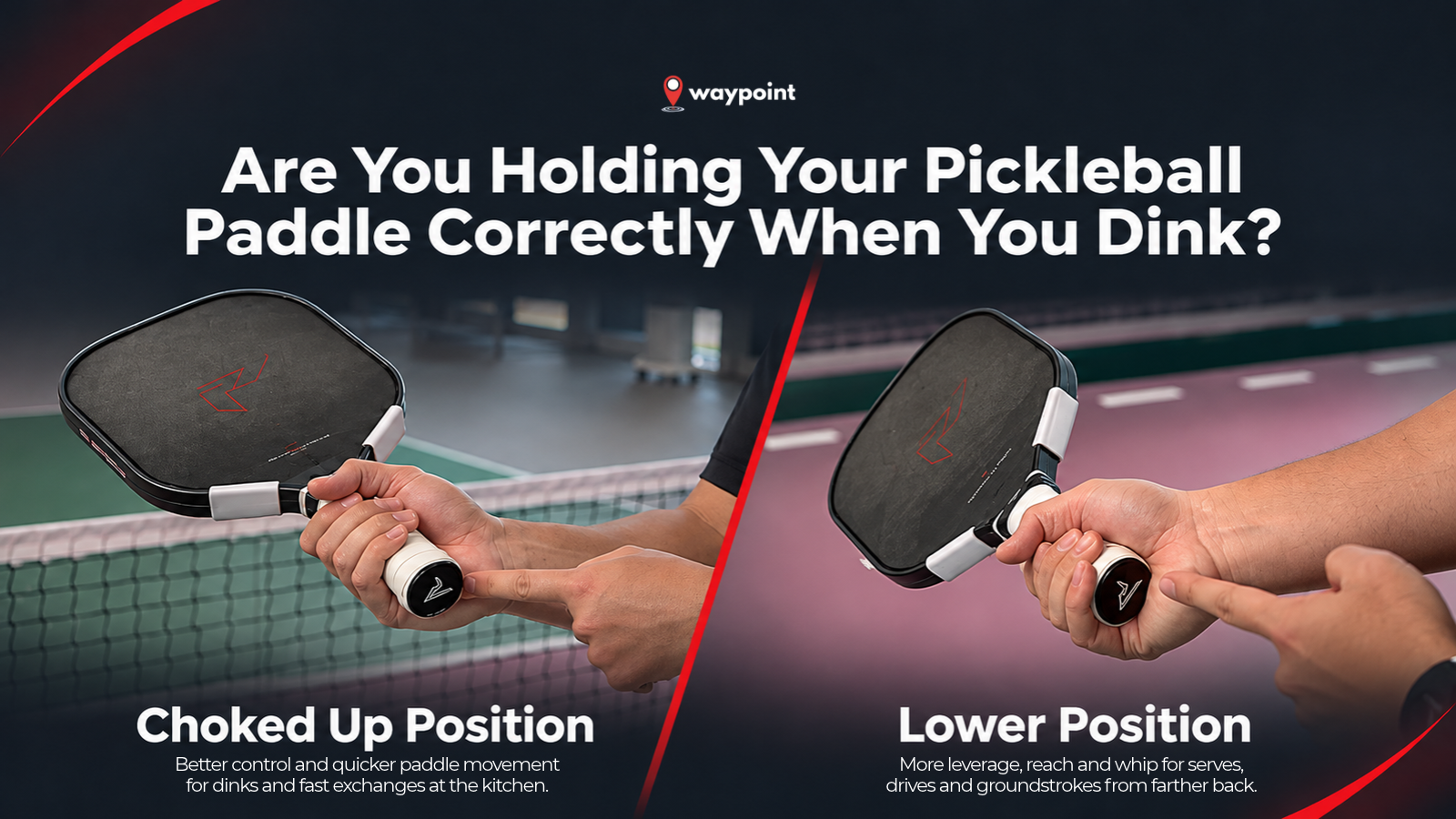

Most players think about what type of grip they use, but Coach Darren Ho says there is another detail worth paying attention to: where your hand actually sits on the paddle. Holding lower can give you more leverage from the back, while choking up may give you more control and quicker hands when you start dinking.
When Coach Darren Ho first started playing pickleball, he held his paddle quite low on the handle because it felt similar to the way he used to hold a tennis racket. The bottom of his hand would extend slightly beyond the paddle, and that lower grip gave him a useful amount of whip when hitting groundstrokes.
Once he started focusing more on dinking, though, he realised the same position did not feel as effective at the kitchen. His solution was simple: move his hand higher and choke up on the paddle so the bottom of the handle sat more securely against his palm. For him, that adjustment created a better balance of control, spin and hand speed.
So, should you be doing the same?
What Does Choking Up on Your Paddle Mean?
Choking up simply means moving your hand slightly higher on the handle, closer to the paddle face. You are not necessarily changing from one grip style to another. The main difference is where your hand sits.
The Dink describes choking up as shortening the effective lever of the paddle, which can make it feel easier to maneuver during quick exchanges. The adjustment does not need to be dramatic either. Moving your hand only slightly higher can change how much leverage, reach and control you feel.
Why Coach Darren Ho Used to Hold His Paddle Lower
Holding lower on the handle is not automatically wrong. A lower grip gives you more effective paddle length and leverage, which can be useful when hitting serves, drives and groundstrokes from farther back where you have more space for a larger swing.
That was one of the reasons Coach Darren originally preferred it. The position gave him more whip on his groundstrokes and felt familiar because of his tennis background. But the closer he moved to the kitchen, the more the demands of the rally changed.
At the kitchen, you have less time to react, your swings become smaller and your paddle needs to move quickly between forehand and backhand positions. What works from the baseline may not feel as comfortable when you are dinking a few feet away from your opponent.
The Grip Adjustment Coach Darren Ho Uses for Dinking
When Coach Darren starts dinking, he moves his hand higher on the paddle. Instead of letting the bottom of his hand hang beyond the handle, he keeps the base of the paddle supported against the lower part of his palm.
For him, that creates a more compact setup. The Dink notes that choking up can reduce the effective swing weight of the paddle, which may help it feel easier to move during quick exchanges.
That is particularly useful at the kitchen because dinking already relies on small, controlled movements. Pickleball.com recommends keeping the paddle in front, using a relaxed grip and making a compact motion when dinking.
Coach Darren now teaches players that they can hold slightly lower when they are farther back, then choke up more once they move forward and start dinking.
Why Choking Up Can Help With Control
Dinking is less about creating maximum paddle speed and more about controlling height, pace and placement. That is why a slightly shorter lever can feel useful.
Moving your hand higher can make the paddle feel more stable and manageable, especially when you are trying to make small adjustments in front of your body. But grip position is only part of the equation.
Pickleball.com recommends relatively light grip pressure when dinking, along with contacting the ball in front and keeping the swing compact. That means choking up while squeezing the paddle tightly is unlikely to solve your soft game.
Where you hold the paddle matters, but so does how tightly you hold it.
What About Hand Speed and Spin?
Hand speed was another major reason Coach Darren changed his grip position. By moving his hand higher, he found that his hands could move faster in front of his body, which is useful once a slow dink rally suddenly turns into a quicker exchange.
Shortening the effective lever can make the paddle feel easier to switch between positions, although it does not automatically give you faster hands. Reaction time, anticipation, paddle preparation and technique still matter.
Coach Darren also found that choking up allowed him to maintain a relatively high amount of spin. That does not mean moving your hand higher automatically creates more spin, because spin still depends on paddle path, paddle face, contact and technique.
Professional player Gabe Tardio has also discussed using a higher grip position for increased maneuverability while maintaining enough wrist movement to generate spin. His explanation also points out that choking up too far can begin to restrict movement.
The goal is not to move your hand as high as possible. It is to find a position that gives you enough control without making the paddle feel cramped.
Why Not Choke Up All the Time?
Because you give something up. Moving your hand higher reduces some of your effective reach and leverage, which are both useful when you are serving, driving or trying to cover more distance from the back of the court.
That is why Coach Darren does not treat one grip position as perfect for every shot. From farther back, he is comfortable holding slightly lower. Once he moves to the kitchen and starts dinking, he prefers to choke up.
Some players may prefer keeping the same hand position throughout the point, while others naturally adjust depending on where they are on court. There is no single grip position that every player has to copy.
So, Are You Holding Your Paddle Correctly When You Dink?
The better question may be whether your current grip position is helping you do what you want at the kitchen.
If your hand sits very low on the handle and you often feel late during dinks or quick exchanges, try moving it slightly higher. You do not need a dramatic change. Start by making sure the bottom of the paddle is supported more securely by your palm instead of having much of your hand hanging beyond the handle.
Then compare how it feels. Can you move between forehand and backhand more comfortably? Does the paddle feel easier to control? Are your dinks more stable? Do you still have enough reach?
If choking up helps, it may suit your game. If it makes you feel restricted, move your hand back down slightly.
Coach Darren Ho’s Main Takeaway
Coach Darren’s advice is not that everyone must hold the paddle in exactly the same position. His bigger point is that your grip position can change depending on what you are trying to do.
Holding lower may give you more whip and leverage from the back, while choking up can make the paddle feel more compact and controlled when you move forward to dink. It is a small adjustment, but one many players may never think about, especially if they came into pickleball from tennis or another racket sport.
The next time you practise your dinks, look at where your hand sits before changing your swing. The problem might not be your dink. You might simply be holding your paddle too low for the shot you are trying to play.
Continue Your Journey
Better pickleball is often built through small adjustments. Grip position, paddle preparation and control can all change how comfortable you feel at the kitchen.
Explore more pickleball tips, training and player insights through Waypoint.
Our Official Links
Find our website and official social media channels here:
https://linktr.ee/waypoint.fan
Every Journey Starts With a Waypoint.
Sources & References
- Pickleball.com – How to Dink in Pickleball
https://pickleball.com/docs/en/article/how-to-dink-in-pickleball - Pickleball.com – Pickleball Shots & Techniques Library
https://pickleball.com/docs/en/article/pickleball-shots-techniques-library-every-shot-you-need-to-know - Pickleball.com – Top 10 Fundamentals Needed for a Great Dink
https://pickleball.com/learn/the-top-10-fundamentals-needed-for-a-great-dink - The Dink – Gabe Tardio’s Choking Up Paddle Grip Technique
https://www.thedinkpickleball.com/paddle-grip-technique-gabe-tardios-choking-up-secret/ - The Dink – Why Pro Players Choke Up on Their Pickleball Grip
https://www.thedinkpickleball.com/why-pro-players-choke-up-on-their-pickleball-grip/ - The Dink – Why Pro Pickleball Players Are Choking Up on Their Paddles
https://www.thedinkpickleball.com/why-pro-pickleball-players-are-choking-up-on-their-paddles/