
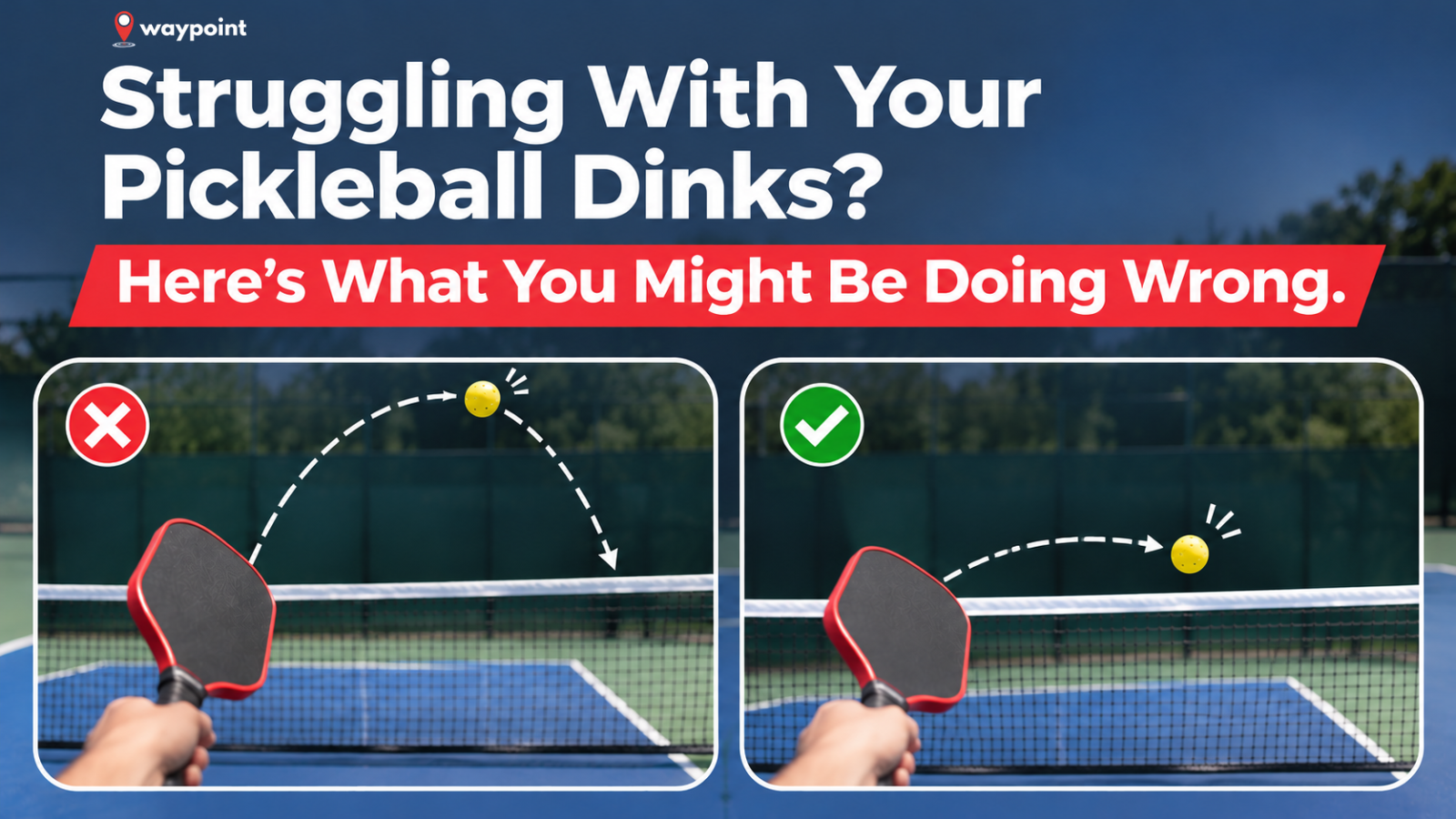

Struggling to keep your pickleball dinks consistent? In Waypoint’s instructional video, Coach Darren Ho explains common mistakes and shares practical tips to improve paddle control, develop a softer touch and make your dinks more consistent.
Dinking might look like one of the easiest shots in pickleball. You’re standing close to the net, gently exchanging shots with your opponent. However, getting the ball to land consistently in the kitchen can be harder than it looks.
Many beginners struggle because their dinks travel too high, go too far or fall short into the net. In Waypoint’s instructional video featuring Coach Darren Ho, he explains why one common mistake is trying to hit the ball instead of cushioning it.
Through a practical demonstration, Coach Darren shows how small adjustments to paddle movement can help players develop better control.
1. Stop Hitting the Ball and Start Cushioning It
One of the most common mistakes beginners make is treating a dink like a regular groundstroke. Instead of gently guiding the ball over the net, they swing at it and add more power than necessary.
Coach Darren recommends a softer approach. As the ball comes toward you, use a gentle pushing motion to cushion it over the net. The goal is to create a controlled shot that lands in your opponent’s kitchen without giving them an easy opportunity to attack.
This technique aligns with USA Pickleball’s official dinking guide, which recommends small, compact swings and a relaxed grip. By focusing on control rather than power, players can develop a more consistent touch and reduce unnecessary errors.
2. Keep Your Backswing Short
Another mistake beginners make is using a backswing that’s too large. While longer swings can help generate power for other shots, they make delicate shots like dinks harder to control.
Coach Darren recommends using as little backswing as possible. Instead of pulling the paddle far behind your body, keep it in front and use a small forward motion to guide the ball over the net.
According to USA Pickleball’s basic technique guide, effective dinking involves a controlled movement with minimal or no backswing. This helps players avoid overpowering the ball.
The idea is simple: you don’t need a big swing to move the ball a short distance. Keeping your movement compact also makes it easier to prepare for the next shot.
3. Keep Your Paddle in Front of You
Paddle positioning is another important part of Coach Darren’s demonstration. He reminds players to keep their paddle visible and positioned in front of their bodies rather than letting it move too far behind them.
This helps players prepare for incoming shots without making large adjustments. It also encourages a more compact movement, which is especially useful during quick exchanges near the kitchen line.
USA Pickleball’s dinking guide also recommends keeping the paddle in front of the body throughout the shot.
Rather than bringing your paddle backward before every dink, focus on meeting the ball in front of you and gently guiding it toward your target.
4. Use the Sound of Your Paddle as a Guide
One of the more interesting tips from Waypoint’s video involves listening to the sound of the ball making contact with your paddle.
Coach Darren encourages players to make as little noise as possible when practicing their dinks. His suggestion is to use this as a reminder to cushion the ball rather than strike it with unnecessary force.
Of course, paddle sounds can vary depending on the equipment and how the ball makes contact. A quieter shot doesn’t automatically mean it’s a better dink, but it can be a useful exercise for developing awareness.
Instead of focusing on how hard you’re hitting, pay attention to your touch and how gently you can guide the ball over the net.
5. Avoid Unnecessary Paddle Movements
When beginners struggle with their dinks, they sometimes try to correct the shot by adding extra wrist movements or sudden flicks. However, these adjustments can make their shots even less consistent.
Coach Darren recommends keeping the movement simple. With your paddle in front and a short backswing, gently push the ball over the net without making unnecessary adjustments.
This also aligns with USA Pickleball’s technique guidance, which recommends controlled movement without excessive wrist action when performing a basic dink.
The goal isn’t to make the shot more complicated. It’s to develop a repeatable movement that gives you better control over the ball.
How to Practice Your Pickleball Dinks
If you’re struggling with consistency, try a simple exercise with a partner. Stand on opposite sides of the kitchen line and exchange soft dinks, focusing on control rather than speed.
Start by keeping your paddle in front and using a short backswing. Try to land each shot inside your partner’s kitchen while maintaining a relaxed grip. As you become more comfortable, challenge yourselves to complete ten consecutive dinks without making an error.
You can also try the sound exercise demonstrated by Coach Darren. Pay attention to how the ball contacts your paddle and experiment with a softer touch. The goal isn’t to eliminate all sound, but to become more aware of how much force you’re applying.
Remember that consistency comes with practice. Focus on making each movement simple and controlled before increasing the pace of your rallies.
Better Dinking Starts With Better Control
Dinking isn’t about how hard you can hit the ball. It’s about controlling the height, pace and placement of your shots.
Waypoint’s demonstration with Coach Darren Ho highlights how small adjustments can make a difference. Shortening your backswing, keeping your paddle in front and cushioning the ball can help you develop a more consistent technique.
The next time you’re struggling with your dinks, remember that you don’t always need to do more. Sometimes, the best adjustment is to keep things simple.
Continue Your Journey
Whether you’re learning your first dink or improving your consistency at the kitchen line, every small improvement helps you become a better player.
At Waypoint, we share practical pickleball tips, coaching insights and stories to help players learn, improve and enjoy the sport.
Our Official Links
Find our website and official social media channels here:
https://linktr.ee/waypoint.fan
Every Journey Starts With a Waypoint.
Sources & References
- Waypoint – Pickleball Dinking Tips Featuring Coach Darren Ho
https://www.instagram.com/p/DgCFXdAJ0aH/ - USA Pickleball – How to Dink and Why It’s Important for Your Success in Pickleball
https://usapickleball.org/pickleball-skills/level-two/how-to-dink-and-why-its-important-for-your-success-in-pickleball/ - USA Pickleball – Pickleball Basic Terms and Techniques
https://usapickleball.org/pickleball-skills/level-one/pickleball-basic-terms/ - USA Pickleball – Official Pickleball Rules Summary
https://usapickleball.org/rules/summary/