

INTRODUCTION
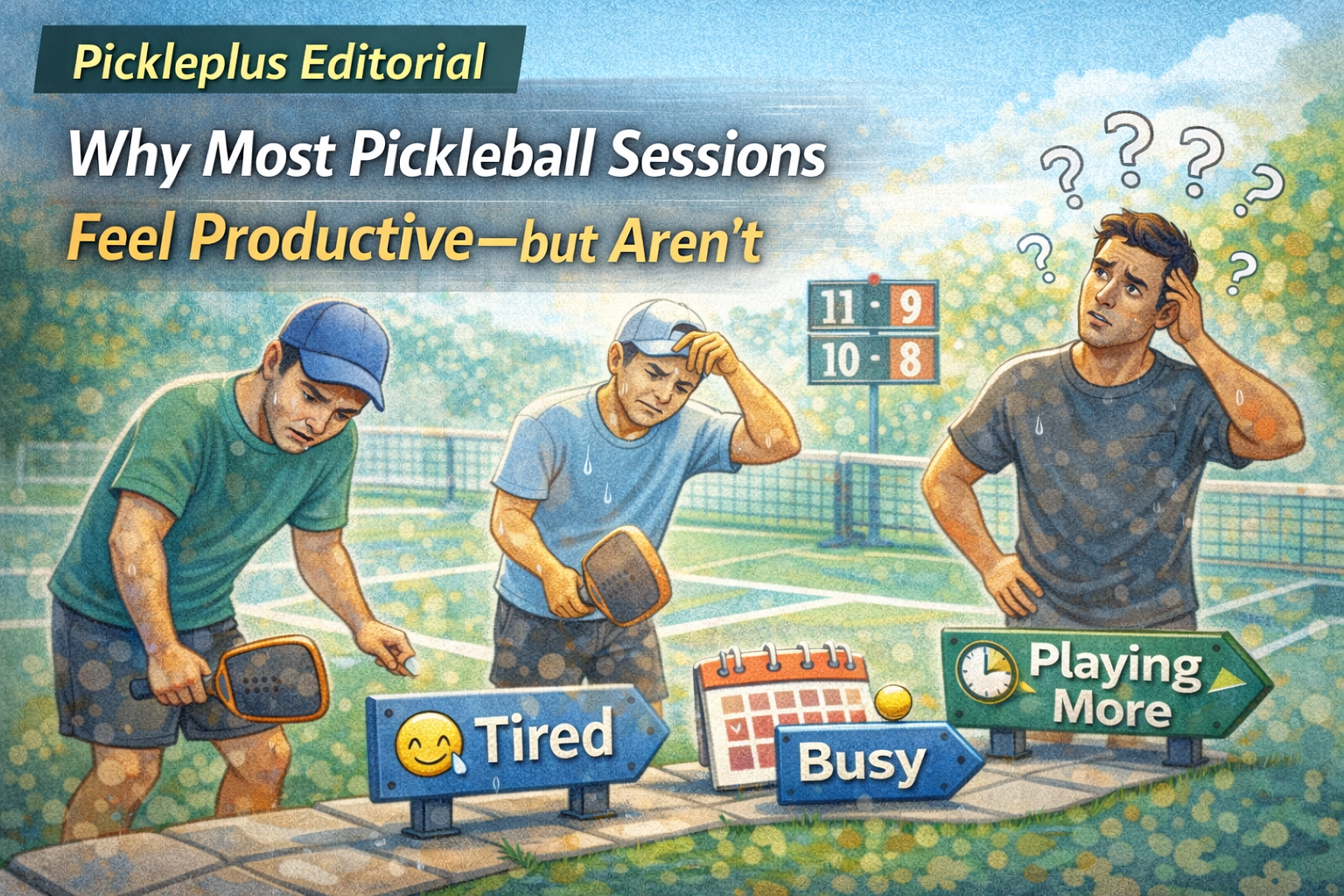
Most pickleball players leave the court feeling like they have done something worthwhile.
They are tired.
They have played multiple games.
They have been active for hours.
By most surface measures, the session feels productive.
Yet, over time, many of these same players realise something uncomfortable: despite consistent effort, their game has not changed in any meaningful way.
This disconnect exists because feeling productive and actually progressing are not the same thing.
WHY PRODUCTIVITY IS EASY TO FAKE IN PICKLEBALL
Pickleball rewards visible effort.
Long rallies, close scores, and physical fatigue create a strong sense of accomplishment. Social interaction reinforces that feeling, especially when sessions are enjoyable and competitive.
However, none of these indicators reliably measure improvement.
They measure engagement, not development.
As a result, players often confuse motion with momentum.
THE THREE SIGNALS THAT CREATE A FALSE SENSE OF PROGRESS
Most unproductive sessions share at least one of the following signals.
1. Physical Fatigue
Tiredness feels earned. Unfortunately, fatigue only proves that energy was spent, not that learning occurred.
2. Volume of Games
Playing many games feels efficient. In reality, repetition without reflection reinforces existing habits, good and bad.
3. Close Results
Losing narrowly or winning frequently can both mask stagnation. Scores reveal outcomes, not underlying decision quality.
When these signals dominate evaluation, sessions feel productive even when nothing shifts.
WHY BUSY SESSIONS OFTEN MAINTAIN THE STATUS QUO
During games, players prioritise survival.
They choose familiar shots, avoid risk, and default to patterns that protect results. This makes sense competitively, but it limits learning.
Over time, these behaviours harden. The session becomes an exercise in maintaining current ability rather than extending it.
Productivity becomes circular: effort sustains comfort instead of challenging it.
THE ROLE OF SOCIAL DYNAMICS IN MISREADING PROGRESS
Social play adds another layer of distortion.
Group norms often discourage experimentation. Players avoid changes that disrupt flow or cause short-term errors. Advice becomes generic, and feedback remains polite rather than precise.
While this preserves harmony, it also suppresses growth.
As a result, many sessions optimise for enjoyment while unintentionally discouraging development.
WHY THIS PATTERN APPEARS MOST AT THE INTERMEDIATE LEVEL
Beginners improve regardless of structure because everything is new. Advanced players often seek precision intentionally.
Intermediate players sit in between.
They know enough to compete, but not enough to diagnose their own limitations clearly. At this stage, productive-looking sessions can persist for months or years without delivering meaningful progress.
This is where plateaus form quietly.
HOW TO TELL IF A SESSION ACTUALLY CONTRIBUTED TO PROGRESS
A productive session creates activity.
A progressive session creates information.
After a session that drives improvement, players can usually identify:
- One recurring decision error
- One pattern that improved or degraded
- One clear area that deserves attention next
If none of these emerge, the session likely maintained ability rather than developed it.
WHY EVALUATING SESSIONS DAILY CREATES CONFUSION
Short evaluation windows exaggerate noise.
Day-to-day performance fluctuates naturally. When players judge sessions in isolation, inconsistency feels alarming and productivity feels reassuring, even when both are misleading.
Progress reveals itself over longer arcs, not single outings.
Without that perspective, players overvalue effort and undervalue direction.
WHAT ACTUALLY CHANGES UNPRODUCTIVE SESSIONS
The shift does not require more discipline or intensity.
It requires intentional separation:
- Sessions meant to explore
- Sessions meant to test
- Sessions meant to consolidate
When every session tries to do everything, none of them move the needle.
Clarity of purpose, not effort, distinguishes productive activity from genuine progress.
FINAL THOUGHT
Most pickleball sessions feel productive because they are busy, social, and tiring.
Progress, however, does not respond to busyness.
It responds to clarity.
Until players learn to evaluate sessions by what changed rather than how hard they worked, productivity will continue to masquerade as improvement.
CONTINUATION PATHS
Players who begin questioning whether their sessions are actually driving improvement often want a clearer way to track patterns beyond immediate feelings.
Pickleplus exists to help players reflect on participation, consistency, and progression over time:
https://pickleplus.io
For coaches, distinguishing between activity and development becomes easier when trends are visible across weeks rather than inferred from isolated sessions.
Tools like Pointflow were built to support that longer-term clarity:
https://pointflow.pickleplus.io
Some players prefer environments that make session intent explicit rather than relying on unstructured repetition.
Events such as the Frenship Cup (Singapore, 28 February 2026) provide that context:
https://docs.google.com/forms/d/e/1FAIpQLSeC3UWkUPVJ0i9IbP0uHwLs1yZsMrnT-obEhw9q3iqJbwdaZQ/viewform