

INTRODUCTION
Many pickleball players believe confidence is a requirement.
They assume they must feel ready, certain, or mentally strong before committing fully to change. When confidence dips, they hesitate. When doubt appears, they delay adjustments.
This belief feels logical, yet it reverses how improvement actually works.
In pickleball, confidence rarely leads progress.
Instead, progress creates confidence.
WHERE THE CONFIDENCE MYTH COMES FROM
Early improvement creates a misleading association.
When players first start, gains arrive quickly. Shots improve, wins increase, and confidence rises alongside performance. Over time, this trains players to believe that confidence fuels results.
However, that early phase masks a crucial truth. Confidence grows easily when everything is new and gains are automatic. Later, when improvement requires destabilising habits, confidence no longer leads the process.
The order quietly flips.
WHY WAITING FOR CONFIDENCE STALLS PROGRESS
Confidence thrives on familiarity.
When players wait to feel confident before changing, they protect what feels known. They repeat patterns that feel safe and delay adjustments that feel uncertain.
As a result, confidence remains intact while progress slows.
Ironically, the very instinct meant to protect confidence often prevents the experiences that would rebuild it at a higher level.
WHAT ACTUALLY HAPPENS DURING REAL IMPROVEMENT
Meaningful improvement introduces instability.
New decisions interrupt old timing. Adjustments reduce short-term reliability. Performance fluctuates even as understanding improves. During this phase, confidence almost always dips.
This dip does not signal failure.
It signals transition.
Players who interpret it correctly stay the course. Those who misread it retreat to comfort.
WHY CONFIDENCE IS A LAGGING INDICATOR
Confidence reflects trust.
Players feel confident when decisions require less conscious effort and outcomes feel predictable again. That trust only forms after repetition, feedback, and adjustment have settled.
Because of this, confidence appears after the work has taken root, not before it begins.
Trying to manufacture confidence early reverses the process and increases frustration.
THE DIFFERENCE BETWEEN COURAGE AND CONFIDENCE
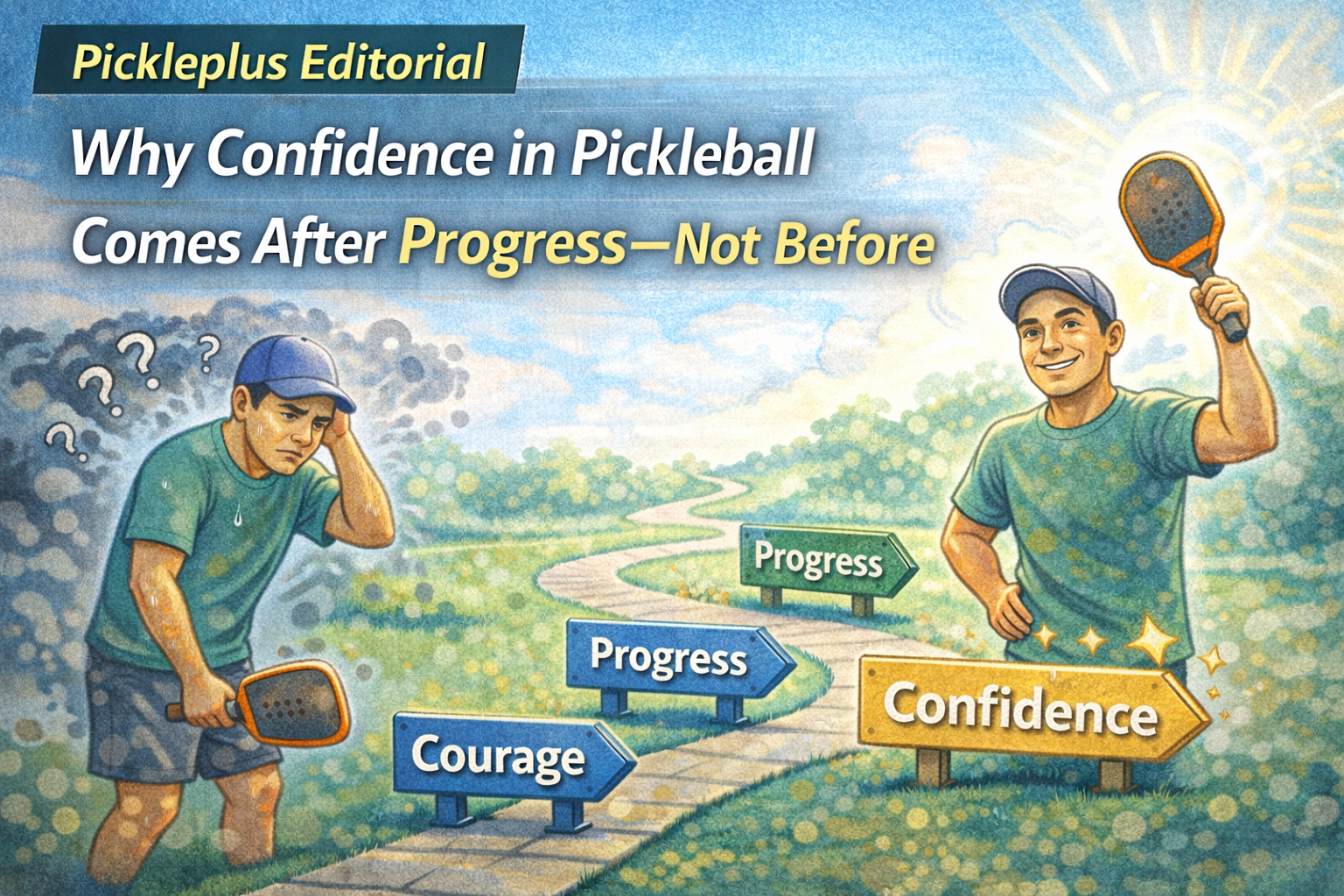
Courage precedes progress.
Confidence follows it.
Courage allows players to:
- Accept temporary inconsistency
- Commit to changes without guarantees
- Continue despite unclear feedback
Confidence emerges later, once the body and mind align again.
Players who confuse confidence with readiness often wait indefinitely. Players who act with courage regain confidence naturally.
WHY CONFIDENCE OFTEN RETURNS QUIETLY
Unlike early gains, rebuilt confidence does not announce itself.
It shows up subtly:
- Decisions feel simpler
- Recovery improves after mistakes
- Outcomes stabilise across environments
By the time players notice it, confidence has already been present for a while.
This is why chasing confidence directly rarely works.
HOW TO RELATE TO LOW CONFIDENCE PRODUCTIVELY
Low confidence does not require correction.
It requires context.
When confidence dips during adjustment, the correct response is not to stop or compensate, but to narrow focus and reduce noise. Stability returns faster when players remain patient rather than reactive.
Confidence recovers naturally once clarity replaces chaos.
WHY THIS MATTERS LONG TERM
Every meaningful improvement cycle includes uncertainty.
Players who expect confidence first struggle repeatedly. Players who understand confidence as an outcome progress more consistently over years rather than months.
This distinction separates those who plateau early from those who continue evolving.
FINAL THOUGHT
Confidence in pickleball is not something you summon.
It is something you earn quietly through aligned effort over time.
If confidence feels low, that does not mean you are unready. More often, it means you are early in the process.
Progress goes first.
Confidence follows.
CONTINUATION PATHS
Players who experience fluctuating confidence often benefit from tracking patterns over longer periods rather than relying on session-by-session feelings.
Pickleplus exists to help players contextualise participation, consistency, and development over time:
https://pickleplus.io
For coaches, understanding confidence as a lagging indicator becomes clearer when trends are visible across weeks rather than inferred from isolated performances.
Tools like Pointflow were built to support that longitudinal clarity:
https://pointflow.pickleplus.io
Some players prefer to navigate confidence dips in structured environments where expectations are clear and progress is measured beyond outcomes.
Events such as the Frenship Cup (Singapore, 28 February 2026) provide that context:
https://docs.google.com/forms/d/e/1FAIpQLSeC3UWkUPVJ0i9IbP0uHwLs1yZsMrnT-obEhw9q3iqJbwdaZQ/viewform