
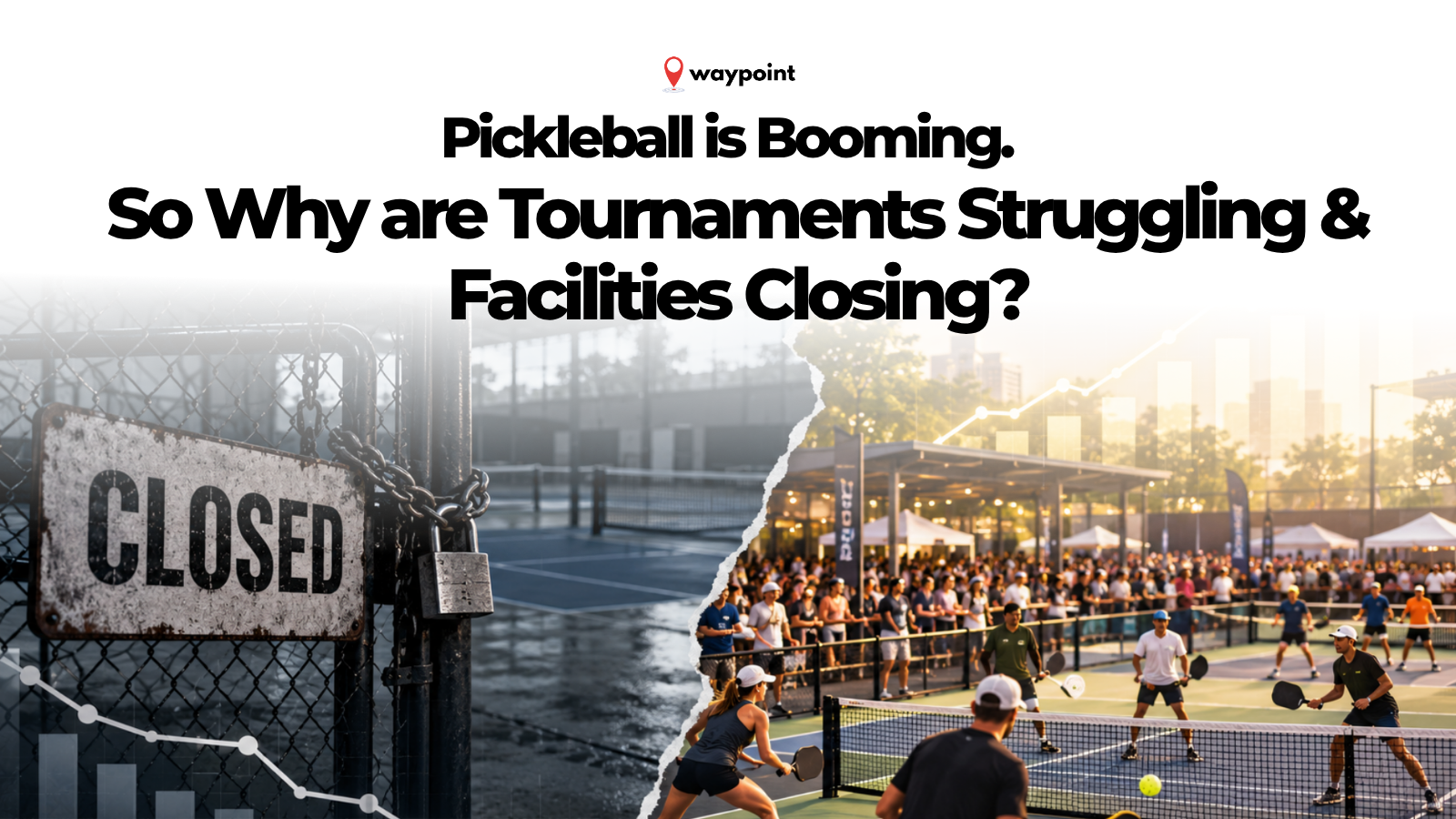

From The Picklr’s bankruptcy in America to China’s rapid expansion and the emergence of new markets across Asia, the pickleball industry is confronting an uncomfortable reality: more players do not necessarily mean more sustainable businesses.
By Waypoint Editorial | October 2026
THE PARTICIPATION BOOM IS REAL. SO ARE THE WARNING SIGNS.
Pickleball has become one of the world’s most talked-about sports.
Across the United States, China, India, Australia and Southeast Asia, new courts are appearing in shopping centres, warehouses, country clubs, residential developments and purpose-built sporting facilities. Equipment manufacturers are launching new products, investors are funding ambitious expansion plans, and sporting organisations are introducing competitions to increasingly enthusiastic communities.
By almost every conventional measure of participation, pickleball has been an extraordinary success.
Yet beneath this remarkable growth, a different story is beginning to emerge.
Some tournament organisers are finding it increasingly difficult to attract registrations. Facility operators are facing rising costs, intensifying competition and pressure to maintain occupancy. Players have more choices than ever, but that does not necessarily translate into greater spending or loyalty.
In October 2026, one of the industry’s most recognisable indoor pickleball franchises, The Picklr, filed for bankruptcy protection despite having expanded to more than 70 locations across the United States.
The contradiction is difficult to ignore.
How can a sport attract millions of new players while businesses built around that same sport struggle to survive?
The answer is more complicated than oversupply, expensive court rentals or tournament fatigue. The pickleball industry has become exceptionally good at attracting people to the sport. What it has not consistently achieved is creating a connected, sustainable ecosystem that keeps those people engaged. And this problem is becoming increasingly relevant across the world.
1. THE PARTICIPATION BOOM IS REAL. SO ARE THE WARNING SIGNS.
To understand the challenges facing pickleball, we must first acknowledge just how successful the sport has become.
According to the Sports & Fitness Industry Association (SFIA), approximately 24.3 million Americans played pickleball in 2025, compared with just 4.2 million in 2020.
That represents more than a fivefold increase in five years.
More importantly, the number of core participants, defined as those playing at least eight times annually, increased from 1.4 million to 7.5 million during the same period.
These are not simply people trying the sport once. Millions are returning regularly, making pickleball part of their recreational and sporting routines.
However, participation statistics do not tell the entire story.
According to USA Pickleball’s 2025 Annual Growth Report, the organisation sanctioned 144 tournaments during the year, while its membership exceeded 104,000.
Meanwhile, its national court database recorded more than 18,000 playing locations and over 82,000 courts.
These figures illustrate an important distinction.
The number of people playing pickleball is vastly larger than the number participating in formal sanctioned competition.
That is not necessarily a problem. Most recreational sports have considerably more casual participants than competitive athletes.
However, it becomes a commercial problem when tournament organisers and facility operators assume that recreational participation will naturally translate into tournament registrations, memberships and increased spending.
There is also an important limitation in the available evidence: comprehensive global data showing a decline in total tournament registrations does not yet exist. Sanctioned competitions represent only part of the market, and independent events are not consistently counted. Nevertheless, reports of tournament fatigue, uneven registrations and financial pressure on facilities raise questions that deserve serious attention.
The industry needs to stop assuming that growing participation automatically means growing commercial demand.
These are two very different measurements.
2. THE PICKLR: WHEN RAPID EXPANSION MEETS FINANCIAL REALITY
Perhaps the clearest recent example of the challenges facing the industry comes from The Picklr, one of America’s most prominent indoor pickleball franchise brands.
Founded in 2021, The Picklr rapidly expanded its operations through a network of dedicated indoor facilities.
Its growth attracted significant investment, including a 2024 funding round that valued the company at approximately US$59 million.
By October 2026, the brand had established more than 70 locations across the United States, with international operations in Australia, Canada and Japan.
Yet on 9 October 2026, Picklr Inc. and certain affiliates filed for Chapter 11 bankruptcy protection in the United States.
According to financial disclosures reported by Inc. and Fox Business, the company recorded approximately US$10.3 million in revenue during 2025 but suffered a net loss of US$4.4 million.
Its reported liabilities had reached approximately US$19 million by the end of March 2026.
The principal issue was not a sudden disappearance of pickleball players.
Instead, the company had accumulated substantial financial obligations through corporate guarantees on leases associated with approximately 40 franchise locations.
Founder and CEO Jorge Barragan acknowledged that the company had taken on too many of these guarantees.
The Chapter 11 filing was intended to facilitate financial restructuring and negotiations with landlords.
Importantly, the bankruptcy filing did not mean that the entire franchise network had closed. The company stated that its clubs and independently operated franchise locations would continue operating.
WHAT WENT WRONG?
The Picklr’s situation demonstrates how the economics of physical sporting facilities can become increasingly difficult as businesses scale.
Indoor pickleball venues require substantial upfront investment.
Facilities must secure suitable properties, construct courts, install lighting and ventilation, provide amenities, and employ operational staff.
According to industry estimates reported by Inc., individual Picklr facilities typically required approximately US$1.2 million to US$2 million in initial investment.
Once operational, these businesses face recurring expenses regardless of how many customers use their courts.
Commercial leases, utilities, staffing, maintenance, marketing and financing costs continue even during periods of low utilisation.
The Picklr also relied heavily on membership-based offerings, providing access to court time and other activities for recurring fees.
While memberships can generate predictable revenue, they introduce another challenge.
If too many members want to play during the same peak periods, availability becomes constrained.
Customers may become frustrated when they cannot access the services they are paying for.
Meanwhile, courts can remain underutilised during quieter hours.
The result is a business that may appear extremely popular without necessarily generating sufficient revenue to cover its operating costs.
THE LESSON FROM THE PICKLR
The Picklr’s restructuring should not be interpreted as evidence that all pickleball facilities are failing. Many independent facilities continue operating successfully, and the sport remains highly popular.
Its specific difficulties were also influenced by corporate financial decisions that do not apply to every operator.
However, the case illustrates a broader risk.
Building more courts does not automatically create a stronger sporting business.
A facility’s success depends on more than participation numbers.
It depends on sustainable operating costs, effective utilisation, customer retention and the ability to generate value beyond individual court bookings.
The Picklr’s experience is a warning against confusing rapid expansion with sustainable growth.
It is a lesson that emerging pickleball markets should take seriously.
3. CHINA: EXTRAORDINARY GROWTH, BUT CAN THE INDUSTRY BUILD SUSTAINABLE DEMAND?
China represents one of pickleball’s most significant emerging opportunities.
Unlike the United States, where the sport developed over several decades before achieving mainstream popularity, China is building its pickleball ecosystem at remarkable speed.
The China Pickleball Tour began with approximately 80 stops in 2024.
By 2026, the circuit had expanded to more than 1,000 stops, reflecting growing institutional support and interest in organised competition.
The scale of this expansion is impressive.
However, it also raises an important question.
Is China developing a sustainable sporting ecosystem, or simply expanding the number of facilities and events faster than the market can support?
The answer will depend on how effectively the industry converts initial interest into long-term participation.
HEBI: SPORT AS AN ECONOMIC DEVELOPMENT STRATEGY
Hebi, in Henan Province, provides an interesting example of pickleball being developed as more than a recreational activity.
Since 2023, the city has promoted pickleball through schools, communities, public spaces, businesses and government organisations.
According to reporting by People’s Daily, the city has developed more than 1,500 courts and engaged over one million participants through its pickleball initiatives.
Its 2025 National Pickleball Championships attracted 311 athletes from 25 teams.
The event reportedly generated more than RMB15 million in tourism-related revenue.
Hebi has also developed manufacturing activities connected to pickleball equipment, linking sporting participation with industrial development.
This approach is significant because it recognises that sport can generate economic value beyond court rentals.
However, Hebi’s experience also raises questions that other cities should consider.
What happens after major tournaments conclude?
How do recreational players continue engaging with the sport?
Can facilities maintain consistent participation outside organised events?
How do local businesses benefit from recurring sporting activities rather than occasional competitions?
And how can the relationships developed through these programmes be maintained over time?
A successful sporting city cannot depend exclusively on hosting more tournaments.
It must create an environment where participation becomes part of everyday life.
GUANGZHOU: TOURNAMENTS STILL HAVE A PLACE
China also demonstrates that competitive pickleball can attract meaningful participation.
The 2026 Guangzhou Pickleball Open, held in October, attracted nearly 300 players from China and overseas.
The competition featured 469 matches and a prize pool of RMB111,500.
More than 48% of participants came from outside Guangzhou, demonstrating the potential for tournaments to attract travelling players.
Alongside the competition, organisers held a pickleball carnival that introduced the sport to new participants through public activities and coaching sessions.
This is particularly interesting because the event combined formal competition with recreational participation and public engagement.
Rather than treating the tournament as an isolated sporting activity, organisers created opportunities for a wider audience to participate.
That approach offers a potential direction for the industry.
Tournaments should not exist exclusively for the players competing.
They can also serve as platforms for community engagement, tourism, entertainment and commercial activities.
CHINA’S STRUCTURAL CHALLENGE
Despite rapid growth, China faces challenges in coordinating its emerging pickleball ecosystem.
A 2026 academic study published in Frontiers in Public Health identified fragmented governance, uneven access to facilities, inconsistent infrastructure standards and limited integration between sporting organisations as barriers to sustainable development.
These issues illustrate a problem that extends beyond China.
Building facilities and organising competitions are relatively straightforward compared with developing the systems that connect them.
Without stronger coordination, markets risk creating disconnected sporting assets that compete for the same participants.
China has an opportunity to develop pickleball differently.
Rather than repeating the mistakes of more mature markets, it can build an ecosystem that connects recreational participation, competitive development, tourism, education and commercial opportunities from the beginning.
4. INDIA: WHEN RECREATIONAL DEMAND GROWS FASTER THAN THE COMPETITIVE ECOSYSTEM
India represents another important emerging market.
The country’s large population, growing recreational sports culture and increasing interest in racket sports create substantial opportunities for pickleball.
Private facilities, sports clubs and booking platforms are helping introduce the sport to new audiences.
However, the characteristics of recreational demand deserve careful consideration.
Many players are primarily interested in convenient, accessible opportunities to play with friends or similarly skilled opponents.
Their motivation is not necessarily to participate in formal tournaments.
This creates an important distinction between recreational participation and competitive demand.
A player may be willing to pay regularly for enjoyable social games while having little interest in spending significantly more on tournament registration, travel and accommodation.
Facilities and organisers that fail to recognise this distinction risk overestimating their potential markets.
India’s developing pickleball ecosystem also presents questions about infrastructure utilisation.
Demand may be concentrated during evenings and weekends, leaving facilities with substantial unused capacity during working hours.
Building additional courts may improve availability during peak periods.
However, it can also increase competition and operating costs.
The opportunity lies in understanding how to engage different audiences throughout the day.
Schools, corporate groups, beginners, families, recreational communities and competitive athletes all represent different potential markets.
Successful operators will need to develop programming that reflects those differences.
5. SOUTHEAST ASIA: TOO MANY FACILITIES COMPETING FOR THE SAME PLAYERS?
Across Singapore, Malaysia and other Southeast Asian markets, pickleball has attracted growing interest from entrepreneurs, investors and sporting organisations.
New facilities are being developed in commercial properties, industrial spaces and recreational venues.
The sport’s accessibility makes it particularly attractive in densely populated urban environments.
However, these same markets often face substantial property and operating costs.
Commercial facilities must generate sufficient revenue to cover rental expenses, utilities, staffing and maintenance.
In markets where participation remains concentrated within relatively small communities, new facilities may initially compete for the same players rather than creating entirely new demand.
Consider a hypothetical neighbourhood with 500 regular pickleball players.
Initially, one facility might attract a substantial proportion of those players.
When several additional facilities open nearby, the total number of active players does not automatically increase proportionately.
Instead, operators may find themselves competing for existing customers.
Discounted court rentals, promotional memberships and heavily subsidised events can help attract attention.
However, these measures may also weaken revenue across the market.
The same challenge applies to tournaments.
When several organisers schedule similar competitions during the same period, they may divide the available participants rather than generate additional demand.
This does not mean Southeast Asia is experiencing a uniform decline in tournament registrations or widespread facility closures.
Reliable market-wide evidence would be required to establish those claims.
It does mean that operators should be cautious about assuming that increasing participation guarantees sufficient demand for every new facility.
A growing market can still become commercially overcrowded.
The question is whether operators are creating new value or simply competing to capture a larger share of existing spending.
6. AUSTRALIA AND OTHER MARKETS: GROWTH REQUIRES MORE THAN INFRASTRUCTURE
Australia has a strong tradition of community sport and established racket-sport infrastructure.
These conditions provide opportunities for pickleball to develop through existing clubs, recreational centres and sporting organisations.
However, the challenge remains similar.
Not every participant wants the same experience.
Some players are motivated by fitness and social interaction.
Others want structured competition, coaching or ranking opportunities.
Younger athletes may seek pathways into higher-performance programmes.
Families may prefer affordable community activities.
A successful sporting ecosystem must recognise these differences.
Facilities and tournament organisers cannot assume that every recreational player will eventually become a competitive participant.
Nor should they assume that traditional tournament formats will appeal equally to every demographic.
As pickleball develops across international markets, operators must increasingly design experiences around actual player behaviour rather than simply replicate established business models.
7. TOURNAMENT FATIGUE: WHY MORE PLAYERS DO NOT NECESSARILY MEAN MORE REGISTRATIONS
Perhaps the most overlooked challenge facing pickleball is the changing relationship between players and organised competition.
For years, tournaments have followed a relatively familiar structure.
Players register, pay an entry fee, enter age or skill divisions, compete through round-robin or elimination formats, and receive medals or prizes.
For serious competitive athletes, this model remains important.
However, the broader recreational audience may have different expectations.
A player who enjoys three social sessions every week may see little value in paying a substantial tournament fee.
Another player may enjoy competition but dislike spending an entire day waiting between matches.
Others may question whether repeated participation in similar events justifies the financial and time commitments involved.
Tournament participation involves more than registration fees.
Players may need to consider transportation, accommodation, meals, equipment and time away from work or family.
Even local tournaments can require significant commitments.
The industry should therefore ask a fundamental question.
Are tournaments being designed around what players actually want, or around formats that organisers have become accustomed to delivering?
THE PROBLEM WITH REPETITION
As tournament calendars become more crowded, differentiation becomes increasingly important.
If several competitions offer similar formats, divisions and experiences, players have fewer reasons to participate in all of them.
A tournament cannot rely indefinitely on novelty.
Nor can it assume that medals and rankings will motivate every participant.
The value proposition must evolve.
Shorter competition windows, guaranteed playing time, better scheduling, team formats and alternative competitive experiences may appeal to audiences underserved by traditional tournaments.
Skills challenges, recreational leagues, mixed-ability events and social competitions could also provide meaningful alternatives.
Not every competitive experience needs to follow the same format.
And not every player needs to become a tournament athlete.
The industry must become more creative in how it defines participation.
8. FACILITIES ARE SELLING COURT TIME WHEN THEY SHOULD BE BUILDING COMMUNITIES
The traditional pickleball facility business model is relatively straightforward.
Build courts, attract players and charge for access.
However, this approach has limitations.
A court is a physical asset with a finite number of available hours.
Once peak periods are fully booked, operators cannot increase capacity without expanding their facilities or adjusting how existing courts are used.
Meanwhile, quieter periods may remain underutilised.
This creates an economic imbalance.
Facilities can experience high demand during evenings and weekends while struggling to generate sufficient revenue throughout the rest of the week.
The solution is not necessarily to build more courts.
It is to create more opportunities for participation.
Consider two hypothetical facilities operating the same number of courts.
The first relies almost exclusively on hourly bookings.
The second combines court rentals with coaching programmes, recreational leagues, corporate activities, school partnerships, skills challenges and community events.
Both facilities have the same physical infrastructure.
However, the second has more opportunities to engage different audiences and generate recurring revenue.
It may also develop stronger relationships with its customers.
A player who identifies with a facility’s community has more reasons to return than someone who simply chooses whichever venue offers the lowest rental price.
This does not mean every facility should attempt to provide every possible service.
Additional programmes introduce costs and operational complexity.
The important principle is that facilities should understand what their communities value and develop offerings accordingly.
A court booking is a transaction. A sporting community is a relationship.
The future of successful pickleball facilities may depend on recognising that difference.
9. THE INDUSTRY HAS A DATA PROBLEM
Despite pickleball’s rapid commercial expansion, many operators still have limited understanding of the people participating in their activities.
A facility may know how many courts were booked during a particular month.
However, it may not know why certain customers stopped returning.
A tournament organiser may know how many players registered.
However, it may have little understanding of why previous participants chose not to enter again.
A brand may sponsor an event without knowing whether its investment influenced customer engagement or purchasing behaviour.
These gaps matter.
Participation statistics tell us how many people play a sport.
They do not necessarily explain what those people want.
They do not reveal how much players are willing to spend, which experiences they prefer or what would encourage them to remain engaged.
Without this understanding, businesses risk making decisions based on assumptions.
Facilities may expand before establishing sustainable demand.
Tournament organisers may introduce more competitions without understanding declining interest in existing formats.
Brands may continue sponsoring events without meaningful evidence of commercial returns.
The industry needs better information.
But collecting data is not enough.
The real value comes from understanding the connections between participation, behaviour, experiences and long-term engagement.
That requires responsible data practices, appropriate consent and systems that provide genuine benefits to participants.
10. BRANDS AND SPONSORS NEED MORE THAN LOGOS ON BANNERS
Sponsorship has traditionally helped fund sporting competitions.
However, many pickleball sponsorship arrangements remain focused on conventional forms of exposure.
A brand contributes money or products in exchange for logo placement, event naming rights, social media mentions or advertising opportunities.
These arrangements can create awareness.
But awareness alone may not provide sufficient commercial justification.
Brands increasingly need to understand whether their investments generate meaningful engagement.
A paddle manufacturer sponsoring a tournament should ideally gain opportunities to introduce products, understand player preferences and build ongoing relationships with potential customers.
A sporting apparel brand might create interactive challenges or community experiences.
A tourism organisation could use sporting events to introduce participants to local destinations.
These activities can generate value beyond temporary advertising exposure.
More importantly, they can create opportunities for sponsors to support the cost of sporting participation.
If organisers can demonstrate meaningful commercial value to sponsors, they may become less dependent on registration fees.
This could eventually enable more accessible tournaments, community programmes and sporting experiences.
However, sponsor-funded participation requires a sustainable commercial model.
It cannot simply rely on brands subsidising events without measurable returns.
The industry must become better at demonstrating why sporting engagement is commercially valuable.
11. THE MISSING LINK: A CONNECTED SPORTING ECOSYSTEM
The challenges facing pickleball are often discussed separately.
Tournament organisers talk about registration numbers.
Facility operators talk about occupancy and rental costs.
Brands talk about sponsorship returns.
Players talk about convenience, affordability and enjoyment.
Sporting organisations talk about participation and development pathways.
Yet these issues are closely connected.
A recreational player may begin by attending a casual session.
As their confidence grows, they might seek coaching or stronger opponents.
Eventually, they may become interested in leagues, competitions or travelling to sporting events.
Along the way, they may purchase equipment, develop relationships with clubs and participate in community activities.
This is not a series of unrelated transactions.
It is a sporting journey.
However, the industry frequently treats each activity as a separate interaction.
Court bookings take place through one system.
Tournament registrations happen elsewhere.
Coaching programmes are managed independently.
Community activities are promoted through messaging groups or social media.
Brands engage participants through separate marketing campaigns.
The result is fragmentation.
Players must navigate disconnected services, while operators struggle to understand how their activities contribute to long-term engagement.
This is one of the industry’s greatest missed opportunities.
The next stage of pickleball’s development should not simply focus on creating more sporting activities.
It should focus on connecting the activities that already exist.
12. WHY WAYPOINT IS TAKING A DIFFERENT APPROACH
The challenges facing pickleball are precisely why we believe the industry needs a different kind of sporting platform.
At Waypoint, our approach begins with a simple observation.
Sport does not happen in isolated transactions. It happens through journeys.
A player does not become part of a sporting community simply by booking a court.
A tournament does not create lasting value simply because registrations have been collected.
A brand does not establish a meaningful relationship with consumers simply by displaying its logo at an event.
These activities become more valuable when they are connected.
Waypoint is being developed as a sports journey platform that brings together players, facilities, events, competitions, communities, brands and destinations.
Rather than focusing exclusively on one transaction, we want to connect the experiences that encourage people to participate in sport over time.
FOR PLAYERS: DISCOVER MORE REASONS TO PARTICIPATE
Not every pickleball player wants to compete in tournaments.
Some enjoy recreational games.
Others want to improve their skills, meet new opponents or participate in community activities.
Some are interested in sporting travel and discovering new destinations.
Waypoint’s discovery and journey-building approach is intended to help people find relevant sporting opportunities.
These can include competitions, recreational activities, challenges and experiences connected to their interests.
The objective is to make participation more accessible while recognising that different players have different motivations.
We believe the most valuable sporting platform is not necessarily the one that processes the most transactions.
It is the one that gives people meaningful reasons to return.
FOR TOURNAMENT ORGANISERS: RETHINK THE COMPETITIVE EXPERIENCE
Waypoint is not intended to function merely as another tournament registration platform.
Our event capabilities bring together registration, scheduling, draws, brackets, results, live event information and participant engagement.
This provides a foundation for organisers to develop different types of sporting experiences.
Traditional competitions will remain important.
However, we also see opportunities for alternative formats that make participation more accessible, entertaining and commercially sustainable.
These could include shorter competitions, team-based events, skills challenges, recreational leagues and innovative entry mechanisms.
The objective is to give organisers greater flexibility to experiment with formats that better reflect their audiences.
Just as importantly, connected participation information can help organisers understand how their events perform over time.
Instead of focusing exclusively on registration numbers, organisers can begin examining engagement, repeat participation and player preferences.
FOR FACILITIES: MOVE BEYOND COURT RENTALS
Facilities should not have to rely exclusively on filling courts during peak hours.
Waypoint’s approach creates opportunities to connect venues with activities that encourage recurring participation.
A facility could use connected event and discovery experiences to promote recreational programmes, competitions, coaching activities or community challenges.
It could introduce new audiences to its venue through sporting activations.
It could also collaborate with brands and organisers to develop experiences that extend beyond ordinary court rentals.
These opportunities do not eliminate the importance of sound facility economics.
Waypoint cannot make an unsustainable lease affordable or guarantee that every programme will be profitable.
However, it can provide infrastructure for connecting activities and helping operators develop more meaningful relationships with participants.
That distinction is important.
We are not trying to replace the facilities that make sport possible. We want to help them become more valuable to the communities they serve.
FOR BRANDS: TURN SPONSORSHIP INTO PARTICIPATION
Traditional sponsorship often ends when an event concludes.
Waypoint’s approach is designed to create opportunities for brands to participate in the sporting journey itself.
A paddle manufacturer could support a skills challenge.
An apparel company could develop an interactive activation.
A tourism partner could connect an event with nearby attractions.
A sponsor could support community activities or reward participation.
Waypoint’s interactive features, including QR-based waypoints, challenges and event activations, create opportunities for participants to engage directly with these experiences.
With appropriate consent and responsible data practices, these interactions can also provide insights into engagement and campaign effectiveness.
The objective is to help brands move beyond passive exposure.
Instead of simply placing a logo in front of players, brands can become part of the experiences those players value.
This also creates opportunities for organisers and facilities to develop new commercial partnerships.
Over time, such partnerships could help reduce reliance on player-funded events.
FOR CITIES AND DESTINATIONS: CONNECT SPORT WITH TOURISM
China’s development of pickleball demonstrates the potential for sport to contribute to local economic activity.
A tournament can attract visitors.
However, the economic opportunity extends beyond the competition venue.
Participants may require accommodation, transportation, dining and entertainment.
They may also be interested in discovering attractions or participating in other sporting activities.
Waypoint’s journey-based approach can help connect sporting events with these broader experiences.
Through destination discovery, interactive waypoints and location-based challenges, an event can become part of a larger sporting and tourism journey.
This creates opportunities for collaboration between event organisers, local businesses, tourism authorities and sporting communities.
Rather than treating sporting events as isolated activities, we believe they can become gateways to wider experiences.
13. WHAT ACTUALLY MAKES WAYPOINT DIFFERENT?
There is no shortage of software platforms offering tournament registration, facility booking or event management.
These services are useful, and many already perform their intended functions effectively.
Waypoint is not attempting to differentiate itself simply by offering another version of the same tools.
Our difference lies in how we believe those tools should work together.
Traditional platforms often focus on completing transactions. Waypoint is focused on connecting the experiences before, during and after those transactions.
A conventional tournament system helps players register for an event.
Waypoint’s broader approach is to connect that event with discovery, participation, live experiences and future opportunities.
A conventional booking system manages court availability.
Waypoint seeks to connect facilities with programmes, competitions, challenges and communities that create reasons for people to return.
A conventional sponsorship arrangement provides advertising exposure.
Waypoint aims to help brands create interactive experiences that can generate more meaningful engagement.
A conventional event platform often becomes less relevant once an event concludes.
Waypoint’s ambition is for every event to become another connection within a continuing sporting journey.
The distinction can be summarised simply.
We do not believe the future of sport lies in managing more isolated transactions. We believe it lies in connecting people to more meaningful experiences.
This is not a claim that Waypoint has already solved every challenge facing the pickleball industry.
Building a connected sporting ecosystem requires participation from facilities, organisers, brands and sporting communities.
It also requires experimentation, commercial discipline and a willingness to develop new approaches.
But we believe this is the direction the industry needs to move.
14. THE NEXT PHASE OF PICKLEBALL WILL BE DEFINED BY RETENTION
For several years, the industry has celebrated growth.
More players.
More courts.
More facilities.
More tournaments.
More brands.
These achievements have helped establish pickleball as a mainstream recreational sport.
However, the next phase of development will require different measures of success.
Facilities must begin asking whether customers are returning regularly and whether their operating models are sustainable.
Tournament organisers must examine whether participants find their events worthwhile.
Sporting organisations must understand whether players have accessible opportunities to develop.
Brands must evaluate whether their involvement creates meaningful relationships with consumers.
And the industry as a whole must become better at understanding how these different activities contribute to long-term engagement.
The most successful sporting businesses may not be those that attract the largest number of first-time participants.
They may be those that create the strongest reasons for existing participants to remain involved.
This requires a shift in thinking.
From acquisition to retention.
From transactions to relationships.
From isolated events to connected experiences.
From building more infrastructure to making better use of what already exists.
And from measuring participation alone to understanding the quality of participation.
15. THE INDUSTRY DOES NOT NEED MORE OF THE SAME
The Picklr’s financial restructuring is a reminder that rapid expansion carries risks, even in a growing market.
China’s development demonstrates the opportunities created by coordinated investment in sport, while also highlighting the importance of building sustainable participation pathways.
India and Southeast Asia illustrate the potential of emerging recreational markets, alongside the challenges of commercial property costs, changing consumer expectations and increasing competition.
Australia and other developing markets face similar questions about how to connect recreational participation with structured sporting opportunities.
These markets are different.
Their cultures, operating costs, sporting infrastructure and commercial conditions vary considerably.
Yet they share an important challenge.
How do we turn growing interest in pickleball into lasting value for players, operators, communities and commercial partners?
The answer cannot simply be to build more courts.
Nor can it be to organise more tournaments that resemble those already available.
The industry must become more thoughtful about the experiences it creates.
It must understand that recreational participation and competitive participation are not interchangeable.
It must recognise that facilities need sustainable economics, not just busy courts.
It must provide sponsors with meaningful commercial opportunities.
And it must connect the different parts of the sporting ecosystem so that participation becomes easier, more rewarding and more sustainable.
Pickleball has already demonstrated its ability to attract millions of people.
The next challenge is giving those people meaningful reasons to remain engaged.
THE FUTURE OF PICKLEBALL IS NOT MORE COURTS. IT IS MORE REASONS TO PLAY.
The challenges facing pickleball should not be interpreted as evidence that the sport is failing.
On the contrary, the extraordinary growth of participation demonstrates just how appealing pickleball has become.
However, popularity alone cannot sustain an industry.
Facilities must remain financially viable.
Tournaments must deliver experiences worth paying for.
Brands must see value in supporting the sport.
And players must continue finding enjoyment, opportunities and communities that make participation worthwhile.
The next chapter of pickleball will not be defined solely by how many new courts are constructed or how many tournaments appear on the calendar.
It will be defined by how effectively the industry connects the people, places and experiences that make the sport meaningful.
Because ultimately, the measure of a successful sporting industry is not simply how many people start playing.
It is how many reasons we give them to keep coming back.
WAYPOINT: BUILDING WHAT’S NEXT FOR SPORT
More than tournaments. More than bookings. More than another sports platform.
The challenges facing pickleball are not unique to pickleball.
Across recreational sports, amateur competitions, community activities and sporting destinations, the same fragmentation exists.
Players struggle to discover relevant opportunities.
Facilities compete for customers without always understanding their needs.
Tournament organisers rely on familiar formats and registration models.
Brands invest in sponsorships without consistently achieving meaningful engagement.
Sporting destinations host events without always capturing the wider opportunities they create.
Waypoint is being built to connect these experiences.
We believe the future of sport should be more accessible, engaging and connected.
And we believe that future must be developed together with the people and organisations already shaping the industry.
WE ARE LOOKING FOR PARTNERS WHO WANT TO BUILD SOMETHING DIFFERENT
If you operate a pickleball facility, we want to explore how connected sporting experiences, community programmes and activations can help you engage players beyond ordinary court rentals.
If you organise tournaments, we want to work with you on formats and experiences that make competition more accessible, engaging and worthwhile.
If you represent a sporting brand, we want to explore partnerships that move beyond conventional sponsorship and create meaningful connections with participants.
If you manage a club or sporting organisation, we want to help connect your activities with broader opportunities for participation and development.
If you represent a city, destination or tourism organisation, we want to explore how sport can become part of a larger journey that benefits visitors, communities and local businesses.
We are not looking to build another isolated service in an already fragmented industry.
We want to work with partners who recognise that the future of sport requires a more connected approach.
LET’S BUILD THE NEXT CHAPTER TOGETHER.
The pickleball industry has already proven that it can attract players.
Now it must demonstrate that it can create a sustainable ecosystem around them.
At Waypoint, we believe the opportunity lies in connecting what already exists, rethinking what no longer works and creating new experiences that bring lasting value to everyone involved.
Don’t just organise another tournament. Create a journey.
Don’t just fill another court. Build a community.
Don’t just sponsor another event. Become part of the experience.
And don’t just follow the growth of sport. Help shape what comes next.
Discover. Participate. Connect. Go Further.
Explore Waypoint and connect with us:
Waypoint — Every sporting journey starts somewhere.