
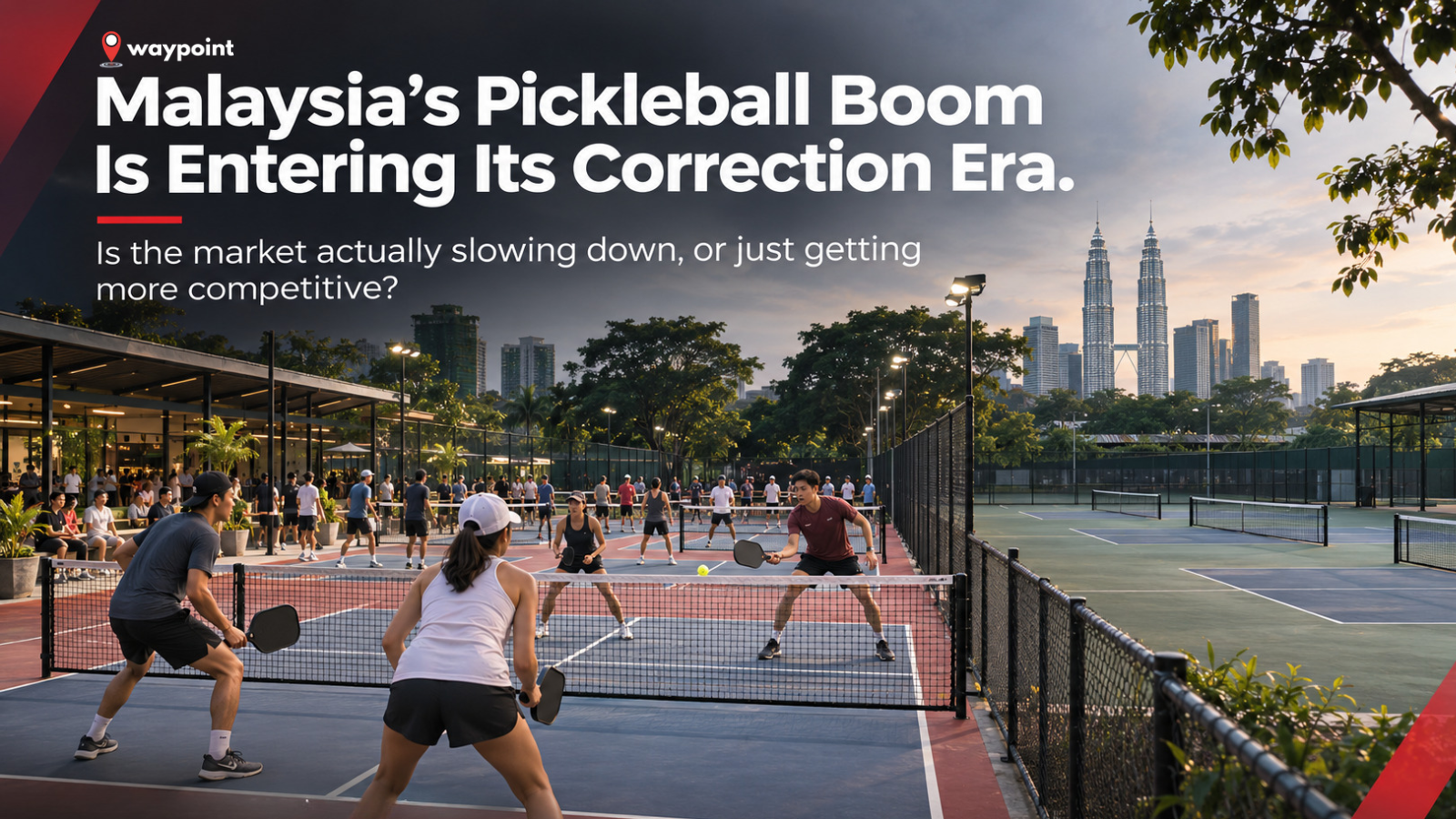

Malaysia spent the last two years opening pickleball courts at remarkable speed. Now some venues feel quieter, booking competition is getting tougher and operators are being forced to think beyond simply building more courts. But the available data suggests something more complicated than a collapse in demand.
For a while, the Malaysia pickleball market seemed almost impossible to slow down. New venues appeared across Kuala Lumpur, Selangor, Penang, Johor and other parts of the country, while booking apps filled with new options, brands entered the sport and major international tournaments chose Malaysia as a regional base.
Now, a different conversation is starting. On November 16, Pickle361 reported on ReSkills’ argument that Malaysian pickleball has entered a “market correction”. The idea is not that Malaysians suddenly stopped playing, but that the number of places competing for those players may have grown faster than demand at each individual venue.
That distinction matters. A healthy sport can still produce quieter individual courts if the same player base is being spread across far more locations. So, is Malaysia’s pickleball boom actually slowing down? The answer depends on what you are measuring.
Why the Malaysia Pickleball Market Is Getting More Competitive
One of the biggest changes in Malaysia is simple: players have far more choice than they used to. A 2025 Courtsite analysis already warned about the possibility of oversupply. At the time, the platform reported more than 160 registered pickleball venues and over 1,000 dedicated courts, up from fewer than 10 converted or hybrid venues in 2023.
Court supply continued spreading after that. PicklePadel.my’s 2026 directory currently identifies more than 390 pickleball venues across Malaysia, although the directory itself cautions that its figures are not a complete market census.
With so many new places to play, the same player base is now being spread across more facilities. A neighbourhood that once had two busy pickleball centres might now have eight or ten. Even if the total number of players stays the same, each individual venue can look noticeably quieter because those players have more choices.
That is essentially the idea behind the current “market correction” argument.
The Booking Data Points to Fragmentation, Not Disappearance
The clearest evidence comes from booking behaviour. Earlier this year, Pickle361 and AFA Community analysed 1.4 million bookings processed across the AFA network during 2025. Their dataset covered more than 270 facilities and over 600,000 users across sports.
The pattern was not fewer people participating overall. Instead, average utilisation became thinner as supply expanded. Peak periods remained competitive, while off-peak hours weakened first, and players had more freedom to choose venues based on convenience rather than travelling further because only a few courts were available.
Courtsite saw strong growth from another angle. Between July 2024 and June 2025, monthly pickleball bookings on its platform increased from 1,042 to 47,374.
Those figures are older than the current correction discussion, so they cannot tell us exactly what happened in late 2026. They do show how quickly both demand and infrastructure expanded before the market became more competitive.
The issue may therefore be less about whether people still want to play pickleball and more about whether every venue built during the boom can attract enough of them consistently.
Malaysia Still Has a Large Player Base
There is also little evidence that pickleball has suddenly disappeared from everyday participation. The Malaysia Pickleball Association recently estimated that the country has around 150,000 active players, with roughly 10 to 15 per cent involved at a competitive level.
Different platforms produce different estimates because they track players in different ways. Reclub data presented at the Asia Pickleball Summit earlier this year recorded around 120,000 unique Malaysian players and more than 302,000 activities in the 12 months to May 2026.
That activity count was particularly notable. According to the same dataset, Malaysia recorded more organised pickleball activities than the Philippines despite having fewer unique players.
So while the hype may not feel as intense as it did during the first wave, there is still a substantial playing community underneath it. That distinction matters because hype and participation are not the same thing.
The Boom May Simply Be Moving Into a Harder Phase
The first stage of a fast-growing sport is relatively straightforward. People discover it, courts become difficult to book, investors notice demand and new venues open.
The next stage is much harder because players start having several nearby choices. At that point, simply owning pickleball courts is no longer enough, and operators begin competing on location, surface quality, pricing, coaching, community, leagues, social events and the overall experience.
ReSkills argues that this is where Malaysia is now. Its position is that clubs increasingly need retention strategies rather than relying on new-player curiosity alone.
That matches concerns Courtsite raised much earlier. Its 2025 analysis warned that venues with high rent, utilities and maintenance costs could become vulnerable if supply continued growing faster than utilisation.
Court rental pricing adds another layer. A September 2026 survey of eight Klang Valley operators found weekday rates ranging from around RM25 to evening prices of RM70 per hour before applicable taxes.
Players now have enough options to compare those prices rather than accepting whatever court is available. For venue owners, that is a completely different market from the early boom.
Quieter Courts Do Not Automatically Mean a Dying Sport
Seasonality also makes the current conversation harder to interpret. AFA’s booking analysis found that Malaysian sports participation tends to strengthen between April and October before softening from November through March, when year-end travel, Chinese New Year and Ramadan affect availability.
That matters because the latest conversation about quieter pickleball courts is happening in November. One quieter month therefore cannot tell us whether the wider market is shrinking.
There were other disruptions this year too. Malaysia experienced significant haze during September and October, affecting outdoor sport and causing postponements in several other competitions. There is no reliable national figure showing exactly how much pickleball participation was affected, so it would be difficult to measure its impact.
A better test will come over a longer period. If peak-season bookings during 2027 continue falling while active-player growth also stalls, that would provide stronger evidence of weakening demand. Right now, the clearer evidence is that supply has become much more competitive.
Big Events Are Still Finding Players
Malaysia’s tournament scene also provides another useful indicator. The APP Asia Tour held two major Malaysian events this year, with the Kuala Lumpur Open recording 1,760 player participations from 28 countries. The Penang Open attracted another 1,386 participations from 22 countries.
Malaysia has also been selected as the permanent home of APP Asia’s regional headquarters. The organisation announced the decision earlier this year as part of its wider investment in professional and grassroots pickleball across Asia.
Meanwhile, the Malaysia Pickleball Association is now pursuing a bid to introduce pickleball as a demonstration sport at the 2027 SEA Games, proposing men’s doubles, women’s doubles and mixed doubles.
Those developments do not prove every commercial court will succeed. They do suggest that Malaysia still has enough players, organisers and commercial interest to remain an important pickleball market.
The Real Correction May Be Happening to the Business Model
This may be the most important distinction in the current debate. Pickleball itself does not necessarily need to be shrinking for pickleball businesses to feel pressure.
If 100 players once had access to two venues, both operators could enjoy strong utilisation. If those same players suddenly have ten options, the economics change dramatically even though nobody has stopped playing.
That makes the current moment less of a referendum on whether Malaysians still like pickleball and more of a test of which venues can build something players want to return to. The easiest part of the boom may have been opening courts. The harder part is filling them consistently.
Operators that rely only on court rental may struggle more than venues that build coaching programmes, leagues, tournaments and regular communities around their facilities. Location and pricing will matter too, especially as players become less willing to travel far when similar courts are available nearby.
In that sense, a correction is not necessarily bad for the sport. It can force the market to become more competitive, more community-focused and more sustainable.
So, Is Malaysia’s Pickleball Market Actually Slowing Down?
There are signs that the extraordinary early hype has cooled. Players have more choices, individual venues are competing harder for bookings and off-peak utilisation appears more difficult than it was during the initial expansion.
But the available data does not support the simpler claim that Malaysians are abandoning pickleball. Participation remains substantial, major tournaments are still attracting large fields, new community programmes continue to appear and Malaysia remains important enough to serve as APP Asia’s regional base.
What has changed is the relationship between supply and demand. Malaysia no longer has a pickleball market where opening courts automatically means players will come, and that may actually be a sign of maturity rather than decline.
The next phase will be about figuring out which venues can turn first-time players into regular communities, which operators can survive more intense competition and whether total participation continues growing after the initial excitement settles.
Malaysia’s pickleball boom may not be ending. It may simply be entering the part where growth gets harder.
Continue Your Journey
Pickleball across Asia is moving beyond its first wave of rapid growth. As more courts, leagues and businesses enter the sport, the next challenge will be building communities that keep coming back.
Waypoint follows the places, players and developments shaping where pickleball goes next.
Our Official Links
Find our website and official social media channels here:
https://linktr.ee/waypoint.fan
Every Journey Starts With a Waypoint.
Sources & References
- Pickle361 – Malaysian Pickleball Enters Its Correction Era, According to ReSkills
https://www.pickle361.com/blogs/news/malaysian-pickleball-enters-its-correction-era-according-to-reskills - Pickle361 & AFA Community – Malaysia Pickleball Was Never Sudden: What the First 1.4 Million Bookings Reveal
https://www.pickle361.com/blogs/news/malaysia-pickleball-was-never-sudden-what-the-first-1-4-million-bookings-reveal - Courtsite – Infrastructure Overload? Assessing the Risk of Oversupply
https://blog.courtsite.my/infrastructure-overload-assessing-the-risk-of-oversupply/ - PicklePadel.my – State of Padel & Pickleball Malaysia 2026
https://picklepadel.my/en/reports/state-of-padel-2026 - Pickle361 – Asia Pickleball Summit 2.0 Recap 2026
https://www.pickle361.com/blogs/news/asia-pickleball-summit-2-0-recap-2026 - Bernama – Malaysia Pickleball Association Eyes Pickleball for 2027 SEA Games
https://www.bernama.com/en/region/news.php?id=2633848 - APP – APP Asia Tour Leaders Reflect on a Breakthrough Year in Malaysia
https://www.theapp.global/news/app-asia-tour-leaders-reflect-on-a-breakthrough-year-in-malaysia - Bernama – Malaysia Named APP Asia Headquarters
https://www.bernama.com/en/news.php?id=2574396 - MissLobang Malaysia – Pickleball Court Pricing in KL and Klang Valley 2026
https://www.misslobang.my/article/pickleball-courts-kl-klang-valley-prices-2026 - Oppotus – Social Sport Evolution: Broad Habits on Pickleball, High Passion for Padel
https://www.oppotus.com/broad-habits-pickleball-high-passion-padel/