

INTRODUCTION
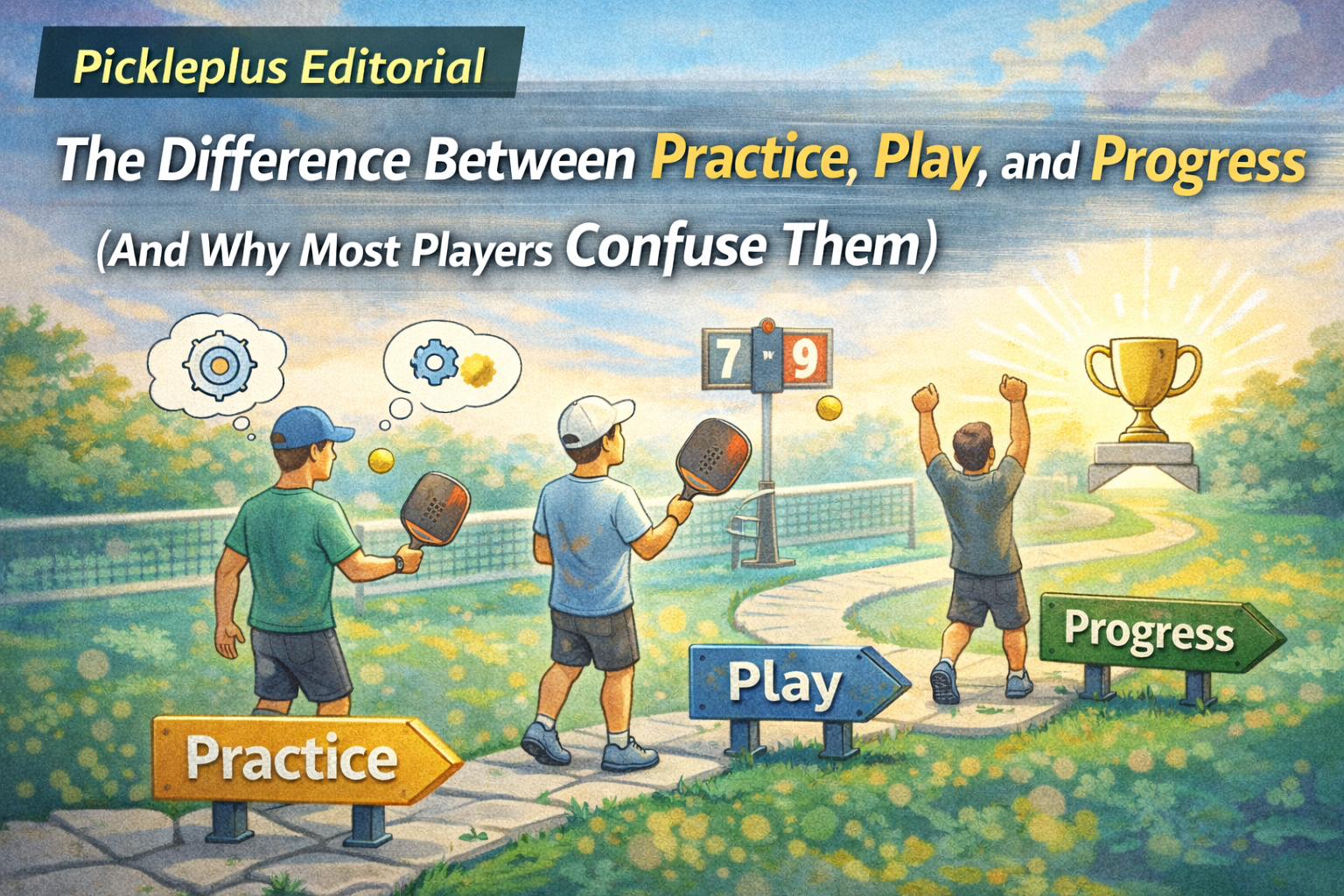
Most pickleball players believe they are practicing.
In reality, most are simply playing more.
This distinction matters far more than it seems. When players blur the line between practice, play, and progress, effort increases while results stagnate. Frustration follows not because commitment is lacking, but because intent is misaligned.
Understanding the difference between these three concepts does not require more discipline. It requires clearer thinking.
WHY THIS CONFUSION IS SO COMMON
Pickleball grew quickly, and for a long time, growth rewarded volume. More games led to rapid improvement, especially in the early stages. That experience trained players to equate time on court with development.
As skill levels rose, however, the same logic stopped working. Yet the habits remained.
Players kept increasing activity while expecting the same rate of progress. When improvement slowed, they assumed something was wrong with them rather than with the structure of their engagement.
WHAT “PLAY” ACTUALLY IS
Play is outcome-driven.
It prioritises:
- Winning points
- Staying competitive
- Protecting comfort under pressure
During play, players default to what feels reliable. They avoid experimentation and fall back on familiar patterns, especially when scores matter.
Play is essential. It builds instincts, pressure tolerance, and enjoyment. However, play primarily reveals ability. It does not reliably develop it once fundamentals settle.
WHAT “PRACTICE” ACTUALLY IS
Practice is intention-driven.
It focuses on:
- Isolating specific problems
- Repeating uncomfortable adjustments
- Allowing mistakes without consequence
Unlike play, practice sacrifices immediate results in service of long-term change. It feels slower and often less satisfying because progress is measured in understanding rather than points.
Practice becomes ineffective when it mimics play too closely. Without clear intent, repetition reinforces existing habits instead of reshaping them.
WHY MOST PLAYERS THINK THEY ARE PRACTICING WHEN THEY ARE NOT
Many sessions sit in a grey area.
They feel structured because drills exist. They feel demanding because effort is high. However, without a clear purpose, these sessions drift back toward play behaviours.
When drills prioritise rally survival, competition, or scorekeeping, players unconsciously protect outcomes again. The session feels productive, yet learning remains shallow.
The body works hard. The game does not change.
WHAT “PROGRESS” ACTUALLY MEANS
Progress is neither practice nor play.
Progress is the result of correctly sequencing both.
It shows up as:
- Better decisions under pressure
- Faster recognition of patterns
- Reduced effort for the same outcome
- Greater consistency across environments
Progress often appears quietly. It rarely announces itself in a single session. Instead, it emerges over time when practice reshapes habits and play tests them honestly.
WHY CONFUSING THESE THREE SLOWS IMPROVEMENT
When players treat play as practice, they protect comfort and avoid risk. When they treat practice as play, they chase performance instead of change.
In both cases, learning stalls.
The issue is not effort. It is expectation. Players expect progress from activities that were never designed to produce it at that stage.
HOW THIS CONFUSION CREATES PLATEAUS
Once early gains fade, players who rely solely on volume encounter a ceiling.
They:
- Play more to compensate
- Seek more advice
- Change focus frequently
None of these address the underlying issue. Without clarity around intent, additional effort multiplies noise rather than progress.
Plateaus form not because players stop working, but because work loses direction.
WHY CLARITY CHANGES EVERYTHING
When players understand the difference between practice, play, and progress, decisions become simpler.
They stop asking:
- “Am I doing enough?”
And start asking:
- “What is this session meant to accomplish?”
That shift alone restores momentum for many players.
FINAL THOUGHT
Practice, play, and progress are not interchangeable.
Each serves a different purpose, and each matters at different moments. Confusing them does not make players lazy or undisciplined. It simply makes improvement harder than it needs to be.
Progress resumes when intent becomes clear.
CONTINUATION PATHS
Players who recognise this distinction often want a clearer way to reflect on how their time on court translates into development over longer periods.
Pickleplus exists to help players contextualise participation, consistency, and progression across weeks and months:
https://pickleplus.io
For coaches, separating practice intent from play outcomes becomes easier when patterns are visible beyond individual sessions.
Tools like Pointflow were built to support that longer-term perspective:
https://pointflow.pickleplus.io
Some players prefer to experience environments where practice, play, and progress are intentionally separated rather than blended together.
Events such as the Frenship Cup (Singapore, 28 February 2026) offer that context:
https://docs.google.com/forms/d/e/1FAIpQLSeC3UWkUPVJ0i9IbP0uHwLs1yZsMrnT-obEhw9q3iqJbwdaZQ/viewform