
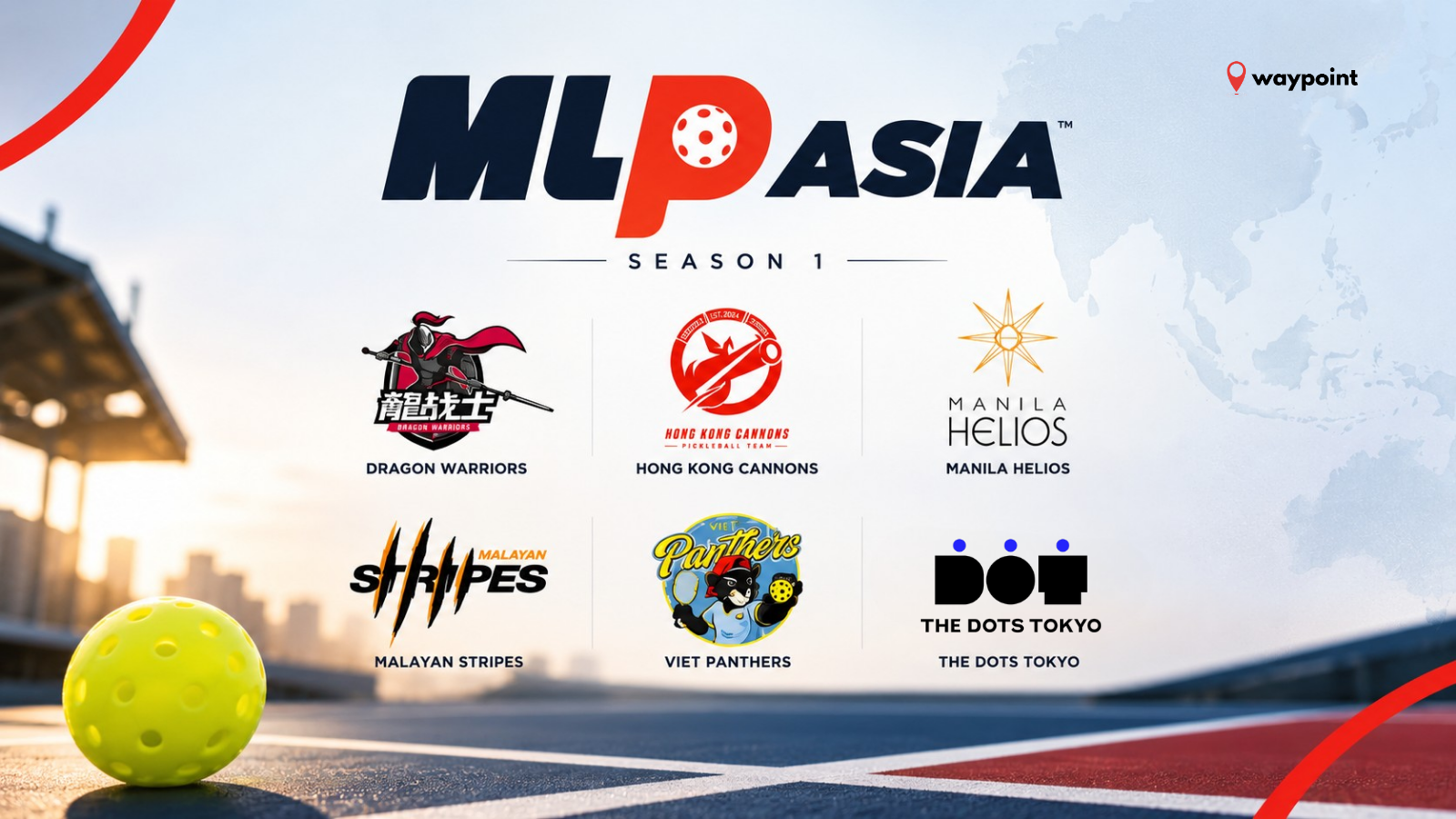

Six teams, six home crowds and one first-ever MLP Asia champion. Major League Pickleball’s team format officially arrives in Asia this November, bringing local and international players together for a new kind of professional pickleball competition.
Major League Pickleball is officially coming to Asia.
The inaugural MLP Asia season begins on 13 November 2026 in Japan, before moving through six home match days across the region. According to MLP Asia’s official Season 1 schedule, teams representing China, Hong Kong, Malaysia, the Philippines, Japan and Vietnam will compete through November, with the top four advancing to the playoffs in December.
It is the next step in a plan that has been developing for almost two years. When PPA Asia and MLP Asia were first announced in November 2024, the idea was to bring both traditional professional tournaments and MLP’s franchise-style team competition into Asian markets. PPA Tour Asia arrived first, while MLP Asia was expected to follow during the 2025/2026 period.
Now the teams are drafted, the schedule is ready and Asia is about to find out whether professional pickleball can build something slightly different: teams that fans actually choose to support.
Six Teams Will Compete in the First Season
MLP Asia launches with six franchises: Dragon Warriors, Hong Kong Cannons, Malayan Stripes, Manila Helios, THE DOTS TOKYO and Viet Panthers. The league’s current official team list confirms all six as the teams competing in the inaugural 2026 season.
Each roster contains six players. Teams first selected three players through a domestic draft, including at least one male and one female player, before filling their remaining three roster positions through an international auction. MLP Asia’s domestic draft announcement explains that this structure was designed to give every franchise a local foundation before bringing in players from the wider international pool.
| Team | Market | 2026 Roster |
|---|---|---|
| Dragon Warriors | China | Lingwei Kong (C), Anni Xie, Longsheng Liu, Grayson Goldin, Jamie Wei, Luc Pham |
| Hong Kong Cannons | Hong Kong | Hong Kit Wong (C), Nok Yiu Tang, Marco Leung, Armaan Bhatia, Chao Yi Wang, Kei Sawaki |
| Malayan Stripes | Malaysia | Jimmy Liong (C), Syed Uzair, Athilla Miasara, Eunggwon Kim, Xiao Yi Wang-Beckvall, Lacy Schneeman |
| Manila Helios | Philippines | Kim Saraza (C), Jacob Diago, Macy Ybanez, Seina Shima, Muhammad Aiman, Mayu Ito |
| THE DOTS TOKYO | Japan | Yuta Funemizu (C), Aiko Yoshitomi, Rika Fujiwara, Nasa Hatakeyama, Mihae Kwon, Daniel Moore |
| Viet Panthers | Vietnam | Quan Do (C), Hien Truong, Sophia Nhi Huynh, Tama Shimabukuro, Kaitlyn Christian, Ho Tam |
The complete rosters were confirmed when the international draft concluded on 14 September. Eighteen players were selected over three auction rounds to complete the six squads.
One small change happened after those rosters were announced. Japan’s franchise was initially referred to as Team Tokyo, but it has since officially launched as THE DOTS TOKYO. The team is jointly operated by TBS Holdings and dentsu Sports & Entertainment and will host the first night of MLP Asia competition on 13 November. MLP Asia introduced the new identity in October.
How Will the First MLP Asia Season Work?
The first season is relatively short and easy to follow. Pool play takes place over six match days between 13 and 28 November, with each franchise receiving one home night. When a team hosts, it plays two different opponents back-to-back in front of its home crowd.
Here is the full pool schedule from MLP Asia’s official announcement:
| Date | Home Team | Opponents |
|---|---|---|
| 13 November | THE DOTS TOKYO | Manila Helios, Malayan Stripes |
| 14 November | Hong Kong Cannons | Viet Panthers, Dragon Warriors |
| 20 November | Manila Helios | Dragon Warriors, Hong Kong Cannons |
| 21 November | Viet Panthers | Malayan Stripes, THE DOTS TOKYO |
| 27 November | Dragon Warriors | THE DOTS TOKYO, Viet Panthers |
| 28 November | Malayan Stripes | Hong Kong Cannons, Manila Helios |
By the end of November, the top four teams in the standings will advance to the playoffs. The semifinals are scheduled for 11 December, followed by Super Saturday on 12 December, when MLP Asia will crown its first champion.
The home-night structure is one of the more interesting parts of the league. Instead of putting every team in one location for the entire season, each franchise gets a chance to become the centre of attention in its own market. For a new league trying to build local support, that could matter just as much as the matches themselves.
What Does an MLP Match Actually Look Like?
MLP is not played like a normal knockout pickleball tournament.
Each team matchup begins with women’s doubles and men’s doubles, followed by two mixed doubles games. If the overall matchup reaches 2-2, it goes to a DreamBreaker, where players rotate through singles in a deciding game to 21. The format is explained in MLP Asia’s launch profile for THE DOTS TOKYO.
That immediately changes how teams need to be built. One outstanding player cannot simply carry the entire roster because different combinations are required throughout the matchup. Men’s, women’s and mixed doubles all contribute to the result, while the DreamBreaker introduces an additional singles challenge if the teams remain tied.
The standings also reward teams differently depending on how they win. MLP Asia’s current standings rules award three points for a regulation win, two for a DreamBreaker win, one for a DreamBreaker loss and zero for a regulation loss.
That means even losing can still produce a valuable standings point if a team manages to push the matchup all the way to a DreamBreaker.
Why Is the Team Format Interesting for Asia?
Asia is already getting more professional pickleball tournaments. PPA Tour Asia has expanded across the region, while APP has also been developing its own Asian circuit.
MLP is trying to offer something different.
Instead of asking fans to follow only individual players, it gives them a franchise connected to a particular market. Someone in Malaysia can support the Malayan Stripes, while a fan in Vietnam has the Viet Panthers. Japan has THE DOTS TOKYO, the Philippines has Manila Helios, China has Dragon Warriors and Hong Kong has the Cannons.
That sounds simple, but it could solve an important problem for professional pickleball: how do you turn people who enjoy playing the sport into people who also want to watch it?
Traditional team sports have a built-in answer. Fans might start supporting a club because it represents their city, country or community, then continue following that club even as individual players change. MLP Asia is essentially testing whether pickleball can create the same type of connection.
The domestic draft helps reinforce that idea. Lingwei Kong captains the Dragon Warriors, Hong Kit Wong leads the Hong Kong Cannons, Jimmy Liong captains the Malayan Stripes, Kim Saraza leads Manila Helios, Yuta Funemizu captains THE DOTS TOKYO and Quan Do leads the Viet Panthers. Those captain selections were confirmed through MLP Asia’s domestic draft before the international players were added.
The result is a league where every franchise has a recognisable local core while still bringing in players from outside its home market.
It Also Creates Another Pathway for Asian Players
The roster model could matter for players too.
Traditional tournaments can be unforgiving. A player travels to an event, loses early and their competition may be over almost immediately. A league creates a different experience because players become part of a team competing across several match days.
MLP Asia’s first international draft brought players such as Kaitlyn Christian to the Viet Panthers, Luc Pham to the Dragon Warriors, Armaan Bhatia to the Hong Kong Cannons and Lacy Schneeman to the Malayan Stripes. The full list of international picks is available in MLP Asia’s official draft recap.
For domestic players, that creates opportunities to compete alongside athletes with experience in different tours, markets and playing environments. It also brings professional competition closer to home rather than requiring every ambitious Asian player to build their career entirely through tournaments in the United States.
The Viet Panthers show how that could work in practice. Their six-player roster combines Vietnamese players Quan Do, Hien Truong, Sophia Nhi Huynh and Ho Tam with U.S.-based players Tama Shimabukuro and Kaitlyn Christian. The team’s official launch announcement also confirmed AP Sports Club as its home venue, with plans for a dedicated competition court and seating for approximately 1,000 spectators.
That begins to look like more than players simply wearing the same shirt for a weekend. It creates the possibility of permanent team identities, home venues and local communities forming around them.
The Real Test Is Whether Fans Pick a Side
MLP Asia now has the teams, the players and the schedule. What it does not have yet is history.
There are no long-running rivalries between Dragon Warriors and Viet Panthers. Fans have not spent years following Malayan Stripes or Manila Helios. THE DOTS TOKYO has not yet built generations of supporters.
All of that has to start somewhere.
Season 1 will therefore be about more than determining which team lifts the trophy on 12 December. It will be the first test of whether pickleball fans in Asia want to follow professional teams in the same way they already follow individual athletes and tournaments.
Some franchises are already starting to build beyond the match itself. THE DOTS TOKYO’s owners have spoken about building its fan community and developing pickleball in Japan, while the Viet Panthers have introduced a home venue, merchandise and longer-term plans around player and youth development.
If those identities become meaningful, MLP Asia could add something genuinely different to the region’s professional pickleball scene.
If they do not, it risks becoming another set of matches on an increasingly crowded calendar.
That is what makes the first season interesting.
The question is not only who becomes MLP Asia’s first champion. It is whether, by the end of the season, fans actually care which team wins.
Continue Your Journey
Professional pickleball is growing quickly across Asia, and MLP Asia adds a completely new team-based format to the region. At Waypoint, we are following the players, tournaments, teams and communities shaping what comes next.
Our Official Links
Find our website and official social media channels here:
🔗 https://linktr.ee/waypoint.fan
Every Journey Starts With a Waypoint.