

The inaugural OCBC-Great Eastern Pickleball Open has demonstrated what happens when corporate investment, community participation and competitive sport come together. But beyond the impressive numbers lies a bigger question: How can Singapore turn this momentum into sustainable growth for pickleball?
A Milestone for Singapore Pickleball
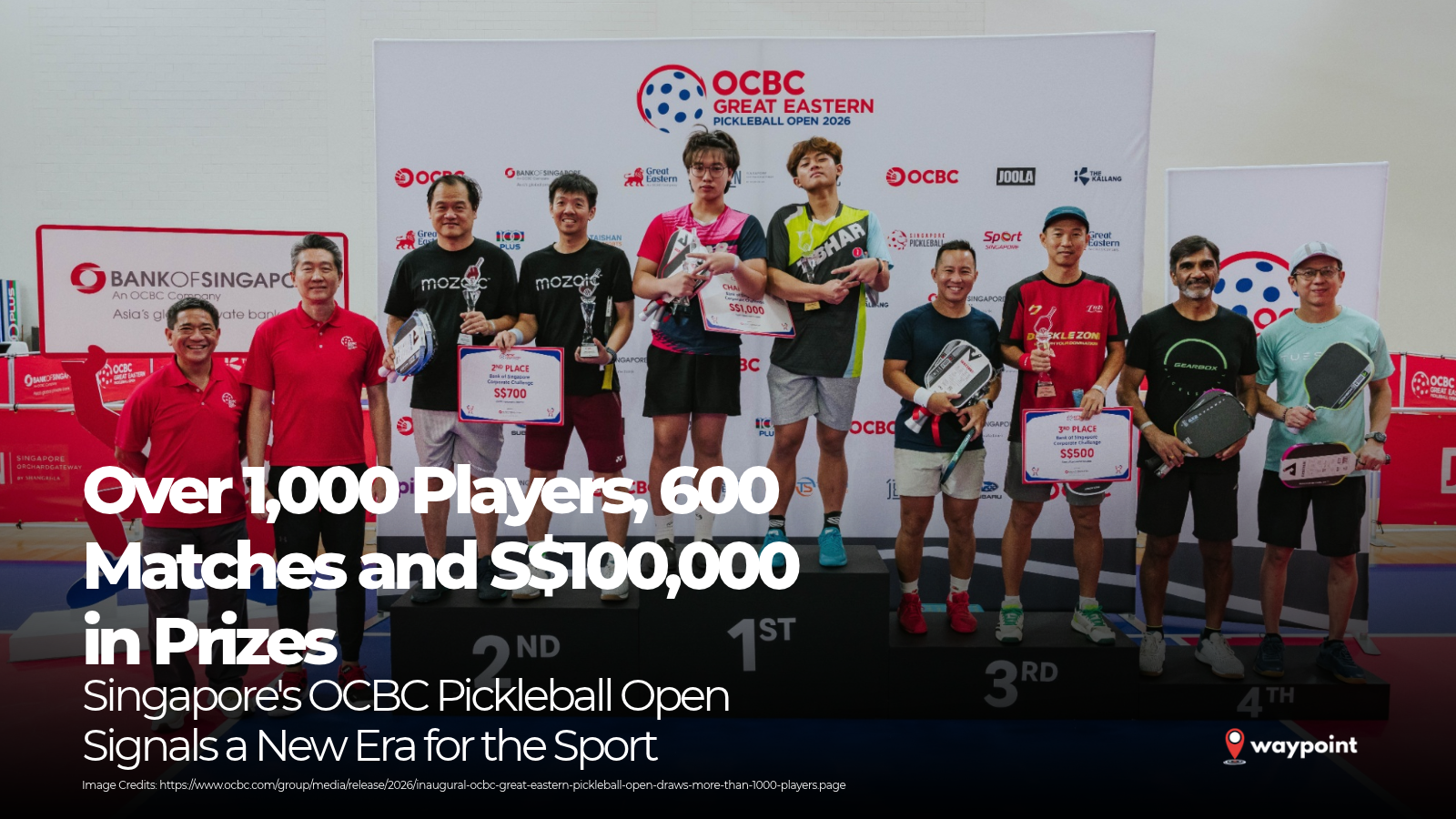
Singapore’s pickleball community celebrated a significant milestone over the weekend as the inaugural OCBC-Great Eastern Pickleball Open concluded at OCBC Arena, The Kallang, on 25 October 2026.
Held over three days from 23 to 25 October, the tournament attracted more than 1,000 players, nearly 1,000 spectators and participants from countries including Australia, India and Thailand.
More than 600 matches were contested across four competition categories, with over S$100,000 worth of prizes available to the winners.
For a sport that has experienced remarkable grassroots growth in Singapore, the tournament represented something more significant than another competition.
It demonstrated that pickleball can attract substantial corporate sponsorship, engage participants across generations and deliver sporting experiences on a scale previously associated with more established sports.
Perhaps most importantly, it showed that major corporations are beginning to recognise pickleball as a serious platform for community engagement, brand visibility and participation.
And that could change the trajectory of the sport in Singapore.
Four Categories, Four Champions
The inaugural tournament featured four competitive categories designed to accommodate different player backgrounds and abilities.
In the Open category, Kosing Pikoleros, represented by Christopher Encarnacion and Ralph Kevin Barte, emerged victorious.
The Novice championship went to Jimmy Setiawan Simon and Raymond Leong, competing as Raymond & Jimmy.
In the Bank of Singapore Corporate Challenge, Zenith Interns secured the championship, while Genesis claimed the Bank of Singapore Invitational Championship title.
Beyond the results, the tournament’s structure demonstrated an important aspect of pickleball’s appeal.
It created opportunities for recreational players, experienced competitors and corporate participants to share the same sporting environment.
This accessibility is one of pickleball’s greatest competitive advantages over many traditional sports.
Participants do not necessarily need decades of experience to enter a tournament, enjoy competitive matches or feel part of a larger sporting community.
That accessibility is precisely what makes pickleball attractive to sponsors and event organisers.
From Teenagers to Grandparents: A Sport Without Generational Boundaries
One of the tournament’s most compelling stories involved 75-year-old Sam Ho Soo Hock.
Having discovered pickleball only months earlier through a seniors’ programme, he participated in his first tournament alongside competitors considerably younger than himself.
The youngest participant was just 13.
That 62-year age difference highlights something unusual about pickleball.
Few competitive sports can bring teenagers, working professionals, parents and grandparents into the same tournament environment while maintaining meaningful participation across different abilities.
This creates an opportunity that extends far beyond conventional sports marketing.
For corporations, pickleball offers access to multiple generations of consumers.
For communities, it provides a relatively accessible activity that encourages social interaction and active ageing.
For sports organisations, it creates a pathway through which participants can progress from introductory sessions to recreational play and eventually competitive events.
The challenge is ensuring that these pathways remain connected.
Corporate Sponsorship Is Becoming a Major Growth Driver
The involvement of OCBC, Great Eastern and Bank of Singapore is particularly significant.
Corporate sponsorship in emerging sports often begins with relatively modest investments in individual competitions or community activities.
The OCBC-Great Eastern Pickleball Open demonstrated a more comprehensive approach.
Rather than focusing exclusively on a single weekend of competition, the initiative included introductory workshops designed to encourage new participants to experience pickleball.
The wider programme featured 24 learn-to-play workshops leading up to the tournament.
This approach matters because it recognises that participation must be developed before competitive events can achieve meaningful scale.
The tournament itself becomes the culmination of a broader engagement programme rather than an isolated marketing activity.
For sponsors, that potentially creates multiple opportunities to engage consumers.
For players, it offers a more welcoming introduction to competitive sport.
For the pickleball industry, it provides a model worth studying.
However, one question remains.
What happens to those players after the tournament ends?
The Real Opportunity Begins After the Final Match
A successful tournament can generate excitement, media attention and thousands of individual interactions.
But those benefits can disappear quickly if there is no mechanism to maintain engagement.
Consider the more than 1,000 players who participated in the OCBC-Great Eastern Pickleball Open.
Some were experienced competitors. Others were entering their first tournament. Many may have discovered new playing partners, clubs or competitive ambitions.
What happens next?
How many will participate in another tournament?
How many will join structured coaching programmes?
How many will become regular members of local pickleball communities?
And how can sponsors continue engaging these participants beyond the initial event?
These questions represent one of the biggest opportunities facing the pickleball industry today.
The next stage of pickleball’s development is not simply about organising bigger tournaments. It is about connecting participation across tournaments, facilities, coaching programmes and communities.
This is where sports technology and integrated participation platforms can play an increasingly important role.
Why the Future of Pickleball Needs More Than Tournament Software
As pickleball grows, its ecosystem becomes increasingly complex.
Players participate in different tournaments organised by different groups.
Coaches operate independently.
Facilities manage their own bookings and membership programmes.
Sponsors support individual events without necessarily having a continuous relationship with participants.
The result is a fragmented sporting ecosystem.
A player might participate in several tournaments annually without having a consistent record of their competitive journey.
A tournament organiser might successfully attract hundreds of participants but struggle to retain them for future events.
A sponsor might reach thousands of people during a competition without understanding how that engagement develops over time.
These challenges are not unique to Singapore.
They are emerging across pickleball markets internationally.
And solving them requires more than another tournament registration system.
It requires an infrastructure that connects the different parts of the sporting experience.
Where Waypoint Fits Into the Bigger Picture
Waypoint is being developed around a simple principle:
Every sporting experience should create an opportunity for the next one.
Rather than treating tournaments, coaching, facilities and communities as separate activities, Waypoint aims to connect them through a shared digital ecosystem.
For players, this means building a continuous sporting journey that can include tournament participation, player development, coaching opportunities and community engagement.
For tournament organisers, it means having tools to manage competitions while developing longer-term relationships with participants.
For facilities and academies, it creates opportunities to connect their programmes with the wider sporting community.
For sponsors, it opens the possibility of supporting participation beyond a single event.
Imagine a player entering their first pickleball tournament.
After the competition, they discover suitable coaching programmes, find other players of similar ability and receive information about upcoming events.
As their experience grows, they build a record of their sporting journey.
Eventually, they might become a regular tournament participant, a club member, a coach or even a community organiser.
Each stage creates opportunities for the next.
That is the kind of connected sporting ecosystem Waypoint is working to build.
Explore the Waypoint sporting ecosystem at waypoint.fan.
Singapore Has the Opportunity to Become a Regional Pickleball Hub
Singapore possesses several advantages that could support its emergence as a major pickleball destination in Asia.
Its international connectivity makes it accessible to regional competitors.
Its corporate sector provides opportunities for sponsorship and commercial partnerships.
Its sporting infrastructure can accommodate major events.
And its increasingly active pickleball community provides a growing base of recreational and competitive participants.
The OCBC-Great Eastern Pickleball Open demonstrated how these advantages can come together.
However, Singapore also faces challenges.
Court availability remains an important consideration as participation grows.
Tournament organisers must balance accessibility with the financial realities of staging competitions.
Players need clearer pathways between recreational participation and higher-level competition.
And facilities must find sustainable operating models that extend beyond simply renting courts.
These challenges will become increasingly important as the market matures.
A growing number of players does not automatically translate into a financially sustainable industry.
The next phase requires better coordination between facilities, coaches, organisers, sponsors and technology providers.
Bigger Tournaments Are Important. Stronger Ecosystems Matter More.
The success of the inaugural OCBC-Great Eastern Pickleball Open deserves recognition.
Attracting more than 1,000 participants to a first-edition tournament is a significant achievement.
The involvement of major corporate sponsors, the diversity of participants and the scale of the competition all demonstrate the sport’s growing appeal.
But the industry’s long-term success should not be measured exclusively by tournament attendance.
It should also be measured by how many people continue playing, how many new communities emerge, how many facilities remain commercially sustainable and how effectively the sport creates opportunities for participants.
The most valuable outcome of a major tournament is not necessarily the number of people who attend.
It is the number of people who remain engaged afterwards.
This is the opportunity that Singapore’s pickleball industry must now pursue.
The Next Chapter Starts With Connection
The OCBC-Great Eastern Pickleball Open has shown what is possible when established organisations invest in an emerging sport.
The next challenge is ensuring that this investment produces lasting benefits.
That requires cooperation between tournament organisers, facility operators, coaches, players, sponsors and technology platforms.
It also requires a shift in perspective.
Instead of viewing each tournament as an individual event, the industry can begin treating every competition as part of a larger sporting journey.
Instead of measuring success only through registrations and attendance, organisers can consider participation, retention and community development.
And instead of building isolated programmes, stakeholders can explore ways to connect their efforts.
This is the future that Waypoint is working towards.
Not simply more tournaments.
Not simply more courts.
But a connected sporting ecosystem in which every player, organiser, coach, facility and sponsor has an opportunity to grow.
Because the real success of a tournament isn’t just what happens during those three days.
It’s what happens next.
Build What’s Next With Waypoint
The future of pickleball depends on more than participation numbers. It depends on creating meaningful connections between players, competitions, coaching, facilities and communities.
Waypoint is building the digital infrastructure to support that future.
Whether you’re organising tournaments, operating a pickleball facility, developing coaching programmes or exploring opportunities to support the sport, Waypoint is designed to help connect your activities with a wider sporting ecosystem.
For players: Discover opportunities to play, compete, improve and build your sporting journey.
For tournament organisers: Explore tools to manage competitions and strengthen ongoing engagement with participants.
For facilities and academies: Connect programmes, coaching and communities through a shared platform.
For sponsors and brands: Explore opportunities to support sporting participation and develop longer-term community relationships.
The next generation of sports growth will be driven not just by bigger events, but by better connections.
Discover Waypoint: waypoint.fan
Waypoint — Every Journey Begins Somewhere.
Sources and References
- OCBC – “Inaugural OCBC-Great Eastern Pickleball Open Draws More Than 1,000 Players,” 25 October 2026
Official post-event announcement covering the 1,000+ players, nearly 1,000 spectators, 600+ matches, S$100,000+ in prizes, winners and participants aged 13 to 75.
OCBC official post-event announcement - OCBC – “Inaugural OCBC-Great Eastern Pickleball Open Set for 23 to 25 October 2026,” 6 April 2026
Official announcement covering the tournament launch and the 24 learn-to-play workshops held in the lead-up to the event.
OCBC tournament announcement - OCBC – “Over S$100,000 in Prizes at Inaugural OCBC-Great Eastern Pickleball Open,” 26 July 2026
Official source for the prize offering and wider community initiatives connected to the tournament.
OCBC prize and community programme announcement
Editorial note: Tournament figures, winners and event details are based on the official OCBC-Great Eastern Pickleball Open announcement dated 25 October 2026. Industry analysis and commentary are independent editorial perspectives.