

By Waypoint Admin
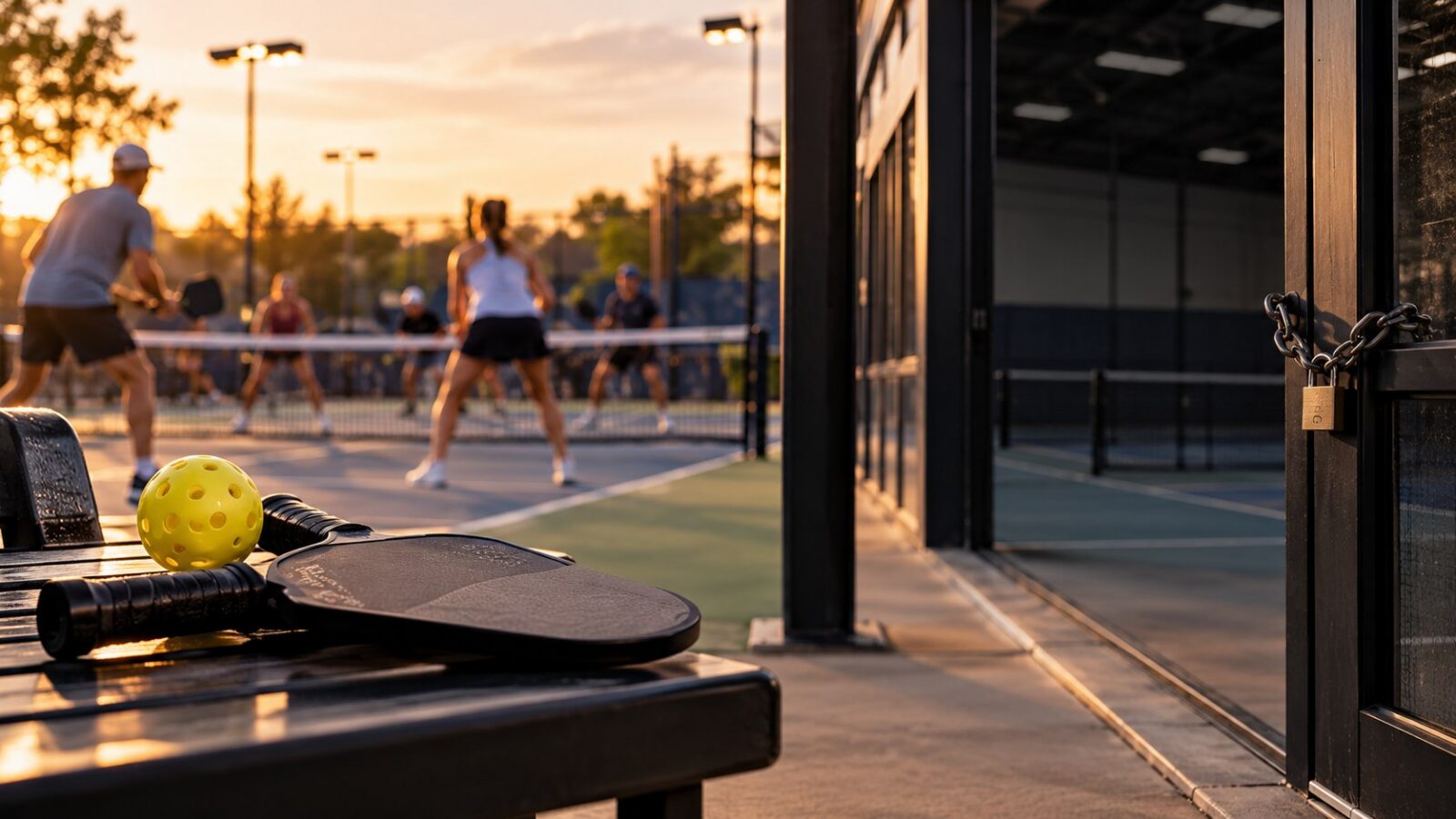
Pickleball is experiencing a curious contradiction.
Participation continues to grow. New courts are being built, brands and investors are entering the sport, professional competition is expanding, and new facilities continue to be announced. Yet, at the same time, pickleball clubs are closing.
At first glance, these developments appear incompatible. A rapidly growing sport should create favourable conditions for the businesses serving it, particularly those providing the physical infrastructure that players need.
The reality is more complicated.
Growth in participation does not automatically translate into a sustainable business model.
According to the Sports & Fitness Industry Association, 24.3 million Americans played pickleball in 2025, compared with approximately 4.2 million in 2020. Of those players, 7.5 million were classified as CORE participants who played at least eight times during the year. Pickleball was also America’s fastest-growing sport for a fifth consecutive year.
The physical infrastructure surrounding the sport has expanded accordingly. USA Pickleball reported 68,458 known courts across 15,910 locations at the end of 2024, with more than 18,000 courts added to its database during that year alone.
Those numbers make the commercial proposition appear compelling. More players should require more courts, and more courts should produce more revenue.
Unfortunately, the economics are not quite that simple.
A Busy Club Can Still Be a Bad Business
Visit a popular pickleball facility at seven in the evening and it can appear to be an exceptionally successful operation. Courts are occupied, players are waiting for games, lessons are taking place, the car park is full and the entire facility is filled with activity.
Return to the same facility at two in the afternoon on a Tuesday and the picture may be very different.
This matters because a pickleball court represents perishable inventory. If a facility operates ten courts for fourteen hours each day, it has 140 court-hours available to monetise. When several courts remain empty for an hour, that inventory cannot be stored and sold tomorrow. The revenue opportunity disappears as soon as the hour passes.
Hotels face a similar problem with unsold rooms, airlines with empty seats and restaurants with unused tables. Pickleball facilities face it with court time, except they must often support that inventory with significant expenditure on property, utilities, staffing, maintenance and financing.
Peak-hour utilisation can therefore create a misleading impression of commercial health. A facility can be almost impossible to book between 6pm and 10pm while remaining economically inefficient across much of the rest of its operating day.
The relevant question is not simply whether the courts are busy. It is whether the entire asset is productive enough to support the cost structure behind it.
Participation Is Not the Same as Willingness to Pay
One assumption made during pickleball’s rapid expansion is that enormous participation growth must create equally enormous commercial demand.
That assumption deserves closer examination.
Millions of people wanting to play pickleball does not necessarily mean millions of people are prepared to pay premium prices to play it. In fact, part of pickleball’s success comes from precisely the opposite characteristic: accessibility.
The equipment requirements are relatively modest, four people can share a court, existing sporting infrastructure can sometimes be adapted, and public parks, schools, community centres and residential developments can provide inexpensive places to play.
All of this is excellent for the growth of pickleball, but it creates an interesting challenge for private facilities.
Their competition does not come exclusively from another commercial club nearby. It can also come from public courts, community facilities, converted badminton halls, condominiums, schools and other venues where the cost of participation is considerably lower.
This creates an important distinction between demand for pickleball and demand for commercial pickleball facilities.
They are not the same market.
As the amount of available infrastructure increases, simply providing courts becomes progressively less differentiated. Private operators must therefore answer a harder question than whether enough pickleball players live nearby:
What are players willing to pay this particular facility for that they cannot easily obtain elsewhere?
The Court-Hour Trap
The simplest commercial model in pickleball is easy to understand: build courts, rent them by the hour and collect the revenue. It is also inherently limited.
A court can only be sold for a particular period once. When every court is occupied during prime time, the operator cannot substantially increase volume without raising prices, extending operating hours or adding more courts. Each solution has practical limits, while adding capacity introduces further capital and operating costs.
Membership models can create another version of the same problem. Recurring subscription revenue appears attractive, particularly when memberships include generous access to courts. However, if hundreds of members predominantly want to play during the same few evening hours, the club has effectively sold multiple customers access to the same scarce inventory.
As membership increases, availability deteriorates. When availability deteriorates, customer satisfaction follows. Operators then face an uncomfortable choice between restricting access, increasing prices or creating additional capacity.
This is why membership economics cannot be understood purely through the number of subscriptions sold. Membership is also a capacity-management problem.
A full membership book is only valuable if members can actually use what they believe they have purchased.
Pickleball Clubs Are Also Real-Estate Businesses
There is another uncomfortable reality behind the industry: pickleball requires a lot of physical space.
Indoor facilities need appropriate court dimensions, ceiling heights, lighting, flooring and circulation areas, while larger clubs increasingly require changing facilities, lounges, retail areas, food and beverage operations and other amenities.
The result is a business that can carry substantial fixed property costs before the first ball is struck.
Recent closures illustrate different aspects of this vulnerability.
In Boise, Idaho, S2 Pickleball closed in June 2026 after falling behind on rent. Its owners told members that they had been attempting to find a solution that would allow the club to remain financially viable without dramatically increasing membership costs.
Elsewhere, Boulder Pickleball closed after three years because the warehouse it occupied was scheduled for demolition and redevelopment.
These cases should not be treated as evidence that every pickleball facility is financially troubled, nor should very different closures be attributed to a single cause. They do, however, demonstrate an important principle: a pickleball club may operate as a sports business, but its survival can be heavily dependent on real-estate economics.
A great community cannot indefinitely compensate for an unsustainable lease, while a profitable operation can still disappear if it lacks sufficient security over the property on which it depends.
What Happens When Courts Are No Longer Scarce?
Court scarcity helped create the first generation of commercial opportunities in pickleball. Players wanted to play and there were not enough suitable places to accommodate them, so providing courts solved an immediate problem.
Successful markets, however, attract supply.
Commercial operators build facilities. Municipalities add public courts. Tennis centres introduce pickleball. Schools and community centres adapt existing spaces. Hotels, resorts and residential developments add courts of their own.
Eventually, the consumer’s question changes from “Where can I play?” to “Where do I want to play?”
That is a profound transition for the industry because, once basic court access becomes increasingly commoditised, operators must compete on factors beyond the existence of the courts themselves.
Location matters. Price matters. Coaching, programming, competition, hospitality, technology, convenience and overall experience matter.
Increasingly, community matters most.
A facility whose principal proposition is simply “we have pickleball courts” may therefore find itself surprisingly vulnerable when another facility opens nearby.
The uncomfortable truth is that having courts does not necessarily mean having a club.
A Booking Customer Is Not Necessarily a Community Member
Pickleball has an unusually strong social dimension. People may initially arrive because they want exercise or competition, but many remain because of the relationships they develop through the sport.
Players meet regular partners, establish playing groups, improve together, find coaches, enter leagues and tournaments, purchase equipment, travel to events and eventually introduce other people to the game. Over time, pickleball can become part of their social identity rather than simply an activity occupying an hour of their week.
That journey has enormous value, yet many facilities participate in surprisingly little of it.
A player may reserve a court through one system, organise games through WhatsApp, record results somewhere else, discover a coach through social media, purchase equipment from an online retailer, enter tournaments through another platform and organise pickleball travel independently.
The facility may therefore provide the most capital-intensive component of the ecosystem — the physical court — while capturing only a small part of the player’s overall relationship with the sport.
That is not merely a missed revenue opportunity. It is a strategic weakness.
If the player’s only meaningful relationship with a facility is the ability to book a court, switching to another facility becomes remarkably easy.
The Product Needs to Become Bigger Than the Court
The next generation of successful pickleball clubs may need to stop thinking of themselves primarily as businesses that sell court time.
Court rental can remain an important revenue stream, but it should sit within a much broader relationship involving coaching, academies, leagues, competitions, junior development, corporate programmes, retail, hospitality, events, sponsorship, travel and other player services.
The greater opportunity, however, is not simply to accumulate additional revenue streams.
It is to connect them.
Consider the journey of a completely new player.
That person might first discover somewhere nearby to try pickleball, attend an introductory session and meet several players of a similar level. Over time, those players begin playing together regularly. As they improve, they seek coaching, enter a league and eventually register for their first tournament.
Competition introduces them to players from other clubs and cities. Their next tournament might require travel. They begin purchasing equipment, following professional players and attending larger events. Eventually, some become coaches, organisers, volunteers or ambassadors who introduce another generation of people to the sport.
The original court booking was merely one waypoint in a much longer sporting journey.
A business that understands and supports that journey has a fundamentally different relationship with the player from one that simply rents a court for sixty minutes.
The Most Valuable Asset May Eventually Be the Community
For much of pickleball’s recent growth, courts have been treated as the scarce resource. In many markets, they genuinely have been.
That scarcity will not necessarily last forever.
Courts can be constructed. Warehouses can be converted. Existing sporting spaces can be adapted. Municipalities can invest in public infrastructure and new commercial competitors can enter attractive markets.
An engaged community is considerably harder to build.
Understanding that community may be even more valuable.
Who plays together? Who is improving? Who wants serious competition and who simply wants a social game? Who travels for tournaments? Who organises groups? Who brings new players into the sport? Who is looking for coaching? What experiences cause players to return, and what causes them to leave?
An organisation capable of understanding these relationships possesses something considerably more sophisticated than a booking database.
It possesses context.
That context can improve programming, player experiences, retention, commercial partnerships and even the way physical infrastructure is allocated.
The future competitive advantage of a sports organisation may therefore be less about owning every part of the player’s journey and more about understanding how those parts connect.
Tournaments Face the Same Economic Question
Similar thinking should be applied to tournaments and events.
A tournament with hundreds of players, sponsors, banners, livestreams and crowded courts can look extraordinarily successful from the outside. However, events also consume court inventory and incur expenditure on venues, staffing, officials, prizes, production, technology, marketing and administration.
The correct measure of an event should therefore extend beyond whether entry fees exceeded direct costs.
A stronger question is what the event created afterwards.
Did participants return? Did new playing relationships form? Did sponsors receive meaningful value? Did players progress into leagues, coaching or future competitions? Did visitors travel, stay, spend and return? Did the organiser gain a better understanding of its community?
A tournament should not simply occupy courts for three days. At its best, it should make the ecosystem surrounding those courts stronger for the rest of the year.
Pickleball Does Not Have a Demand Problem
None of this suggests that pickleball is approaching the end of its growth story. The participation data indicates precisely the opposite.
Nor does the closure of individual clubs prove that commercial pickleball facilities are fundamentally unviable. Successful operators continue to expand, new facilities continue to open, and different markets have very different property costs, demographics and consumer behaviour.
What the closures do suggest is that the industry’s extraordinary growth can no longer compensate indefinitely for weak business models.
Fast-growing industries inevitably attract experimentation. Some concepts work and others do not. Some locations produce excellent economics while apparently similar locations fail. Some operators create communities around their facilities, while others construct courts and assume that a community will naturally follow.
As the industry matures, those differences will become increasingly visible.
The Next Phase of Pickleball Will Reward Better Businesses
The first phase of pickleball’s commercial expansion was largely driven by access. There were not enough courts for the number of people who wanted to play, which meant that simply providing additional capacity could create significant value.
The next phase will be more demanding.
Operators will still need good courts, but courts alone will no longer be enough. Successful organisations will need to understand how people enter the sport, how frequently they participate, who they play with, how they improve, where they compete, what experiences they value and, ultimately, what keeps them engaged.
Most importantly, every operator should be prepared to answer a difficult question:
If another set of equally good courts opened five minutes away tomorrow, why would our players stay with us?
If the answer is simply price, convenience or availability, the business may be more fragile than it appears.
If the answer includes relationships, community, progression, experiences and a genuine sense of belonging, something considerably harder to replicate has been created.
Perhaps this is the real lesson behind the apparent contradiction of pickleball clubs closing while pickleball itself continues to grow. There is nothing contradictory about it. A sport can be thriving while individual businesses built around it struggle, particularly when participation has evolved faster than the commercial models serving that participation.
For years, the industry has concentrated on building more places to play.
The next opportunity is to build better connections between everything that happens before, during and after someone steps onto a court.
Because courts are infrastructure and pickleball is the activity, but ultimately, people are the business.
The pickleball industry may not have a shortage of demand.
It may have a shortage of sustainable business models.
From Courts to Journeys
This is one of the ideas behind Waypoint.
A player’s relationship with sport does not begin when a court booking starts and end sixty minutes later. The journey can begin with discovering somewhere to play, continue through meeting other players, coaching and development, competitions and events, and eventually extend into clubs, communities, travel and entirely new sporting experiences.
The problem is that many of these experiences remain disconnected.
Players search in one place, organise games somewhere else, register through another system, find coaching through another channel and frequently have to discover the next opportunity for themselves.
Clubs and organisers face the other side of the same problem. They may see the booking, registration or tournament entry without necessarily seeing where the participant came from, where that person goes next or how one experience can lead naturally into another.
Waypoint is being developed as a sports journey platform to help connect those experiences.
For players, that means making it easier to discover where to play, what to join and where their sporting journey can take them next.
For clubs, coaches, event organisers and other sports organisations, it means becoming part of a broader sporting ecosystem in which a booking, lesson, competition or event can become the beginning of another experience rather than the end of a transaction.
The objective is not to replace clubs or the physical infrastructure on which sport depends. It is to help make what happens around them more connected and, ultimately, more valuable.
Don’t just book your next court. Find your next Waypoint.
Discover where sport can take you next at “waypoint.fan“