
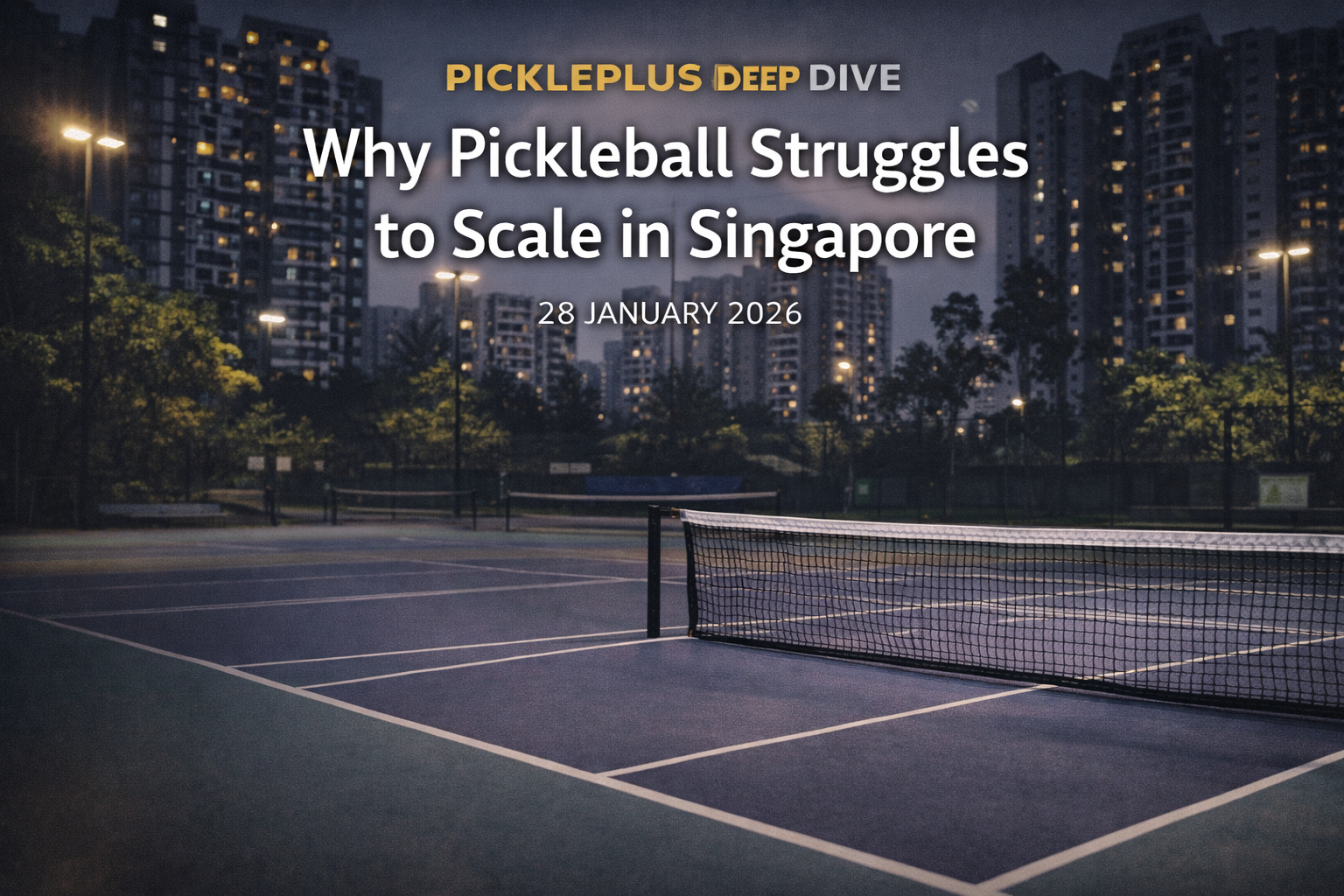

Singapore has strong interest in pickleball, active communities, and growing awareness — yet court access remains limited and fragmented. This is not a failure of popularity, but a reflection of how dense cities reveal the real constraints of modern sport.
Singapore Does Not Lack Interest
Pickleball participation in Singapore has grown steadily:
- Community groups are active
- Social play sessions fill quickly
- New players continue entering the sport
The issue is not whether people want to play.
It is where, when, and how often they are allowed to.
Land Is the Primary Constraint
Singapore’s sports ecosystem is shaped by:
- Extreme land scarcity
- Multi-sport competition for space
- High opportunity cost per square metre
Unlike countries with surplus land, every court in Singapore must justify itself against:
- Football
- Badminton
- Basketball
- Athletics
- Community programming
Pickleball is not rejected — it is competing.
Temporary Courts Cannot Support Permanent Demand
Much of pickleball access today relies on:
- Shared courts
- Temporary line markings
- Off-peak scheduling
- Ad hoc bookings
This works in early adoption phases.
It breaks at scale.
When demand becomes consistent:
- Scheduling friction increases
- Player frustration rises
- Community growth stalls
Temporary solutions do not sustain permanent interest.
Noise Sensitivity Accelerates the Indoor Question
Singapore’s residential density amplifies noise concerns.
Pickleball’s acoustic profile:
- Sharp, repetitive impact
- High frequency
- Long play sessions
This makes outdoor expansion near housing increasingly difficult.
The implication is clear:
Pickleball in Singapore cannot scale outdoors.
Indoor, acoustically controlled environments are not optional — they are inevitable.
Why Singapore Is Actually Ahead of the Curve
Paradoxically, Singapore’s constraints are an advantage.
They force early answers to questions other markets will face later:
- Should pickleball be free or programmed?
- How do facilities remain financially viable?
- What role do clubs and memberships play?
- How do we manage access fairly?
Singapore is not behind.
It is early to the hard part.
What This Reveals About Pickleball’s Future
Singapore shows us that:
- Demand alone does not build sports
- Infrastructure defines participation
- Access becomes the product in dense cities
- Paid, programmed, indoor models scale better
These lessons apply to:
- Hong Kong
- Tokyo
- Seoul
- Shanghai
- Major global cities
Singapore is the case study others will soon mirror.
What to Watch Next in Singapore
- Indoor, purpose-built pickleball venues
- Membership and charge-card access models
- Mall and commercial partnerships
- Structured leagues and programmes
- Reduced reliance on ad hoc outdoor courts
These signals matter more than participation headlines.
Think about this:
“Singapore doesn’t show pickleball’s weakness — it reveals its next evolution.”
Continue Your Pickleball Journey
https://pickleplus.io
https://pointflow.pickleplus.io
Join the Frenship Cup (Singapore)
Sign up for the Frenship Cup, taking place on 28 February 2026.
https://docs.google.com/forms/d/e/1FAIpQLSeC3UWkUPVJ0i9IbP0uHwLs1yZsMrnT-obEhw9q3iqJbwdaZQ/viewform