
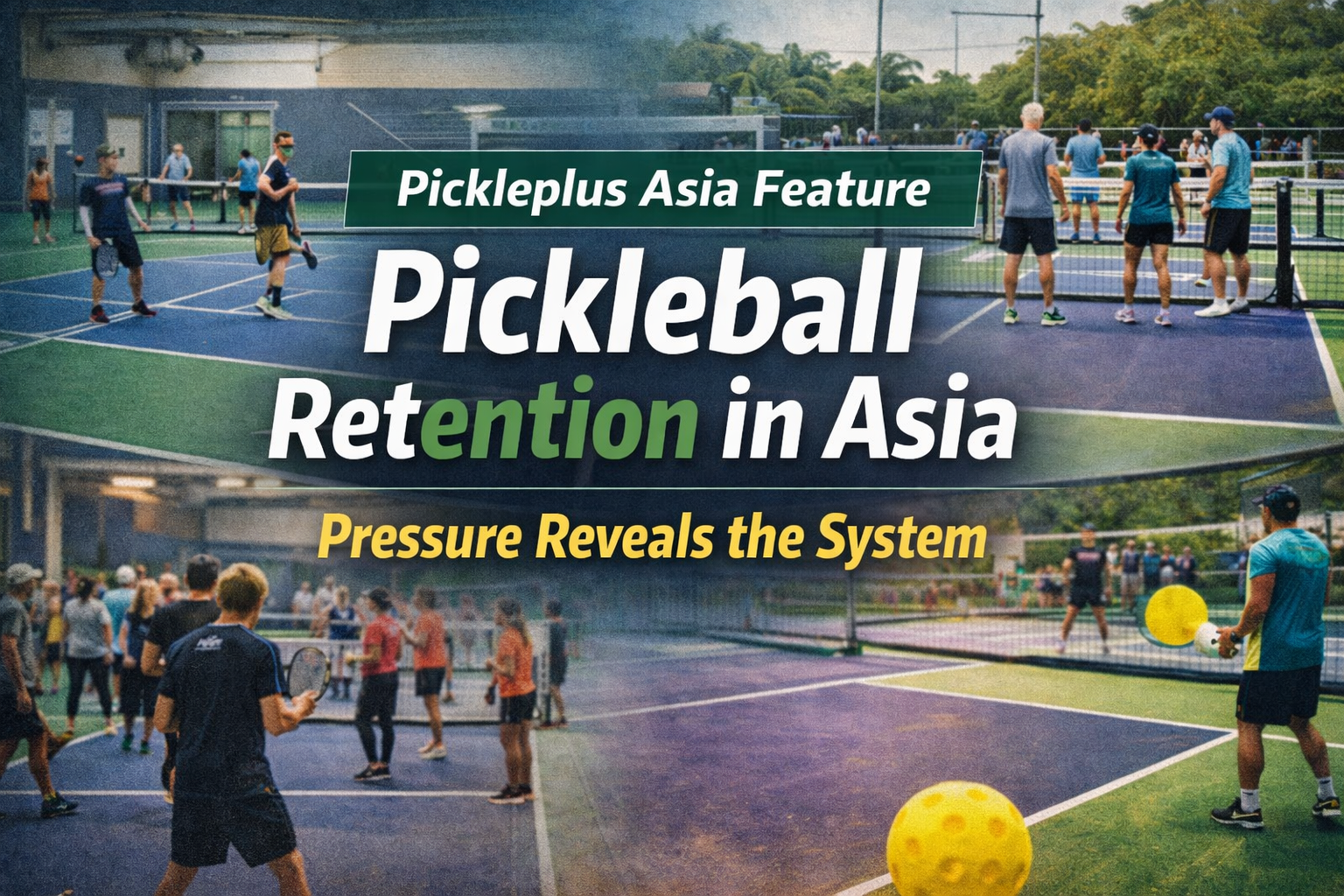

Asia is not where pickleball is growing the fastest.
It is where pickleball is being tested the hardest.
Players arrive curious, engaged, and willing to try.
They also leave quickly if value is unclear.
That reality makes Asia uncomfortable for hype-driven models — and invaluable for anyone serious about building sustainable systems.
WHY RETENTION FAILS FASTER IN ASIA
In many Western markets, pickleball benefits from:
- Retiree time flexibility
- Suburban club culture
- Slower decision cycles
Asia offers none of these luxuries.
Instead, Asia has:
- Time-poor urban players
- Price-sensitive participation
- High expectation of structure and value
If a player cannot answer “What am I getting better at?” within weeks, they disengage.
Asia doesn’t tolerate ambiguity.
And that is exactly why it reveals weak ecosystems early.
THE OPEN PLAY FALLACY
Open play works as an on-ramp, not a destination.
In Asia, over-reliance on open play creates friction fast:
- Skill mismatches discourage beginners
- Better players stagnate
- Social groups fragment
Without progression layers, open play becomes:
- Repetitive
- Politicised
- Emotionally draining
Players don’t quit pickleball.
They quit confusion.
ASIA AS A STRESS TEST, NOT A PROBLEM
What fails quickly in Asia was never strong to begin with.
Asia forces clarity on:
- Skill tiers
- Coaching value
- League structure
- Participation incentives
Markets like China and Southeast Asia expose a simple truth:
If a system cannot explain itself clearly, it cannot retain players.
This is not a cultural issue.
It is a design issue.
WHY THIS IS ACTUALLY GOOD FOR THE SPORT
Asia accelerates evolution.
Because:
- Weak formats collapse faster
- Strong systems stand out earlier
- Retention becomes visible, measurable, intentional
What survives Asia tends to:
- Scale better
- Travel better
- Translate across cultures
Asia is not behind pickleball’s global curve.
It is pulling the curve forward.
WHAT SUCCESSFUL ASIAN ECOSYSTEMS DO DIFFERENTLY
Across emerging Asian pickleball hubs, the patterns are consistent:
- Clear beginner → intermediate → competitive pathways
- Smaller, structured group formats
- Emphasis on leagues over one-off tournaments
- Visible progression markers beyond medals
Retention is treated as a design goal, not an accident.
WHAT THIS MEANS FOR THE GLOBAL GAME
Asia is not asking pickleball to slow down.
It is asking pickleball to grow up.
The next global standards will not come from:
- Louder tours
- More paddles
- Bigger prize pools
They will come from regions that demand:
- Structure
- Continuity
- Meaningful participation
Asia is setting that bar now.
FINAL THOUGHT
If pickleball can retain players in Asia,
it can retain players anywhere.
And if it cannot —
the problem was never Asia.
Create Your Player Passport
Your pickleball journey starts with identity, not rankings.
Create your Pickleplus Player Passport
https://pickleplus.io
Track participation, progression, and community involvement across the Pickleplus ecosystem.
Find Your Perfect Paddle
Most players guess. Data-driven players don’t.
Discover your ideal paddle with PaddleDNA
https://paddledna.pickleplus.io
Match your playing style, level, and preferences to the right equipment — without hype.
For Coaches: Coach Smarter, Not Louder
Retention improves when coaching becomes measurable.
Use Pointflow AI Coaching Tools
https://pointflow.pickleplus.io
Optimise drills, track progress point-by-point, and increase long-term value for your students.
🇸🇬 Compete. Connect. Belong.
Community-first competition starts here.
👉 Join the Frenship Cup (Singapore)
📅 28 February 2026
📝 Register here:
https://docs.google.com/forms/d/e/1FAIpQLSeC3UWkUPVJ0i9IbP0uHwLs1yZsMrnT-obEhw9q3iqJbwdaZQ/viewform