

INTRODUCTION
Most pickleball players believe improvement is linear.
Play more → get better → win more.
In reality, pickleball progression happens in distinct stages, each with its own mindset, needs, and failure points. Players don’t stagnate because they stop trying — they stagnate because they apply the wrong behaviours to the wrong stage.
This is why two players with the same experience can feel worlds apart.
Understanding the stages of a pickleball player isn’t about labels.
It’s about knowing what you need now — and what will hold you back next.
WHY MOST PLAYERS NEVER REALISE THEY’VE STOPPED PROGRESSING
The most dangerous phase in pickleball is not beginner frustration.
It’s comfortable competence.
Players keep:
- Playing weekly
- Winning some games
- Staying socially engaged
But improvement quietly slows. Without clear markers, this feels normal — until months or years pass with little change.
This is not a motivation problem.
It’s a stage-awareness problem.
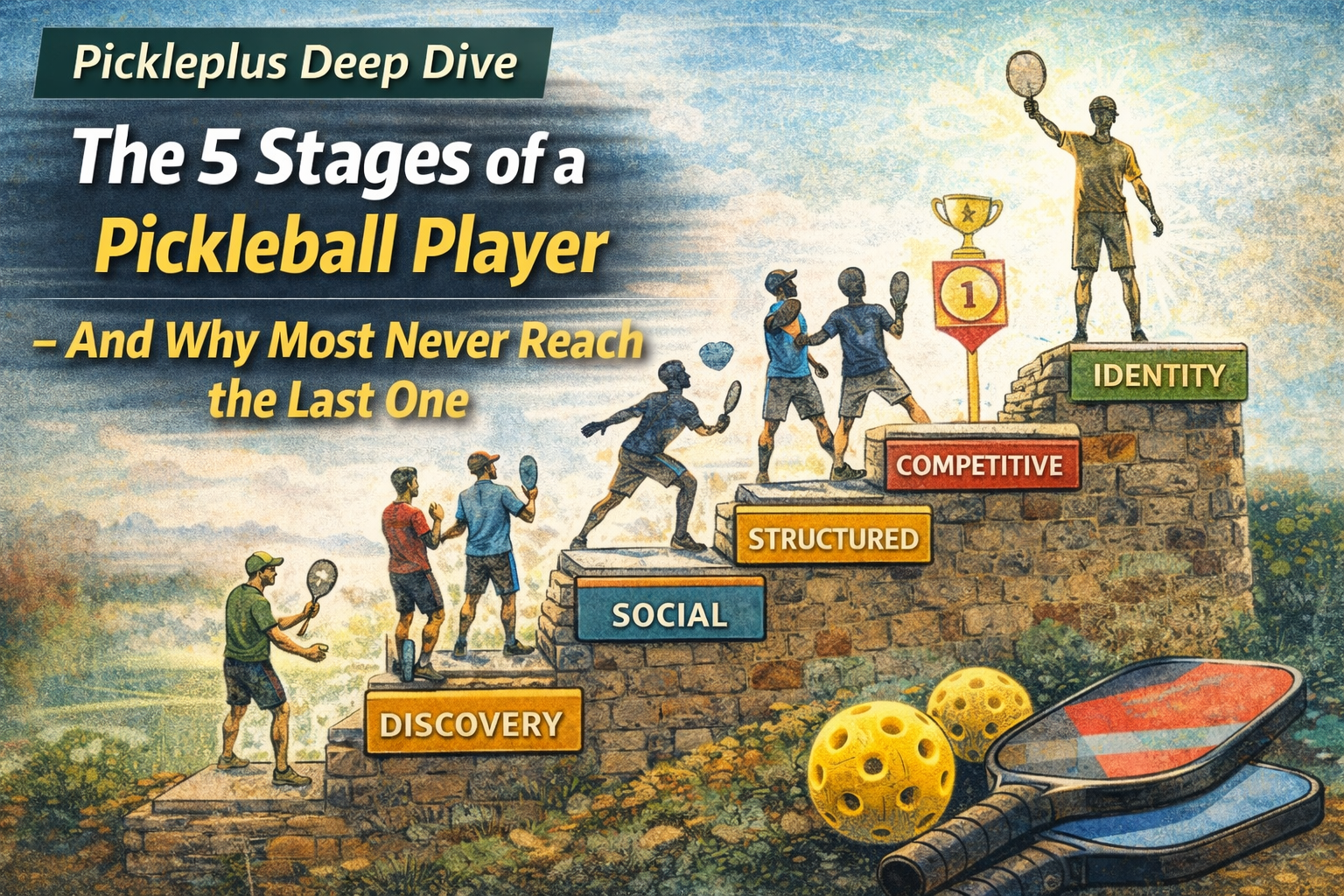
STAGE 1: DISCOVERY PLAYER
Primary driver: Curiosity and fun
Primary risk: Random habits
Discovery players are new to the sport and improve rapidly simply by playing. Everything works because everything is new.
Characteristics:
- Large skill gains in short time
- Little understanding of fundamentals
- Wins and losses feel random
What actually helps at this stage
- Simple exposure
- Low pressure
- Enjoyment
What hurts
- Over-coaching
- Obsessing over gear
- Early comparison to experienced players
Many players mistake this phase for “talent.”
It’s not. It’s novelty.
STAGE 2: SOCIAL PLAYER
Primary driver: Belonging
Primary risk: Stagnation disguised as comfort
Most pickleball players live here.
Social players:
- Have regular groups
- Know basic strategy
- Win consistently within their circle
The game feels good — but progress slows.
Common signs
- “I play all the time but don’t feel better”
- Same partners, same opponents
- Skill capped by group average
Why players stall here
Social validation replaces development pressure. Games optimise for harmony, not growth.
This stage retains players — but does not develop them.
STAGE 3: STRUCTURED PLAYER
Primary driver: Improvement
Primary risk: Overcorrection
This is the first intentional stage.
Structured players seek:
- Coaching
- Drills
- Feedback
- Measurable progress
They begin separating process from outcomes.
What changes
- Training becomes targeted
- Weaknesses are acknowledged
- Losses become information
What often goes wrong
- Too many inputs
- Constant technical changes
- Chasing perfection instead of consistency
Progress accelerates here — if structure is clear.
STAGE 4: COMPETITIVE PLAYER
Primary driver: Performance
Primary risk: Burnout or anxiety
Competitive players care deeply about:
- Results
- Ratings
- Rankings
- External validation
They are committed — but fragile.
Strengths
- Tactical awareness
- Emotional investment
- High training volume
Risks
- Fear of losing status
- Avoiding certain opponents
- Overemphasis on outcomes
Without balance, competition becomes stress instead of growth.
Many players quit mentally at this stage — even if they keep playing.
STAGE 5: IDENTITY PLAYER (THE RAREST STAGE)
Primary driver: Mastery and meaning
Primary risk: Very few
Identity players understand:
- Who they are as players
- Why they play
- What role pickleball has in their life
They:
- Compete when it serves development
- Train with intention
- Contribute to others
- Stay in the sport long-term
Winning matters — but it no longer defines them.
This stage is not about being the best.
It’s about being complete.
WHY MOST PLAYERS NEVER REACH STAGE 5
Because most systems are built to:
- Sort players
- Rank players
- Monetise players
Not to guide them.
Without clear pathways, players:
- Loop between stages
- Plateau unknowingly
- Lose motivation without understanding why
Identity doesn’t emerge by accident.
It emerges through designed progression.
HOW PLAYERS ACTUALLY MOVE BETWEEN STAGES
Progression does not come from:
- Playing more games
- Buying better paddles
- Entering more tournaments
It comes from:
- Visibility of progress
- Correct feedback at the correct time
- Knowing what stage you are in — and what’s next
The mistake is applying Stage 4 intensity to Stage 2 players — or Stage 1 freedom to Stage 3 players.
Mismatch creates frustration.
WHAT THIS MEANS FOR THE FUTURE OF PICKLEBALL
As the sport grows:
- More players will plateau
- More players will churn quietly
- More clubs will struggle with retention
The ecosystems that win long-term will be those that:
- Recognise player stages
- Design experiences around them
- Allow players to evolve without pressure
Pickleball doesn’t need more players.
It needs longer journeys.
FINAL THOUGHT
Most pickleball players don’t quit because they stop loving the game.
They quit because they stop understanding their place in it.
When players know:
- Where they are
- Why they feel stuck
- What comes next
Progress resumes — and so does enjoyment.
Create Your Player Passport
Understand where you are — and what stage comes next.
Create your Pickleplus Player Passport
https://pickleplus.io
Track participation, progression, and your evolving player identity over time.
Find Your Perfect Paddle
Different stages need different tools.
Discover your ideal paddle with PaddleDNA
https://paddledna.pickleplus.io
Match your equipment to your playing style and development stage — not marketing hype.
For Coaches: Coach Smarter, Not Louder
Player stages change how coaching should work.
👉 Use Pointflow AI Coaching Tools
https://pointflow.pickleplus.io
Make progress visible, contextual, and stage-appropriate for every student.
🇸🇬 Compete. Connect. Belong.
Structured competition accelerates stage transitions.
👉 Join the Frenship Cup (Singapore)
📅 28 February 2026
📝 Register here:
https://docs.google.com/forms/d/e/1FAIpQLSeC3UWkUPVJ0i9IbP0uHwLs1yZsMrnT-obEhw9q3iqJbwdaZQ/viewform