

INTRODUCTION
Many pickleball players expect improvement to feel smooth.
They assume better mechanics lead to cleaner execution, which then produces more consistent results. When that sequence breaks down, frustration quickly follows.
In practice, improvement rarely works that way.
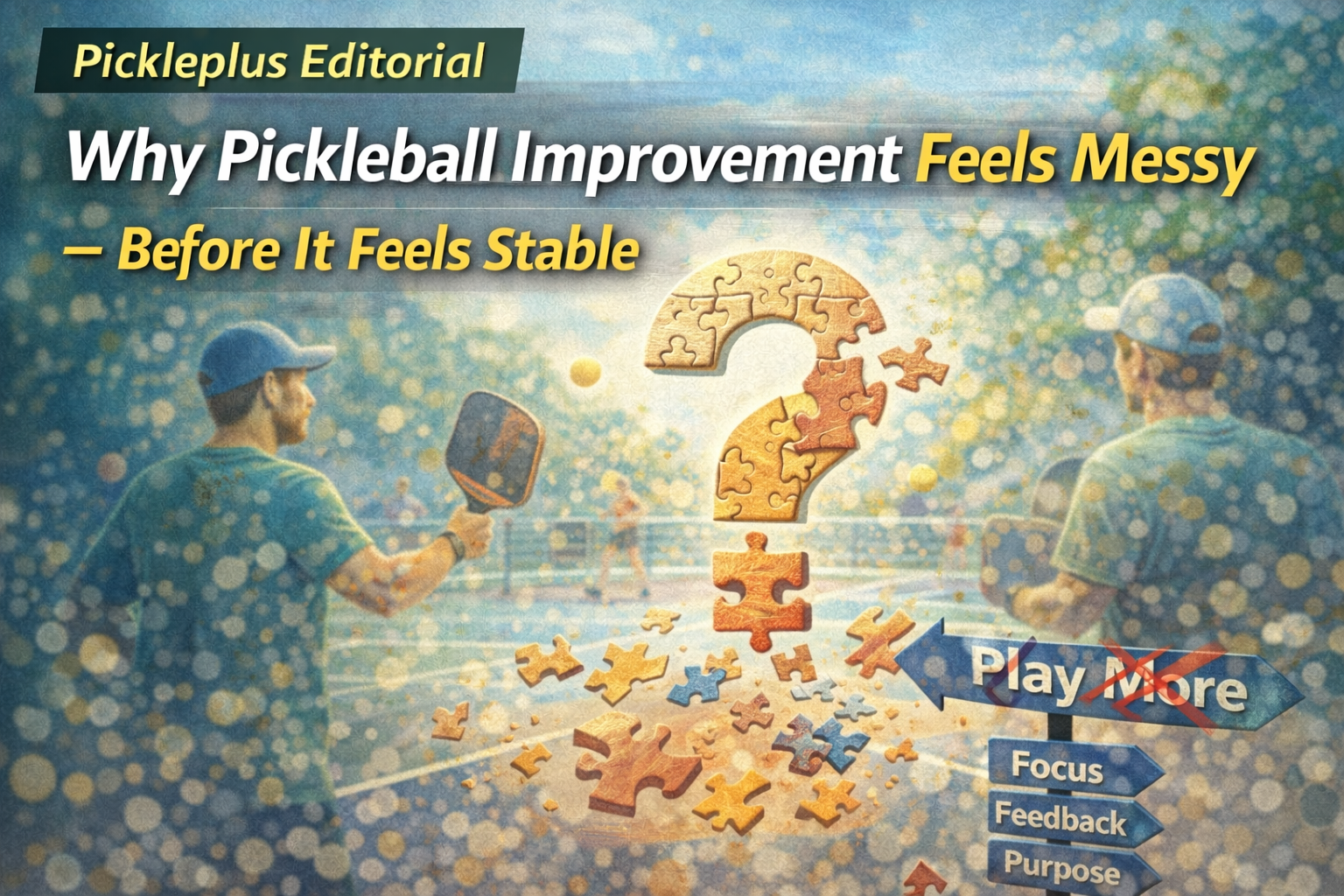
Before skills stabilise, performance usually becomes uneven. Shots fluctuate, confidence wavers, and matches feel less predictable than before. This messy phase catches players off guard, even when they are doing the right work.
Understanding why this happens can prevent unnecessary resets and help progress settle faster.
WHY IMPROVEMENT DISRUPTS BEFORE IT REFINES
Every meaningful improvement replaces an old habit with a new one.
That transition creates instability. The old pattern no longer runs automatically, while the new pattern has not yet integrated fully. During this period, execution feels unreliable, even though understanding has improved.
As a result, players often feel worse precisely because they are changing in the right direction. The game exposes hesitation before it rewards adaptation.
This is not regression.
It is recalibration.
THE COMMON MISINTERPRETATION
Most players interpret inconsistency as a warning sign.
They assume:
- The adjustment is wrong
- The timing is off
- The advice does not apply
Consequently, they abandon the change too early. Unfortunately, this interrupts the learning cycle just as it begins to take hold.
Messy improvement feels uncomfortable because it removes certainty. However, certainty usually belongs to old habits, not better ones.
WHY STABILITY IS A LATE ARRIVAL
Stability does not arrive when players understand what to do.
It arrives when decisions and execution align without conscious effort. That alignment requires repetition under varied conditions, not just clean drills or isolated success.
Until then, players may:
- Make better decisions but miss shots
- Recognise patterns but react late
- Choose higher-quality options inconsistently
These signs indicate progress, even if outcomes lag behind.
THE ROLE OF CONFIDENCE DURING THIS PHASE
Confidence does not drive improvement at this stage.
Confidence follows it.
When players wait to feel confident before committing to changes, they delay stabilisation. In contrast, players who tolerate temporary uncertainty allow the new pattern to settle naturally.
Confidence emerges when the body no longer needs reminders. That moment comes after persistence, not before it.
WHY WEEK-TO-WEEK ASSESSMENTS CAN BE MISLEADING
Short evaluation windows distort perception.
If players judge progress session by session, inconsistency feels alarming. Over longer timeframes, however, trends become clearer. Errors decrease in frequency, recovery improves, and decision quality rises.
Messy improvement only looks chaotic up close. From a distance, it usually forms a clear upward arc.
WHAT TO DO DURING THE MESSY PHASE
Players navigating this stage benefit from restraint more than intensity.
Specifically:
- Maintain one primary focus
- Avoid stacking new adjustments
- Measure progress over weeks, not days
Stability emerges when learning settles, not when pressure increases.
WHY THIS PHASE IS UNAVOIDABLE
There is no clean path from old habits to better ones.
Every player who improves meaningfully passes through a phase where performance feels unreliable. The difference between those who progress and those who stall lies in how they interpret that experience.
Players who understand the mess stay long enough to reach stability.
Players who fight it often return to comfort.
FINAL THOUGHT
If your pickleball feels messier than usual, that does not mean something is wrong.
More often, it means something is changing.
Improvement rarely feels smooth in real time. It feels uncertain, uneven, and occasionally frustrating. Stability arrives later, quietly, once the work has settled.
The players who progress are not those who avoid the mess.
They are the ones who recognise it for what it is.
CONTINUATION PATHS
Players who notice these patterns often want a clearer way to reflect on progress over longer periods rather than relying on session-by-session feelings.
Pickleplus exists to help players contextualise participation, consistency, and development across weeks and months:
https://pickleplus.io
For coaches, recognising when a player is in a destabilisation phase becomes easier when trends are visible over time rather than inferred from individual sessions.
Tools like Pointflow were built to support that longitudinal perspective:
https://pointflow.pickleplus.io
Some players prefer to work through this phase in structured environments that support focus rather than constant comparison.
Events such as the Frenship Cup (Singapore, 28 February 2026) offer that context:
https://docs.google.com/forms/d/e/1FAIpQLSeC3UWkUPVJ0i9IbP0uHwLs1yZsMrnT-obEhw9q3iqJbwdaZQ/viewform