

INTRODUCTION
Most pickleball players believe improvement requires adding more.
More shots.
More movement.
More effort under pressure.
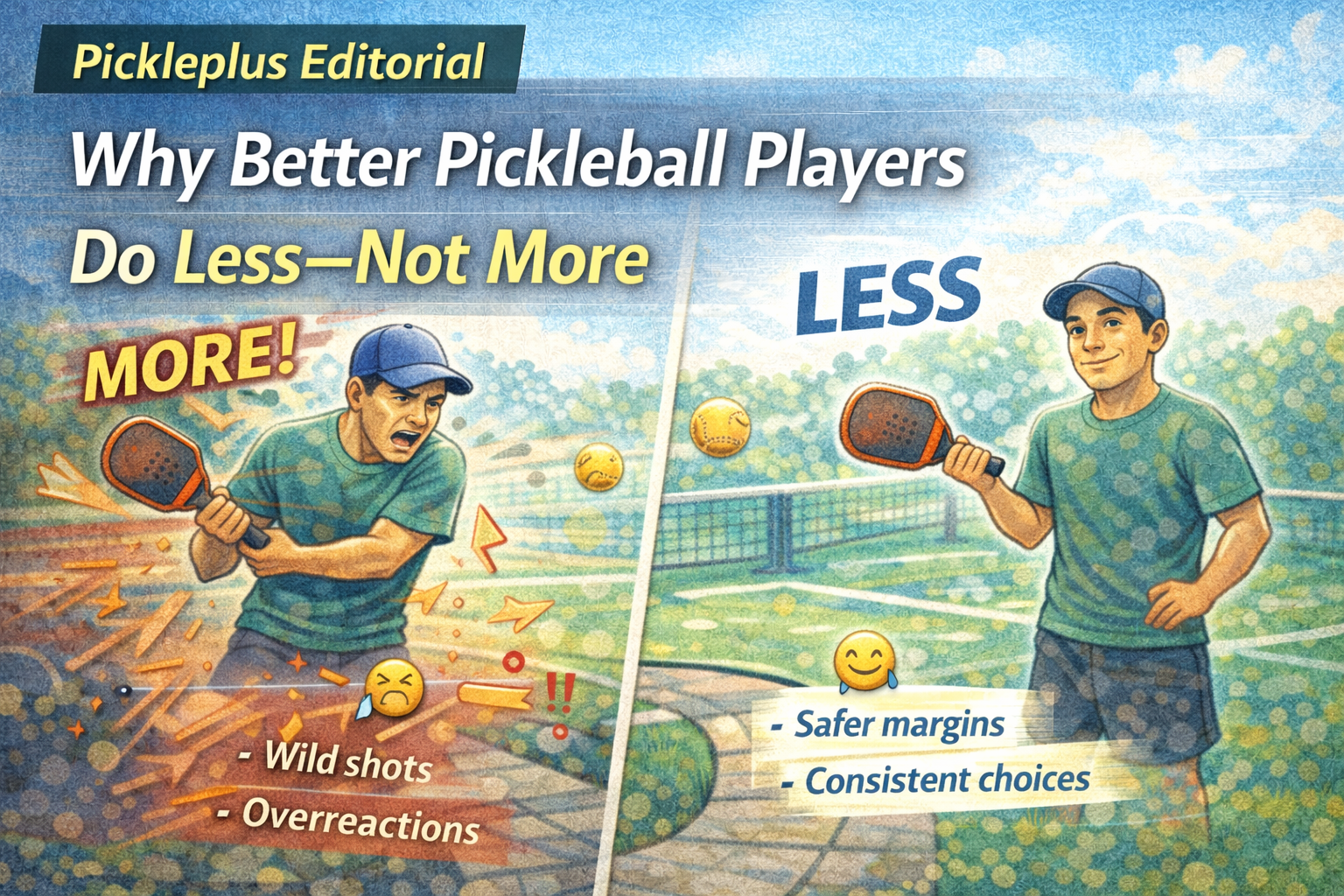
At higher levels, the opposite becomes true.
As players improve, they remove options rather than expand them. They simplify decisions, reduce emotional reactions, and choose margins over risk. What looks passive from the outside is often disciplined restraint.
Better pickleball players do less because they understand more.
WHY “MORE” WORKS EARLY—AND FAILS LATER
Early improvement rewards experimentation.
Beginners gain quickly by trying everything. New shots, aggressive plays, and constant movement build familiarity with the game. During this phase, adding options accelerates learning.
However, once fundamentals stabilise, added complexity becomes noise.
At intermediate levels, players who continue expanding their shot selection increase variability without improving decision quality. Mistakes rise not because technique worsens, but because choices multiply unnecessarily.
DECISION QUALITY BECOMES THE BOTTLENECK
As execution improves, decisions matter more than mechanics.
Better players face similar balls yet choose simpler responses. They select higher-percentage shots, accept neutral positions, and wait for clear advantages. These decisions reduce error without reducing competitiveness.
In contrast, players who chase constant initiative often mistake activity for control.
The difference lies not in ambition, but in judgment.
WHY RESTRAINT CREATES CONSISTENCY
Restraint narrows the decision tree.
When players commit to fewer responses, timing stabilises and confidence grows organically. The body repeats patterns more reliably because the mind interferes less.
Consistency emerges not from perfection, but from predictable choices under pressure.
This is why advanced players appear calmer. They are not less competitive. They simply resist unnecessary decisions.
HOW DOING LESS REDUCES MENTAL FATIGUE
Every decision carries a cognitive cost.
When players attempt too much, mental fatigue accumulates quickly. Focus drops late in games, emotional reactions intensify, and execution suffers. Simplification protects attention and energy across longer sessions.
Doing less allows players to stay present longer.
WHY THIS FEELS COUNTERINTUITIVE
Spectators often equate aggression with skill.
Highlight shots attract attention, while restraint goes unnoticed. As a result, many players believe improvement requires copying visible risk rather than invisible discipline.
In reality, advanced players earn the right to attack by staying patient first. They win more points by avoiding errors than by forcing winners.
WHAT “DOING LESS” ACTUALLY LOOKS LIKE
Doing less does not mean playing passively.
It means:
- Choosing safer margins by default
- Letting rallies develop
- Trusting positioning over forcing outcomes
- Accepting neutral balls without frustration
These behaviours reduce volatility and allow skill to express itself more clearly.
WHY THIS SHIFT MARKS REAL PROGRESS
The move from addition to subtraction signals maturity.
Players who improve long-term eventually ask:
“What can I remove without losing effectiveness?”
That question reshapes practice, play, and competition. It leads to cleaner patterns, calmer matches, and more sustainable progress.
FINAL THOUGHT
Pickleball does not reward constant action.
It rewards clarity, patience, and restraint.
Players who keep adding eventually plateau. Players who learn to subtract regain momentum. Doing less is not a lack of ambition. It is a sign that ambition has found direction.
CONTINUATION PATHS
Players who begin simplifying their decisions often want tools that help them reflect on patterns rather than outcomes alone.
Pickleplus exists to support that longer-term understanding of participation and progression:
https://pickleplus.io
For coaches, decision quality becomes clearer when trends appear across multiple sessions rather than isolated matches.
Tools like Pointflow were designed to surface those patterns over time:
https://pointflow.pickleplus.io
Some players prefer competitive environments that reward patience and consistency rather than constant aggression.
Events such as the Frenship Cup (Singapore, 28 February 2026) provide that context:
https://docs.google.com/forms/d/e/1FAIpQLSeC3UWkUPVJ0i9IbP0uHwLs1yZsMrnT-obEhw9q3iqJbwdaZQ/viewform