

INTRODUCTION
When people talk about pickleball’s growth, the conversation often turns to big names.
Fans follow match results, social clips circulate rapidly, and highlight reels reinforce the idea that elite players represent the future of the sport. Naturally, many recreational and competitive players try to model their own games after what they see.
However, there is a growing disconnect that rarely gets discussed.
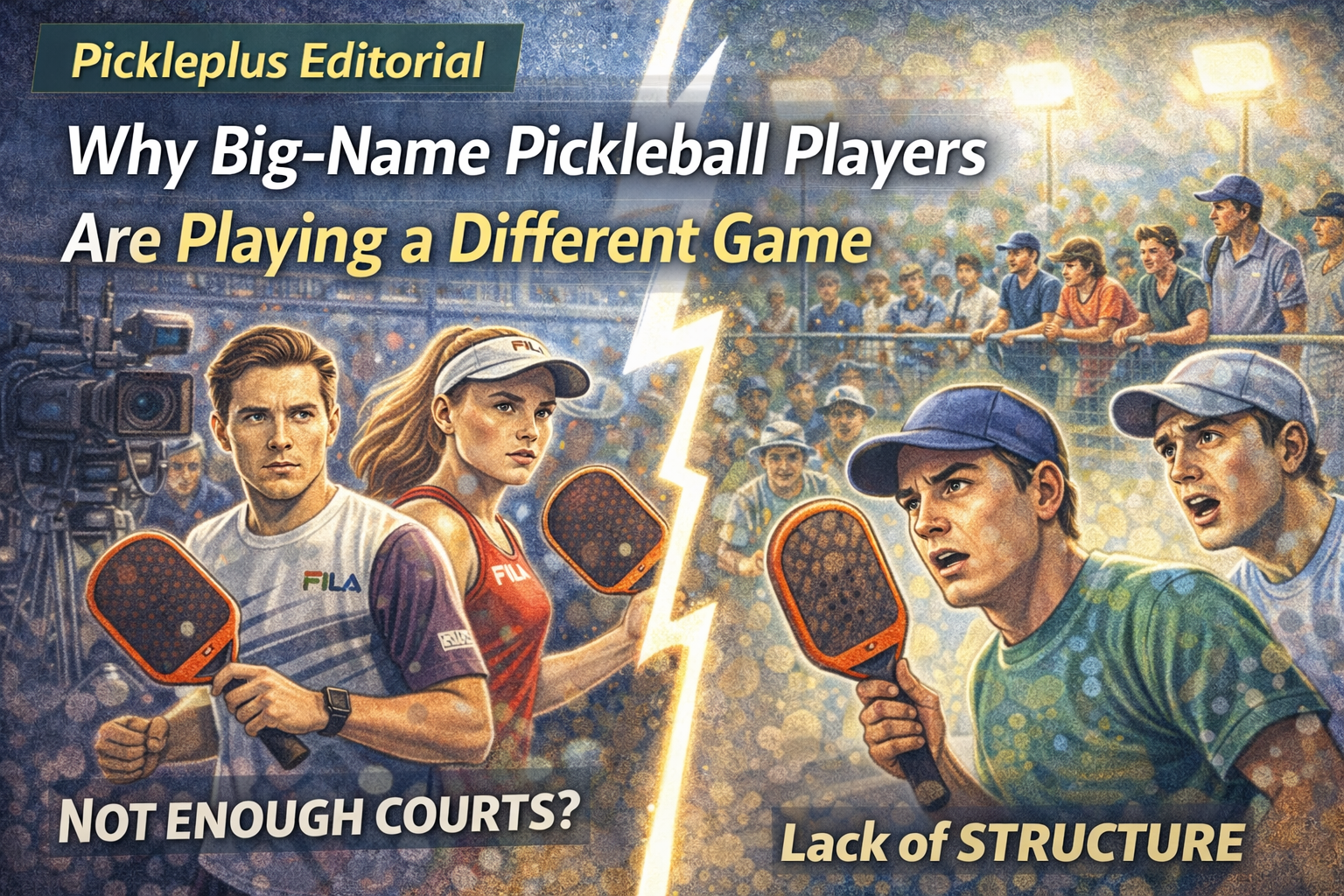
Big-name pickleball players are not simply better versions of everyone else.
They are playing a fundamentally different game.
THE MYTH: ELITE PLAYERS ARE JUST MORE SKILLED
Skill matters, but it is not the full explanation.
Players such as Ben Johns or Anna Leigh Waters do not compete under the same conditions as most players who watch them.
They operate within:
- Stable competitive schedules
- Consistent partner pairings
- Clear ranking incentives
- Professional recovery and preparation routines
These factors shape decision-making just as much as technique.
What looks like confidence is often context.
WHY ELITE MATCHES DON’T TRANSLATE CLEANLY
Professional matches reward different priorities.
At the top level:
- Risk tolerance is calibrated precisely
- Shot selection assumes equal execution on both sides
- Patience is enforced by consequences, not advice
Recreational and intermediate environments rarely mirror these conditions. When players imitate elite aggression without elite context, errors multiply and confidence erodes.
The issue is not imitation.
It is misalignment.
HOW INCENTIVES CHANGE THE GAME
Elite players optimise for outcomes that most players never face.
They play for:
- Rankings and seeding
- Sponsorship visibility
- Long-term competitive positioning
These incentives encourage restraint, percentage play, and emotional control over highlight-driven risk.
In contrast, most non-professionals optimise for:
- Winning today’s games
- Social validation
- Immediate satisfaction
The same shot can be correct in one environment and counterproductive in another.
WHY BIG NAMES APPEAR CALMER UNDER PRESSURE
Calmness is often mistaken for personality.
In reality, it emerges from:
- Predictable competition structures
- Familiar opponents
- Repeated exposure to high-stakes moments
Elite players face pressure regularly enough that it becomes informational rather than emotional. That experience cannot be replicated by watching matches alone.
Pressure tolerance grows through contextual repetition, not inspiration.
THE ROLE OF PARTNERSHIP STABILITY
At the top level, partnerships are intentional.
Training together, understanding tendencies, and sharing decision logic reduce cognitive load. As a result, elite players spend less energy adapting and more energy executing.
Most players rotate partners constantly. That variability forces conservative decisions and limits tactical depth.
Once again, the game itself changes.
WHY THIS CREATES FALSE EXPECTATIONS
When fans consume elite pickleball without context, expectations drift.
Players assume:
- They should attack earlier
- They should tolerate fewer errors
- They should feel confident sooner
When reality does not match those assumptions, frustration follows.
The gap is not effort.
It is environment.
WHAT BIG-NAME PLAYERS ACTUALLY REVEAL ABOUT PICKLEBALL
Elite players demonstrate what pickleball looks like when systems are aligned.
They show:
- What patience produces over time
- How decision quality compounds
- Why structure supports expression
Their success highlights the importance of pathways, not shortcuts.
WHY THIS MATTERS RIGHT NOW
As pickleball grows, visibility concentrates around a small group of stars.
That attention brings energy, but it also risks distorting understanding. Without acknowledging the structural differences elite players operate within, the broader community absorbs unrealistic benchmarks.
Sustainable growth depends on separating aspiration from imitation.
FINAL THOUGHT
Big-name pickleball players are not playing a different game because they are unreachable.
They are playing a different game because their environment allows it.
The lesson is not to copy their shots.
It is to understand the systems that make those shots sensible.
Pickleball’s future depends less on who we watch, and more on how clearly we design the paths that lead there.
CONTINUATION PATHS
Players inspired by elite competition often benefit from understanding where they sit within the broader pickleball ecosystem and what kind of environment best supports their development.
Pickleplus exists to help players contextualise identity, participation, and progression over time:
https://pickleplus.io
For coaches, translating elite patterns into appropriate developmental stages requires longitudinal insight rather than surface imitation.
Tools like Pointflow were built to reveal those patterns across weeks and months:
https://pointflow.pickleplus.io
Some players prefer competitive environments that reflect structured incentives rather than casual rotation.
Events such as the Frenship Cup (Singapore, 28 February 2026) offer that clarity:
https://docs.google.com/forms/d/e/1FAIpQLSeC3UWkUPVJ0i9IbP0uHwLs1yZsMrnT-obEhw9q3iqJbwdaZQ/viewform