
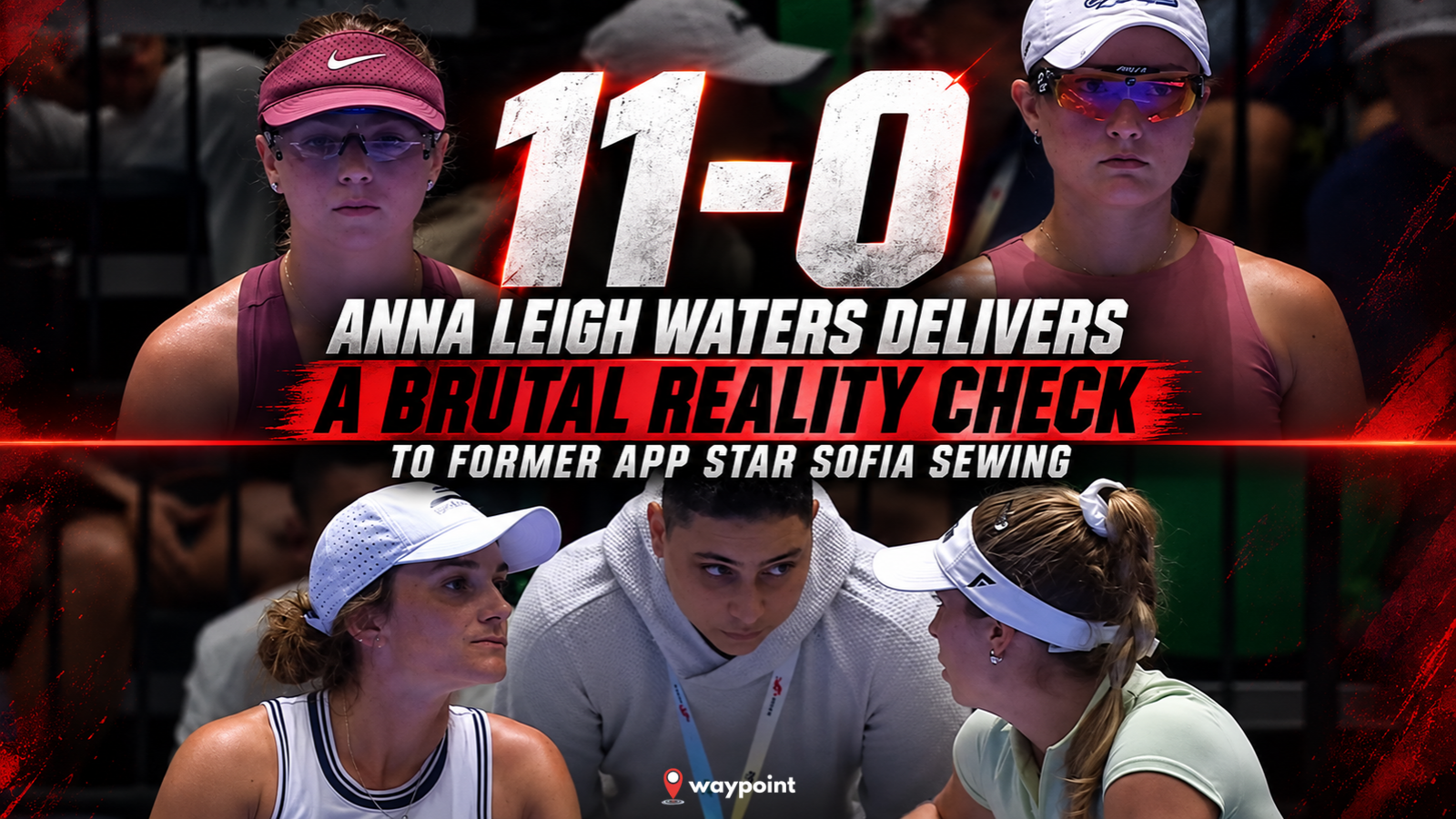

From APP champion to a brutal PPA reality check. Sofia Sewing arrived at the Hong Kong Slam with an impressive résumé and growing expectations. But Anna Leigh Waters and Anna Bright delivered a ruthless 11-4, 11-0 demolition that raises an uncomfortable question: Just how big is the gap between professional pickleball’s rival circuits?
Welcome to the Deep End
Eleven-four. Eleven-zero.
Those were the numbers staring back at Sofia Sewing and Catherine Parenteau after their women’s doubles semifinal against Anna Leigh Waters and Anna Bright at the 2026 Hong Kong Slam.
Four points.
That was all Sewing and Parenteau could manage across two games.
The second game was particularly devastating. They failed to register a single point.
For Sewing, a former APP women’s singles No. 1 who recently committed to joining the PPA Tour, the result was a harsh reminder of just how unforgiving professional pickleball can be at the highest level.
And it happened on one of Asia’s biggest professional pickleball stages.
The Hong Kong Slam, held from October 19-25, 2026, brought together many of the sport’s leading international players for a PPA Asia 1500 event.
With substantial prize money, international attention and some of the biggest names in pickleball competing, the tournament represented another significant milestone in PPA’s expansion across Asia.
For Sewing, however, the semifinal ended in a comprehensive defeat.
But was this simply a bad day on the court?
Or did the result expose something more significant about the competitive landscape between PPA and APP?
From APP Superstar to PPA Challenger
Sofia Sewing is no ordinary professional pickleball player.
Before transitioning towards the PPA Tour, she established herself as one of the APP circuit’s most accomplished competitors.
A former APP women’s singles No. 1, Sewing demonstrated her versatility across multiple disciplines.
Earlier in 2026, she captured a triple crown at the APP Kuala Lumpur Open, winning women’s singles, women’s doubles and mixed doubles.
She followed that achievement with another triple crown at the APP Sacramento Open in May.
Winning three titles at a single tournament is an exceptional achievement at any professional level.
Doing it twice in the same season reinforced Sewing’s reputation as one of APP’s leading stars.
Her decision to move towards the PPA ecosystem consequently attracted attention.
Having signed with Major League Pickleball ahead of the 2026 season, Sewing is scheduled to formally join the PPA Tour on January 1, 2027.
Her transition forms part of a broader movement of players between professional pickleball’s competing organisations.
For fans, this creates an intriguing opportunity.
What happens when champions from one professional circuit begin competing regularly against the established elite of another?
Hong Kong offered an early glimpse.
And the result was brutal.
The 11-0 That Stole the Headlines
The women’s doubles semifinal brought together two formidable partnerships.
On one side stood Anna Leigh Waters and Anna Bright, among the most dominant combinations in professional women’s doubles.
On the other were Sofia Sewing and Catherine Parenteau.
Importantly, Parenteau is herself an established PPA professional with extensive experience competing at the highest level.
This was not an inexperienced pairing making its first appearance on the professional stage.
Yet the match was remarkably one-sided.
Waters and Bright claimed the opening game 11-4.
Then came the second.
Eleven-zero.
A complete shutout.
At the professional level, where players possess exceptional technical abilities and tactical awareness, an 11-0 game is an extraordinary scoreline.
Even dominant players rarely expect to win every point required to close out a game without conceding a single one.
But Waters and Bright did precisely that.
Across the entire semifinal, they conceded just four points.
It was not merely a victory.
It was a demolition.
And for a player arriving from the APP circuit with an impressive record, the timing made the result particularly striking.
Does This Expose a Gap Between APP and PPA?
Here is where the story becomes more interesting than the scoreboard.
For years, professional pickleball has operated through competing organisations, each with its own tournaments, rankings and player populations.
PPA has established itself as home to many of the sport’s most recognisable professional stars.
APP has developed its own competitive ecosystem, producing accomplished players and offering alternative pathways into professional pickleball.
But comparing the competitive standards of two separate circuits has never been straightforward.
A player can dominate one circuit without necessarily facing the same concentration of elite opponents encountered elsewhere.
Similarly, rankings and titles earned within different competitive environments cannot always be compared directly.
Sewing’s achievements on the APP circuit are legitimate and significant.
However, her transition towards the PPA Tour creates a new challenge.
She must now demonstrate that she can compete consistently against players who have spent years establishing themselves at the top of the PPA hierarchy.
The Hong Kong semifinal certainly raised questions.
But it would be misleading to declare that one doubles match proves PPA’s superiority over APP.
Sewing’s APP success included singles competition, while the Hong Kong defeat occurred in women’s doubles.
Her partner, Parenteau, was also an established PPA player.
Furthermore, different partnerships, playing styles and match conditions can influence results considerably.
Nevertheless, the match illustrates a fundamental reality of professional sport.
Being a champion in one competitive environment does not automatically make you a champion in another.
That status must be earned again.
Anna Leigh Waters: A Different Level of Dominance?
While Sewing’s transition provides the controversy, Anna Leigh Waters remains the central figure in the story.
Waters has established herself as the benchmark against which many of the world’s leading female professionals are measured.
Her consistency, attacking ability, court coverage and competitive intensity have made her one of the most formidable athletes in pickleball.
Alongside Anna Bright, she has developed an exceptionally effective women’s doubles partnership.
Their Hong Kong performance demonstrated the scale of that dominance.
After defeating Sewing and Parenteau 11-4, 11-0 in the semifinals, Waters and Bright continued their momentum into the final.
There, they defeated Tyra Hurricane Black and Jorja Johnson 11-6, 11-4 to claim the women’s doubles championship.
Waters then added another title in mixed doubles alongside Ben Johns, defeating Anna Bright and Hayden Patriquin 11-4, 11-3.
Two titles.
Another successful international tournament.
And another reminder of why Waters remains such a difficult opponent to overcome.
The question is no longer simply whether she can win.
It is increasingly about who can consistently challenge her.
But Sewing Had Already Won on the PPA Tour
There is another important detail that makes this story more interesting.
Sewing had already demonstrated that she could succeed against PPA competition.
Shortly before the Hong Kong Slam, she partnered with Catherine Parenteau to capture the women’s doubles title at the Virginia Beach Open.
It was Sewing’s first PPA Tour title.
That achievement should not be overlooked.
It demonstrated that Sewing was capable of adapting to a different competitive environment and succeeding against strong opposition.
Yet just days later, the same partnership suffered an overwhelming defeat against Waters and Bright.
The contrast is revealing.
Winning a professional title is one challenge.
Consistently defeating the strongest players in the world is another.
At the very highest level, the difference between being an excellent professional and being a dominant champion can be substantial.
And in Hong Kong, Waters and Bright made that difference painfully apparent.
A Warning for Players Switching Professional Tours?
As PPA and APP continue expanding their international operations, player movement between their respective circuits is likely to attract increasing attention.
For successful APP players, the PPA ecosystem presents opportunities to compete against some of the most established names in the sport.
But it also introduces new expectations.
Players who have enjoyed considerable success on one circuit may find themselves facing different opponents, tactical approaches and levels of competitive pressure.
The same principle applies to players moving in the opposite direction.
Professional reputation can open doors.
It cannot win matches.
Ultimately, the most meaningful comparison between different professional circuits will come from repeated competition involving their leading players.
One match is insufficient.
One tournament is insufficient.
A credible assessment requires results across multiple events, partnerships and disciplines.
Nevertheless, dramatic encounters such as the Hong Kong semifinal will inevitably fuel discussion.
And with more players moving between circuits, these comparisons are likely to become increasingly common.
The Bigger Story: PPA and APP’s Battle for Asia
The Hong Kong result also comes at an interesting moment for professional pickleball in Asia.
PPA recently announced the first four stops of its 2027 Asian calendar, featuring tournaments in Bangkok, Manila, Penang and Ho Chi Minh City.
APP, meanwhile, has been expanding its own Asian circuit, with events across Malaysia, China, Thailand, Chinese Taipei, India and Vietnam during 2026.
Both organisations recognise Asia’s potential as an important market for professional pickleball.
Both are seeking to attract players, sponsors, tournament partners and audiences.
And both are contributing to the sport’s growing international visibility.
As their presence expands, the movement of players between professional circuits creates an additional dimension to the competition.
Fans will inevitably compare rankings, tournament results and individual performances.
Sponsors may consider the relative visibility and commercial appeal of different organisations.
Aspiring professionals will evaluate which competitive pathways provide the best opportunities for development and career progression.
But the growth of professional pickleball should not become solely a contest between PPA and APP.
The sport’s long-term success depends on the development of a much broader ecosystem.
That includes amateur competitions, junior development, coaching, facilities, grassroots participation and sustainable commercial opportunities.
Professional rivalries generate headlines.
Strong sporting ecosystems create lasting growth.
Is Dominance Good for Professional Pickleball?
There is another question worth considering.
When one athlete becomes overwhelmingly dominant, does that strengthen or weaken the sport’s appeal?
On one hand, exceptional champions attract attention.
They establish standards, inspire younger athletes and provide recognisable personalities around whom professional sports can build their identities.
Waters has undoubtedly contributed to pickleball’s visibility through her achievements.
On the other hand, competitive unpredictability is an important element of spectator entertainment.
Fans enjoy rivalries.
They enjoy underdog victories.
They enjoy watching established champions being challenged by emerging talent.
If results become increasingly predictable, professional organisations must work harder to develop compelling narratives around their competitions.
This is not an argument against dominant athletes.
Excellence should be celebrated.
But the continued development of credible challengers is important for any professional sporting ecosystem.
For players such as Sewing, the opportunity is clear.
They have the chance to challenge an established hierarchy and potentially create the next great professional pickleball rivalry.
That journey may be far more interesting than one difficult defeat.
The Scoreboard Doesn’t Lie. But It Doesn’t Tell the Whole Story.
Anna Leigh Waters and Anna Bright’s 11-4, 11-0 victory over Sofia Sewing and Catherine Parenteau was devastating.
There is no reason to soften the result.
It was a comprehensive defeat against one of the world’s strongest women’s doubles partnerships.
For Sewing, it was a harsh reminder of the challenges involved in establishing herself consistently among PPA’s elite.
For Waters, it was another demonstration of her extraordinary dominance.
But for professional pickleball, the result raises a broader question.
How wide is the competitive gap between the sport’s professional circuits, and what will happen as more of their leading players begin competing against one another?
That question deserves more than one match to answer.
Sewing’s previous achievements remain significant.
Her recent PPA title demonstrates her ability to succeed in a new competitive environment.
And her future performances will provide a clearer picture of where she stands among the world’s best.
But Hong Kong delivered one unmistakable message.
At the highest level of professional pickleball, reputation offers no protection.
Past achievements do not guarantee future results.
And even accomplished champions can find themselves completely overwhelmed.
Eleven-zero.
Sometimes, the scoreboard says everything that needs to be said about a particular match.
The next question is how the defeated player responds.
PPA. APP. One Sport. Millions of Possibilities.
Professional tours compete for titles, talent and attention.
But the future of pickleball belongs to the entire community.
At Waypoint, we’re building a more connected sporting ecosystem where players, organisers, facilities and brands can discover opportunities and grow together.
Because the future of pickleball isn’t just about who wins.
It’s about what we build together.
Be part of the future at waypoint.fan
Waypoint Perspectives
Beyond the Game. Understanding the Industry.
Sources and References
- PPA Tour Asia – Hong Kong Slam 2026 tournament results and official event coverage.
- The Standard (Hong Kong), October 24, 2026 – Anna Leigh Waters and Ben Johns reach Hong Kong Slam finals.
- PPA Tour – Sofia Sewing official player profile and professional tour transition.
- APP Tour – 2026 Kuala Lumpur Open results and 2026 Sacramento Open results.
- PPA Tour – Virginia Beach Open 2026 women’s doubles results.
- PPA Tour Asia – October 2026 announcement of the opening four stops of the 2027 Asian calendar.