

Pickleball has spent years trying to solve one unexpected problem created by its popularity: noise. The familiar pop of paddle against plastic ball may seem harmless on court. But when courts sit close to homes, schools and shared spaces, repeated play can quickly create complaints and conflict.
That challenge led USA Pickleball to introduce its Quiet Category in 2023. The initiative encourages equipment that reduces sound without changing the playing experience too much. Later that year, OWL Sport became the first brand to receive certification for a Quiet Category paddle. At the time, quieter equipment looked like one way to make pickleball easier to accommodate in sound-sensitive communities.
Three years later, OWL has encountered a very different equipment challenge.
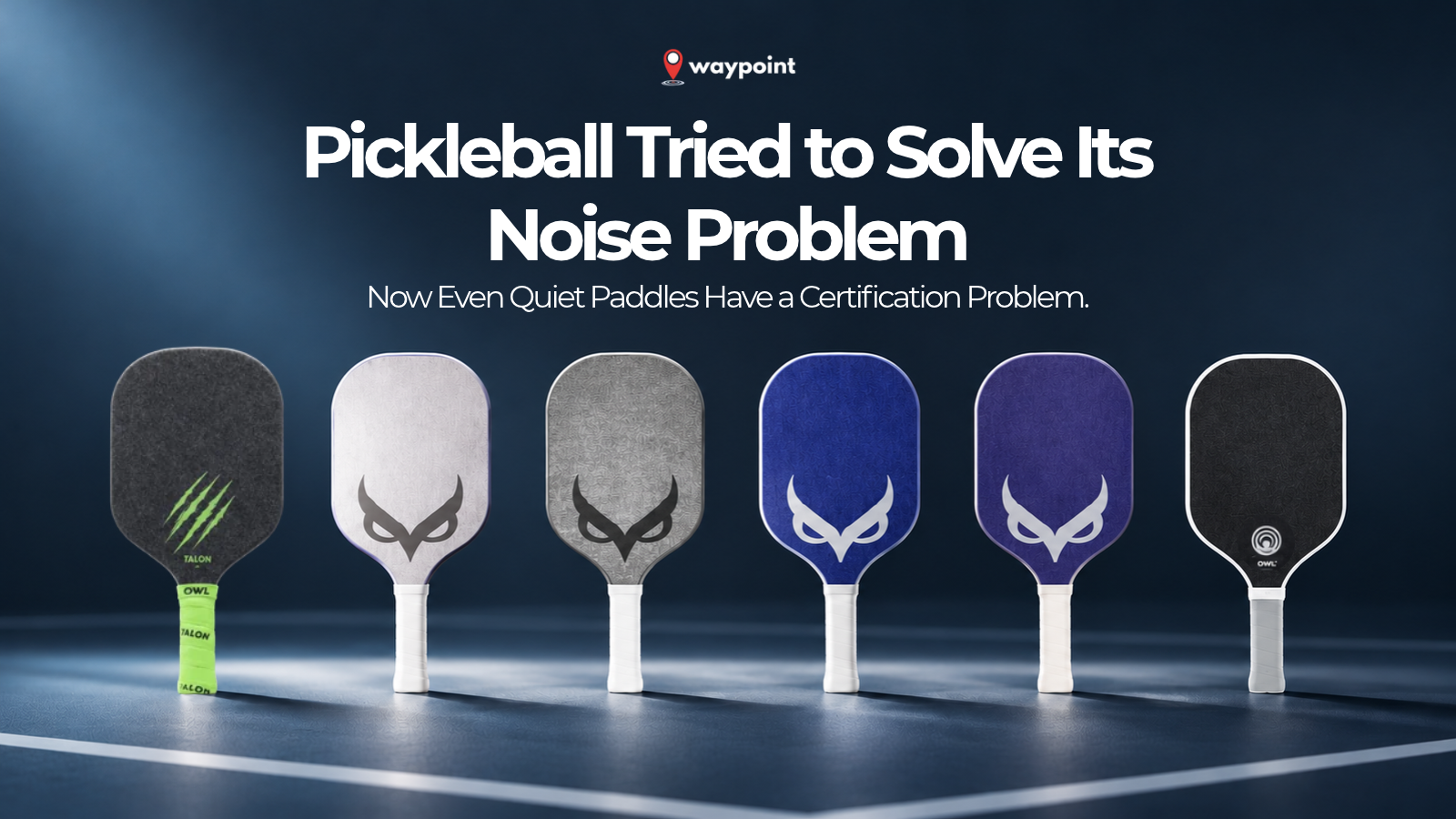
On November 9, 2026, USA Pickleball announced that six OWL Sport models had demonstrated “Degrade to Benefit”. The affected paddles are the Talon X1, CX, CXE, PX, PXE and SILENT STORM. Continued testing found that parts of their performance increased as players used them over time.
Importantly, the issue has nothing to do with the paddles becoming too quiet. USA Pickleball is also not removing them from sanctioned competition immediately. The six models will remain approved through January 31, 2028, before becoming ineligible on February 1.
The decision highlights a much bigger issue in modern pickleball equipment. Certification is no longer only about how a paddle performs when it first reaches the market. Governing bodies now have to consider how that performance changes after months of normal use.
The Noise Solution Has Created a New Engineering Challenge
OWL’s certification issue does not mean quiet paddles have failed. In fact, USA Pickleball acknowledged OWL’s contribution to addressing noise when it announced the transition.
Noise remains a practical challenge for the sport. USA Pickleball still maintains a growing Quiet Category equipment database. It now includes paddles from several manufacturers, along with quieter balls and acoustic products.
The latest testing revealed a different problem.
Modern paddles contain materials that can change through repeated use. Cores may soften, surfaces can wear and internal structures can break in. Those changes do not always reduce performance. Sometimes they can increase it.
USA Pickleball calls this phenomenon Degrade to Benefit, or D2B. A paddle may meet a performance limit during certification, then behave differently after regular play.
That makes equipment regulation more difficult. Certification needs to reflect more than a paddle’s condition on the day it enters a laboratory. Regulators also need confidence that it will remain within the rules as players continue using it.
USA Pickleball made that expectation clear in its November announcement. Its standards aim to keep equipment compliant throughout the useful life of a paddle. The organisation also said OWL is developing updated technology to address the issue.
The goal is therefore not to choose between quieter paddles and compliant paddles. Manufacturers now need to achieve both.
Paddle Testing Is Becoming Much More Sophisticated
The OWL decision comes during a major shift in how USA Pickleball measures paddle performance.
On October 1, 2026, the organisation introduced a new direct Spin Rate Test for newly submitted paddles. Under the updated system, new paddles must measure no higher than 2,100 RPM.
The new test no longer relies mainly on surface measurements as a proxy for spin. Instead, high-speed cameras and automated software measure how quickly the ball rotates after contact.
USA Pickleball says this provides a more direct and repeatable measure of actual performance.
The change reflects what is happening across the paddle industry. Manufacturers now experiment with foam, thermoforming, new core structures and different surface materials. Those technologies can produce more power, spin, stability and control.
As paddle design becomes more advanced, basic measurements can no longer explain everything a product does during play. Regulators therefore need better ways to measure performance directly.
That creates a constant race between innovation and regulation. Manufacturers keep finding new ways to improve equipment. Governing bodies then have to decide where acceptable innovation ends and excessive advantage begins.
For players, the result can feel confusing. Equipment approval is becoming less permanent than many people assume.
OWL Is Not the Only Brand Facing This Problem
The OWL announcement came only one week after another certification decision showed how complicated paddle approval has become.
On November 2, USA Pickleball removed the CPX Hyper+ 14mm and Hyper+ 16mm from its certified list. Market testing found significant differences between the original certification samples and the paddles later sold to consumers. Those differences involved PBCoR and deflection.
Earlier this year, USA Pickleball also removed the Facolos Pro Series Elite X. Further testing found that the production paddle exceeded allowable surface roughness limits. USA Pickleball said the manufacturer acknowledged differences between the production model and the original certification sample.
These situations are not identical to the OWL case. However, together they show how much equipment regulation has changed.
Certification no longer ends when a paddle launches. Governing bodies can sample production units, retest products and examine how equipment behaves after reaching players.
That oversight can help protect competitive fairness. At the same time, it creates more uncertainty for consumers. A player can check that a paddle is approved before buying it, then discover months later that its status has changed.
What Does This Mean for Someone Who Already Owns an OWL?
Current owners of the affected OWL paddles do not need to stop using them immediately.
The Talon X1, CX, CXE, PX, PXE and SILENT STORM remain approved for USA Pickleball-sanctioned competition through January 31, 2028. Their approval ends on February 1.
That distinction matters because equipment discussions often use words such as “banned” or “illegal” too loosely. Losing approval for sanctioned competition does not make a paddle unusable everywhere.
Players can still use the equipment recreationally unless a club, league or organiser sets different rules.
The issue matters most when someone enters a competition that follows a specific approved-equipment list. In that situation, players need to confirm whether their paddle remains eligible under the event’s rules.
OWL owners have plenty of time to prepare because USA Pickleball created a long transition period. It also gives OWL time to develop revised products before the current models lose approval.
That approach could become useful in future cases. When an issue does not require immediate removal, a transition period can protect competitive standards. It also avoids suddenly leaving players with expensive equipment they cannot use at their next tournament.
“Approved” Is Becoming More Complicated Than It Sounds
For most consumers, an approval badge feels straightforward. If a governing body certifies a paddle, many players assume that certification will last as long as the product does.
Modern equipment makes that assumption harder to maintain.
Approval now depends on several things. Production units need to match the original samples, materials must remain within performance limits and testing standards may evolve over time.
From a regulatory perspective, that flexibility is necessary. If new testing shows that equipment no longer meets established limits, a governing body needs the ability to respond.
From a player’s perspective, however, the process needs to stay understandable.
Someone buying a paddle should easily be able to see whether it is currently approved. They should also know whether that approval has a future expiry date and which competitions the decision affects.
Players should not need to understand laboratory terminology or search through technical announcements just to know whether they can use their paddle.
USA Pickleball’s Approved Equipment Database already gives players a central place to check current equipment. Cases like OWL show why checking it before sanctioned competition is becoming increasingly important.
Quiet Paddle Technology Still Has a Role to Play
None of this changes why manufacturers developed quieter paddles in the first place.
Pickleball’s expansion increasingly depends on whether courts can coexist with the communities around them. Strong demand does not automatically prevent resistance when nearby residents experience constant noise.
Quieter equipment offers one possible way to reduce that tension. USA Pickleball’s Quiet Category has expanded well beyond the original OWL paddle. That suggests lower acoustic output has become a meaningful area of product development rather than a short experiment.
The latest decision simply shows that reducing sound is only one part of the engineering challenge.
A quiet paddle also needs predictable performance throughout its usable life. If manufacturers can achieve both, quieter equipment could help open more spaces to pickleball without changing the game completely.
That makes the goal worth pursuing, even if the technology still needs improvement.
The Bigger Issue Is Trust
The most important part of the OWL situation is not simply that six paddles will eventually leave an approved list. Equipment standards will always evolve as the sport develops.
The bigger issue is whether players can trust what an approval means.
Players should be able to buy certified equipment with reasonable confidence in its status. Manufacturers need to produce paddles that remain consistent with the versions they submit for testing. Governing bodies also need to communicate clearly when something changes.
That responsibility becomes more important as equipment gets more advanced.
Regulators need to protect competition without making players feel that equipment rules can change without warning. Manufacturers need enough clarity to design products that remain compliant after months of use. Players need a simple way to understand what they can bring to a tournament.
In the OWL case, the long transition period helps. Players know exactly when the affected models will lose approval, while OWL has time to develop replacements.
That is much easier to manage than discovering a rule change at tournament check-in.
Innovation Does Not End When a Paddle Leaves the Factory
Pickleball’s equipment industry is entering a stage where a product’s lifecycle matters almost as much as its original specifications.
As paddle construction becomes more sophisticated, regulators need to understand how performance changes through normal use. Manufacturers also need to design with those changes in mind.
The latest OWL decision brings those issues together in an unexpected way.
Quiet paddles were created to address one of pickleball’s growing pains. Now their development is exposing another challenge: how to encourage innovation while keeping performance predictable and the rules understandable.
That does not mean the Quiet Category has failed. Instead, it shows what the next generation of quiet equipment needs to improve.
The future of quieter pickleball will depend on more than making less noise. It will also depend on building equipment players can trust from the first game to the last.
Continue Your Journey
Pickleball equipment is changing quickly. Understanding the rules matters just as much as knowing what paddle suits your game.
Waypoint follows the equipment, tournaments, players and developments shaping the sport, helping you make more informed decisions on and off the court.
Our Official Links
Find our website and official social media channels here:
https://linktr.ee/waypoint.fan
Every Journey Starts With a Waypoint.
Sources and References
- USA Pickleball – Statement Regarding OWL Sport
https://usapickleball.org/usap-news/equipment-news/statement-regarding-owl-sport/ - USA Pickleball – Quiet Category Equipment
https://equipment.usapickleball.org/acoustic-equipment/ - USA Pickleball – First Certified Quiet Product: OWL Sport
https://usapickleball.org/usap-news/equipment-news/usa-pickleball-announces-its-first-certified-quiet-product-the-owl-by-owl-sport/ - USA Pickleball – Spin Rate Test Update
https://usapickleball.org/usap-news/equipment-news/update-regarding-the-usa-pickleball-spin-rate-test-and-implementation-timeline/ - USA Pickleball – Approved Equipment Database
https://equipment.usapickleball.org/ - USA Pickleball – CPX Hyper+ Certification Statement
https://usapickleball.org/usap-news/equipment-news/statement-from-usa-pickleball-regarding-the-cpx-hyper-14mm-and-hyper-16mm-paddles/ - USA Pickleball – Facolos Pro Series Elite X Statement
https://usapickleball.org/usap-news/equipment-news/statement-from-usa-pickleball-regarding-the-facolos-pro-series-elite-x-paddle/