
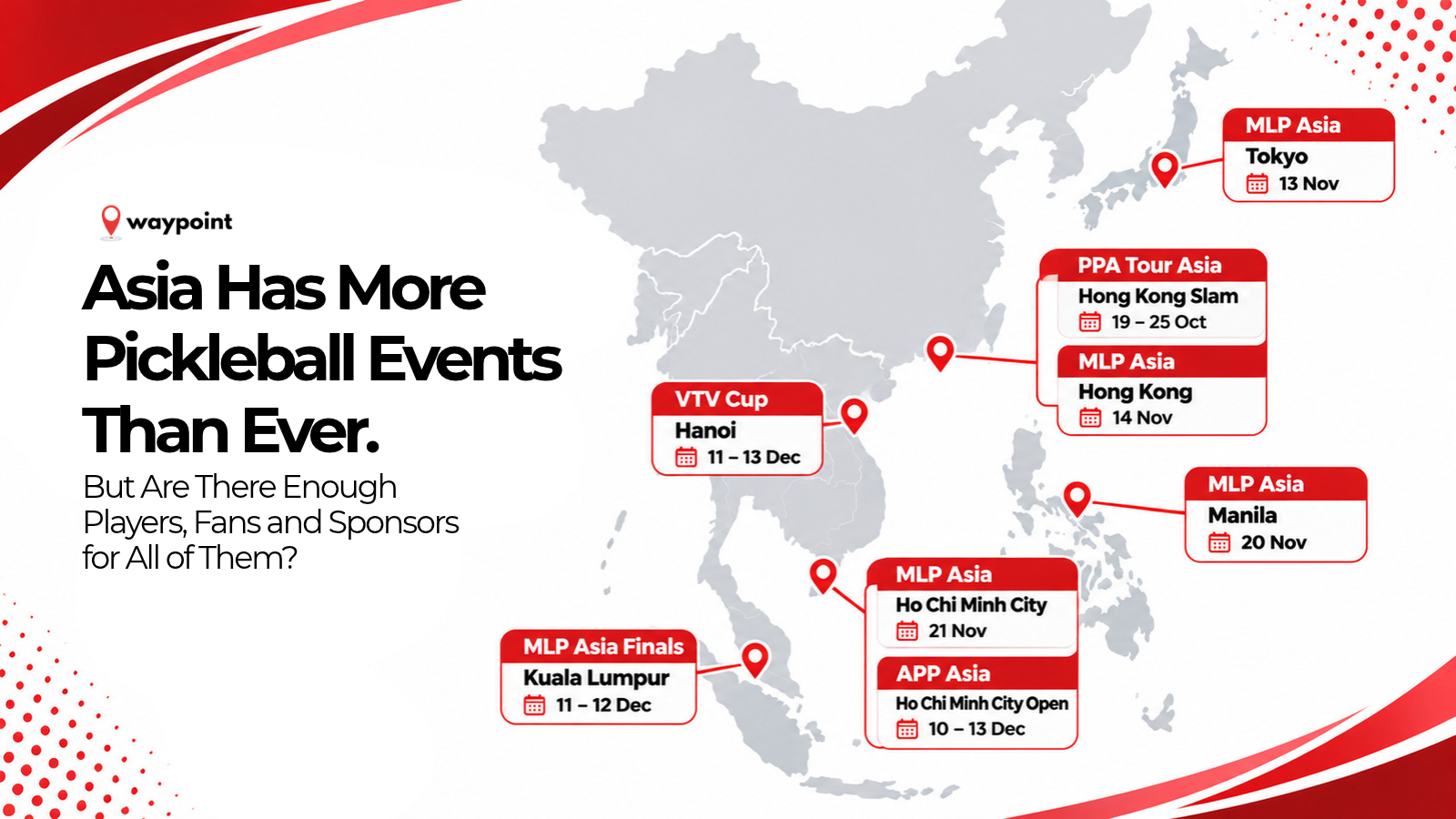

There are less than seven weeks left in 2026, but Asia’s pickleball calendar is nowhere near finished. Major tournaments, a new professional team league and thousands of players are still competing for attention through December. The growth is exciting, but it raises a bigger question: can players, fans and sponsors keep up with all of it?
It is already mid-November, a point when many sporting calendars begin winding down for the year. Pickleball in Asia seems to be doing the opposite.
PPA Tour Asia wrapped its 10-stop 2026 season with the Hong Kong Slam from October 19 to 25, after staging events across seven markets throughout the year.
Less than three weeks later, another major competition was already beginning.
The Year-End Rush Is Already Here
MLP Asia launched its inaugural season on November 13 in Tokyo, followed by Hong Kong on November 14. Manila hosts on November 20, Ho Chi Minh City follows on November 21, and two more regular-season match days take place on November 27 and 28.
The season then moves to Kuala Lumpur, where the top four teams will play the semifinals on December 11 and the championship on December 12.
Even that championship weekend will not have Asia’s pickleball audience to itself.
The APP Asia Ho Chi Minh City Open runs from December 10 to 13, with more than 1,500 players expected across 51 events.
At almost exactly the same time, the VTV Cup takes place in Hanoi from December 11 to 13, with another 700 to 800 competitors expected.
That means one December weekend will feature the first MLP Asia championship in Malaysia and two substantial pickleball events in Vietnam.
For a sport still establishing its professional identity across the region, that is a remarkable amount of competition to fit into the closing weeks of one year. More events create opportunities for players and give brands more reasons to invest. At the same time, the crowded schedule makes the pressure easier to see.
Players can only travel so often, fans can only follow so many matches and sponsors still have to decide which events deserve their budgets.
The question is no longer whether Asia can attract pickleball events. It is whether all of them can grow at the same time.
The Players Are Definitely Showing Up
For now, finding people who want to compete does not appear to be the biggest problem.
The Hang Seng Bank Hong Kong Slam attracted more than 1,000 registered players, including over 650 from Hong Kong. Players submitted more than 2,100 entries across 40 events, with close to 800 entering amateur brackets.
Demand arrived quickly too. Around 280 players registered within the first 30 minutes, and more than 730 had entered within the first 24 hours. The field included players from across Asia as well as the United States, Europe, Australia, New Zealand and Latin America.
That tournament closed PPA Tour Asia’s season in late October, but the wider regional calendar barely slowed down afterwards.
Vietnam may provide the clearest test of how deep competitive demand has become. The APP Asia Ho Chi Minh City Open expects more than 1,500 players from Vietnam and abroad when competition begins on December 10. Its four-day programme includes 51 events and a total prize pool of US$50,000.
One day later, the VTV Cup starts hundreds of kilometres away in Hanoi. Organisers expect 700 to 800 athletes across nine divisions, while Vietnam Television plans 14 live programmes and online coverage of another 32 matches.
Put together, Vietnam could have well over 2,000 players competing across two major events during almost the exact same weekend.
The timing makes those numbers even more interesting. These tournaments are not spread comfortably across a long season. They arrive in mid-December, when athletes may already be balancing travel, work and end-of-year plans.
For participation, at least, the demand looks real.
Playing Pickleball Is Not the Same as Watching It
A packed registration list solves only one part of the equation.
Pickleball has become very good at turning people into players. The harder task is turning those players into fans who regularly watch professionals, follow standings and care about results when they are not personally competing.
Someone can play pickleball three times a week without knowing which professional team won the night before. They can also enter a tournament without following the tour after their own event ends.
Professional sport eventually needs an audience beyond the people holding paddles.
MLP Asia is trying to build that audience through city-based teams. Its six franchises represent China, Hong Kong, Malaysia, the Philippines, Japan and Vietnam, with each team receiving its own home match day during the regular season.
Broad distribution is another part of the strategy. MLP Asia’s broadcast partners include Migu and Youku in China, ViuTVsix in Hong Kong, TBS Sports in Japan, Tonton in Malaysia and TrueVisions in Thailand. Several Vietnamese broadcasters are involved too, while global coverage is available through PPA x MLP Asia’s YouTube channel.
That gives pickleball reach, but reach is not the same as loyalty.
A broadcaster can put a match on screen, but it cannot automatically make someone care which team wins. Building that kind of fandom usually takes recognisable players, rivalries and stories that develop over time.
The first season can create curiosity. Making people come back for another will be harder.
Sponsors Are Showing Up Too
Commercial interest is becoming easier to see.
MLP Asia entered its inaugural season with Franklin Sports as Official Ball Partner, using its new X-44 throughout the competition. JOOLA also joined as the league’s Official Net Partner, with its nets used across the regular season and finals.
The upcoming APP event in Ho Chi Minh City shows an even wider mix of commercial support. Selkirk, Jogarbola, FPT Play, Coolmate and TH True Water are among the companies attached to the event across equipment, apparel, broadcast and beverage partnerships.
PPA Tour Asia has attracted similar investment. Its 2026 season featured official paddle partnerships with Facolos, Franklin and Paddletek, while the Hong Kong finale secured Hang Seng Bank as title sponsor.
That mix matters because commercial involvement is moving beyond companies that only sell pickleball equipment. Banks, broadcasters, apparel companies and consumer brands are entering the ecosystem too.
The harder test comes later. A company may be willing to experiment with pickleball while the sport is growing quickly. Renewing that partnership requires stronger evidence that an event attracts enough viewers, customers and attention.
So the real measure of sponsorship strength may not be who joins during 2026. It may be who is still there in 2027 and 2028.
December Is Where the Calendar Gets Really Interesting
The closing weeks of 2026 may offer an early look at what happens when pickleball events begin competing for attention.
MLP Asia’s semifinals take place in Kuala Lumpur on December 11, followed by the championship on December 12. Meanwhile, APP Asia will already be competing in Ho Chi Minh City from December 10 to 13, while the VTV Cup runs in Hanoi from December 11 to 13.
Those events are not identical, but there will inevitably be some overlap in the people they want to reach. Players, media, sponsors and fans interested in competitive pickleball are being asked to pay attention to several major competitions almost simultaneously.
Vietnam may prove that its player base is deep enough to support two substantial events in separate cities. MLP Asia may also show that a team-league championship can hold attention while tournament pickleball is happening elsewhere.
If all three perform well, that would be a strong sign of how far Asian pickleball has come.
The overlap also shows why scheduling becomes more important as a sport matures. Players have limited travel budgets and time. Broadcasters have limited airtime, while sponsors cannot treat every tournament as the biggest event of the season.
Growth may eventually require coordination, not simply more dates.
Not Every Event Has to Compete for the Same Thing
A crowded calendar is not automatically a bad sign. Different events can serve different purposes.
MLP Asia is trying to build local team identities and fan loyalty. APP combines professional competition with amateur, senior and junior divisions. Meanwhile, PPA Tour Asia uses a tiered structure of Opens, Cups and Slams, with ranking points and prize money increasing at the higher levels.
Those formats can coexist if players and audiences understand why each one matters.
Problems begin when every organiser wants the same elite athletes, sponsors and fans while offering essentially the same experience. If people struggle to understand why one tournament matters more than another, adding more events can eventually create more noise than excitement.
Asia does not necessarily need one organisation to dominate the entire market. Individual events simply need identities strong enough that people deliberately choose them.
There Is Enough Interest to Keep Testing the Market
Organisers are moving quickly because the underlying participation numbers give them a reason to.
A UPA Asia and YouGov study surveyed more than 14,000 respondents across 12 Asian territories. After extrapolating those responses by population, the research estimated that 812 million people had tried pickleball and 282 million played at least once a month.
Those figures are survey estimates rather than a direct count of registered players. That distinction matters, but the research still helps explain why professional organisations see so much potential in the region.
Individual tournaments provide another useful signal. The APP Kuala Lumpur Open in February recorded 1,760 participations and entered the Malaysia Book of Records as the country’s largest participating pickleball tournament at the time.
Months later, Hong Kong drew more than 1,000 registered players for PPA Tour Asia’s season finale.
A large player base gives organisers room to experiment. Many Asian tournaments do not need to rely entirely on ticket-buying spectators because amateur participation can form part of the event itself.
The harder question is what happens after those players finish competing. Do they stay to watch the professionals? Do they follow the next stop? Do they care enough about a player or team to tune in when the competition moves elsewhere?
Those habits will tell us much more about professional pickleball’s long-term strength than registration numbers alone.
So, Are There Enough Players, Fans and Sponsors?
For players, the evidence so far looks encouraging. Strong participation in Malaysia and Hong Kong, combined with the large fields expected in Vietnam, suggests competitive demand already exists across several markets.
There is clearly interest from sponsors too. Equipment companies are being joined by broadcasters, financial brands, apparel companies and other commercial partners.
The biggest unknown is still fans.
Asia now has professional tours, team leagues, broadcast deals, major venues and growing prize money. What it has not yet had much time to build is tradition. There are few long-running rivalries or annual events that audiences have followed for decades.
Those things cannot be created simply by adding another tournament to the calendar. They take time.
2026 Proved Asia Can Host a Lot of Pickleball. 2027 May Show What Actually Lasts.
As the year approaches its end, Asia’s crowded pickleball calendar may be better understood as an experiment than a problem.
Organisers are testing different formats, markets and audiences. Players are getting opportunities that barely existed a few years ago, while brands are learning where their investments might work.
Some events will grow. Others may move dates, change formats or eventually disappear. That is normal when a sport expands this quickly.
What makes the final weeks of 2026 so interesting is that several parts of the ecosystem are now being tested at once. Vietnam will see whether thousands of competitors can support major simultaneous events. MLP Asia will find out whether city-based teams can create genuine loyalty. Sponsors and broadcasters will also begin seeing what kind of audience those investments actually reach.
The question is no longer whether Asia can fill a calendar with pickleball. It clearly can.
The next question is which events become important enough that, when the 2027 calendar arrives, players and fans already know which dates they refuse to miss.
Continue Your Journey
Pickleball in Asia is changing quickly, from new professional tours and team leagues to growing amateur and junior competition.
Waypoint follows the events, players, destinations and developments shaping where the sport goes next.
Our Official Links
Find our website and official social media channels here:
https://linktr.ee/waypoint.fan
Every Journey Starts With a Waypoint.
Sources & References
- PPA Tour Asia – 2026 Tournament Calendar
https://www.ppatour-asia.com/hong-kong-slam-to-close-2026-as-ppa-tour-asia-reveals-calendar/ - PPA Tour Asia – Hong Kong Slam Registration
https://www.ppatour-asia.com/world-wants-in-as-hong-kong-registration-closes/ - MLP Asia – 2026 Regular Season and Finals Schedule
https://mlp-asia.com/from-tokyo-to-the-title-the-road-to-the-mlp-asia-finals/ - MLP Asia – Teams and Home Match Format
https://mlp-asia.com/meet-the-six-teams-draft-sign-up-and-showdown-schedule-revealed/ - MLP Asia – Official Broadcast Partners
https://mlp-asia.com/broadcast/ - MLP Asia – Franklin X-44 Official Ball Partnership
https://mlp-asia.com/franklin-x-44-named-official-ball-of-mlp-asia/ - MLP Asia – JOOLA Official Net Partnership
https://mlp-asia.com/joola-named-official-net-partner-of-mlp-asia/ - APP Asia – Ho Chi Minh City Open 2026
https://theapp.asia/news/app-asia-tour-to-make-vietnam-debut-with-more-than-1500-players-expected/ - Vietnam Television – Pickleball VTV Cup 2026
https://vtv.vn/chinh-thuc-cong-bo-giai-pickleball-vtv-cup-2026-100261109174328527.htm - PPA Tour Asia – Official 2026 Paddle Partners
https://www.ppatour-asia.com/official-2026-paddle-partners-of-ppa-tour-asia-announced/ - APP Asia – Kuala Lumpur Open Participation
https://theapp.asia/news/app-returns-to-malaysia-with-penang-open-2026-this-july/ - UPA Asia & YouGov – State of Play in Asia
https://www.ppatour-asia.com/asia-the-next-frontier-research-released/