
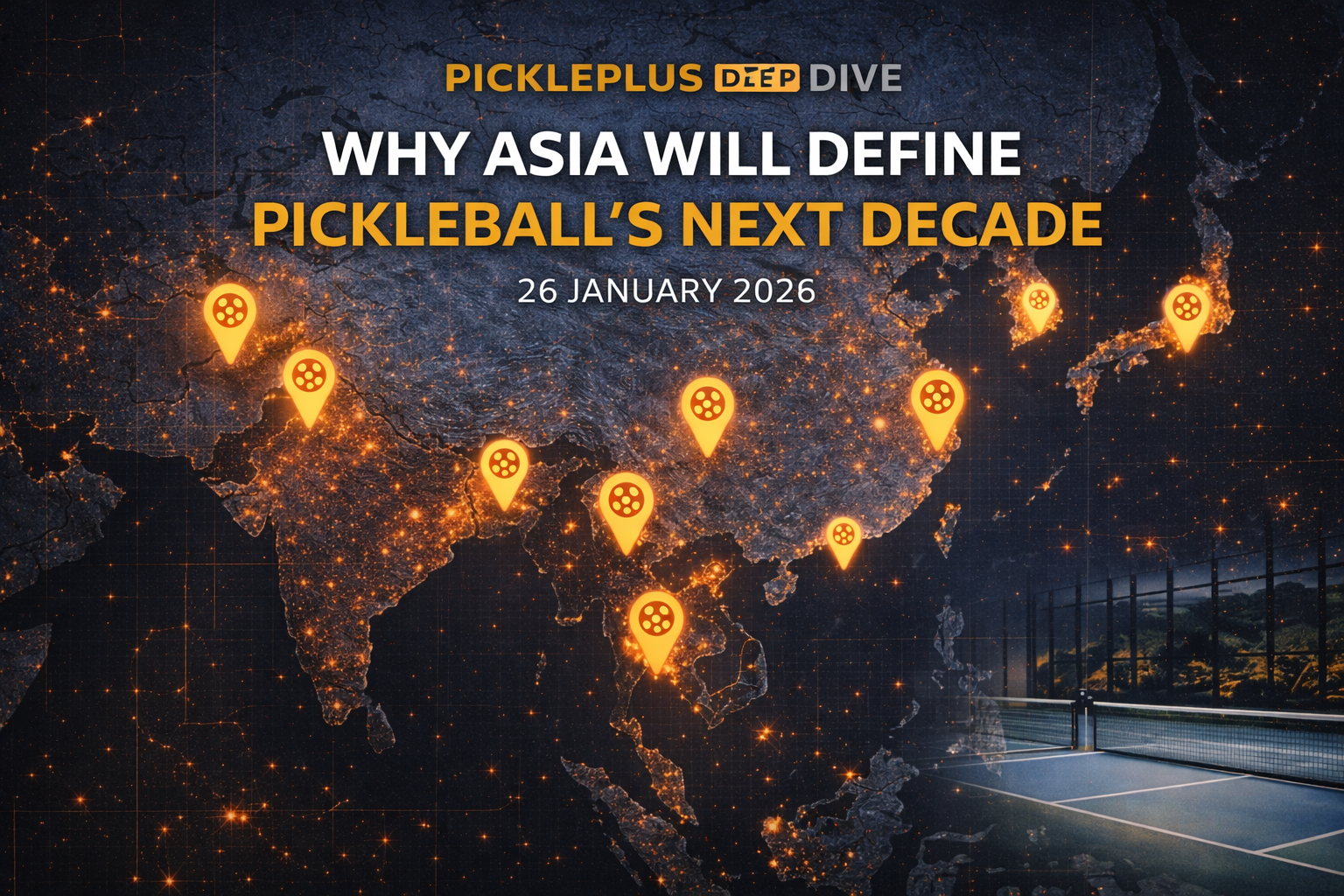

Pickleball’s early growth story belongs to North America, but its next decade will be shaped in Asia. Scale, infrastructure-first thinking, cultural adoption patterns, and long-term capital approach make Asia the decisive battleground for the sport’s future.
The US Built the Spark — Asia Will Build the System
The United States created pickleball’s moment.
Asia will create pickleball’s structure.
This distinction matters.
US growth was driven by:
- Organic adoption
- Retrofitted tennis courts
- Grassroots enthusiasm
- Media amplification after participation exploded
Asia’s growth follows a different logic:
- Planned infrastructure
- Top-down + bottom-up adoption
- Government and institutional involvement
- Long-term ecosystem thinking
This is not slower growth.
It is structural growth.
Why Asia Doesn’t Copy US Sports Models
Asia rarely adopts sports by imitation.
Instead, it adapts them to:
- Population density
- Urban land constraints
- Community-first usage
- Multi-purpose facilities
That’s why:
- Badminton thrived indoors
- Basketball became cultural
- Table tennis scaled nationally
Pickleball fits Asia better than people realise:
- Small footprint
- Low injury risk
- Multi-generational appeal
- Social-first design
Facilities Come First in Asia — Not Media
In the US:
Media attention followed participation.
In Asia:
Participation follows facilities.
This flips the usual narrative.
Asia’s pickleball growth is anchored by:
- Mall-based courts
- Community hubs
- Multi-court indoor facilities
- Structured programmes from day one
Once courts exist, players appear.
Once players appear, ecosystems form.
Asia’s Real Advantage: Density + Repeat Play
Asia’s cities create a unique advantage:
- Short travel distances
- High population density
- Frequent, short play sessions
- Community repetition
This leads to:
- Faster skill progression
- Stronger local communities
- Higher retention rates
- Consistent utilisation
Pickleball benefits disproportionately from repeat play, not occasional tournaments.
China and Southeast Asia Are Not the Same Market
Asia is not one story.
China
- Infrastructure-led
- Commercial operators
- Scalable urban models
- Long-term planning cycles
Southeast Asia
- Community-driven
- Club-based growth
- Strong social component
- Tourism crossover potential
Japan & Korea
- Precision culture
- Technique-driven adoption
- Indoor optimisation
- Structured progression systems
Any platform treating “Asia” as a single market will fail.
Why This Matters for Brands and Operators
For brands:
- Asia is not a licensing extension
- It is a foundational market
- Early movers define standards
For operators:
- Facilities become ecosystem anchors
- Programming > promotion
- Retention beats virality
For media:
- Authority comes from understanding context
- Not copying US headlines
The Quiet Truth: Asia Decides What Pickleball Becomes
If pickleball in Asia becomes:
- A serious community sport → global legitimacy increases
- A lifestyle + wellness activity → cultural longevity
- A structured ecosystem → investment stability
If it becomes none of these, hype fades.
Asia is not following pickleball’s story.
It is writing the next chapter.
What to Watch Next
- Permanent indoor facilities
- National and regional calendars
- Youth and school integration
- Government and institutional support
- Asia-first media narratives
These signals matter more than social views.