


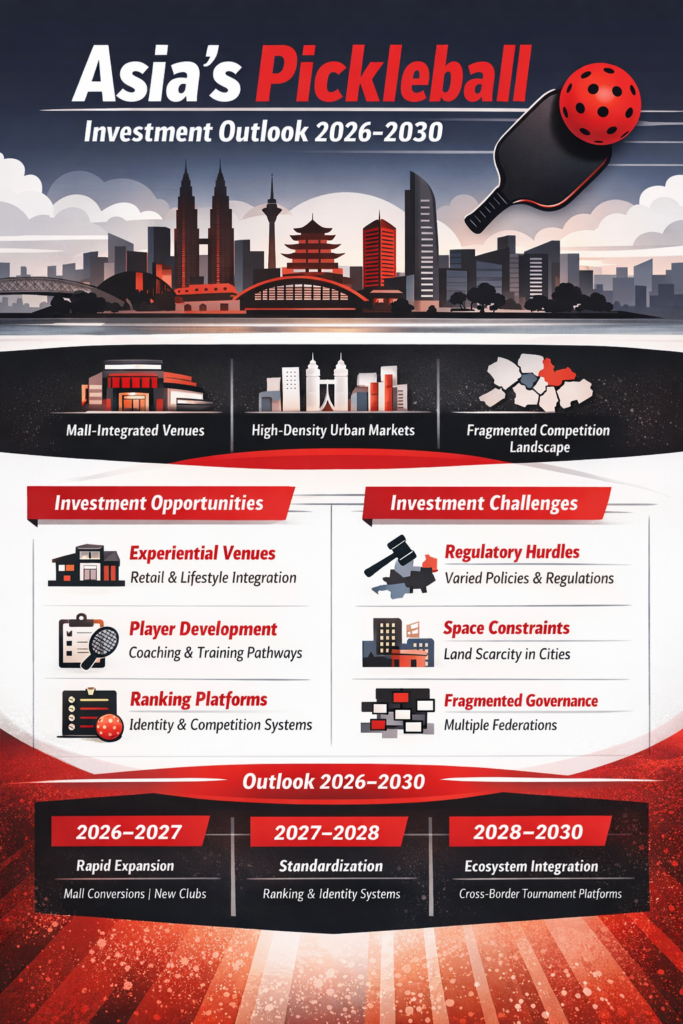
Executive Context
North America validated pickleball’s mass-market demand through measurable participation growth, rapid facility buildout, and the professionalisation of tours. Asia is now entering a different phase: not a mirror replication of the U.S. story, but an early-cycle expansion defined by high-density cities, mall-integrated real estate models, and fragmented competition structures across jurisdictions. For investors and operators, that difference matters more than raw growth narratives.
The central investment question in Asia is therefore not “how fast will it grow,” but “where will scalable and defensible value accrue” as the sport transitions from informal communities to structured ecosystems. In emerging sports markets, value tends to consolidate around either (1) physical infrastructure with strong retention economics, or (2) the systems layer above infrastructure—identity, ranking, competition operations, and measurable development pathways. Asia’s market conditions suggest both layers can be investable, but the sequencing and risk profile differ from the United States.
Industry Data Overview
Asia-wide participation reporting remains fragmented; there is no SFIA-equivalent pan-Asia body producing unified, methodologically consistent annual participation statistics. That limitation is itself a key market feature: low measurement maturity usually correlates with early-stage infrastructure opportunity, but also increases diligence requirements.
Still, credible demand signals exist at the country and city level.
In Singapore, public booking activity has surged. The Financial Times reported that monthly pickleball bookings at ActiveSG facilities increased from fewer than 20 per month historically to nearly 8,000 bookings per month in the first half of 2025, reflecting rapid mainstream adoption pressure in a dense urban environment. A regional report similarly cites Sport Singapore data and describes comparable booking acceleration.
Separately, some industry surveys present very large “awareness” and “ever played” figures across Asia. For example, Pickleball.com published an Asia-focused survey summary claiming hundreds of millions have played at least once and that a subset play monthly. These figures should be treated as survey-derived estimates (not audited participation counts), but they indicate the scale of awareness and trial potential across large populations.
The key takeaway for investors is that Asia is simultaneously (1) under-measured by institutional standards and (2) showing locally verifiable demand pressure in dense markets where court scarcity translates quickly into monetisation opportunities.
Structural Analysis
A. Asia’s real estate advantage is different from North America’s
In many Asian markets, growth is structurally aligned to commercial real estate. High-density cities, mall culture, and mixed-use developments create a pathway where pickleball can scale as an “experiential anchor tenant,” increasing footfall and dwell time for retail operators. This is not merely a facility play; it is a real estate partnership play where utilisation and customer acquisition can be supported by the mall’s existing traffic.
This matters because Asia’s land and lease economics are not comparable to suburban North American builds. Asian operators often win not by out-building competitors on land, but by integrating within high-traffic nodes and packaging pickleball as lifestyle infrastructure: leagues, events, coaching, brand activations, corporate wellness, and premium hospitality.
B. Demand pressure emerges earlier in dense cities—and creates both upside and constraint
Singapore illustrates the “density effect.” Rapid booking growth creates clear willingness-to-pay, but also generates policy friction such as noise complaints and restrictions on where and when the sport can be played. This is not a nuisance detail; it’s an investable signal. Regulatory attention typically arrives when a sport becomes meaningfully mainstream in dense housing environments, and that attention can reshape facility design (acoustic management, court placement, operating hours) and push demand toward premium, better-controlled venues.
The implication is that premium indoor or acoustically managed facilities may have stronger long-term defensibility in high-density Asian cities than informal outdoor conversions near residential areas.
C. Coaching commoditisation will arrive quickly unless structured pathways exist
In early adoption cycles, coaching is scarce and premium-priced. As the market expands, supply increases and coaching becomes price-competitive. Asia is likely to reach this phase faster than many expect because social growth and influencer-based awareness can create rapid supply response.
The investable edge is not “more coaches,” but structured education systems tied to measurable progression, league formats, and competition readiness. Operators that build coaching dependency into their economics face margin fragility; operators that build scalable development systems (curriculum, assessment, performance tracking) can preserve pricing power and retention.
D. Competition fragmentation is a risk—and a platform opportunity
Asia’s tournament and league scene is forming across multiple organisers, venues, and informal communities. Without unified identity and ranking infrastructure, fragmentation increases: players struggle to classify themselves, organisers struggle to seed accurately, and pathways become unclear across cities and countries. Fragmentation is a cost to the ecosystem, but also an opportunity: the first scalable systems layer that normalises identity, results, and rankings can become the infrastructure backbone for cross-border growth.
Comparative Industry Reference
Asia has repeatedly shown that sports and lifestyle concepts scale best when integrated into structured ecosystems rather than isolated venues. Boutique fitness, indoor climbing, badminton academies, and combat sports all demonstrate the same pattern: early growth often looks “community-led,” but the durable value consolidates in brands and systems that operationalise retention (memberships, leagues, progression pathways) and partner with real estate owners who prioritise experiential traffic.
Pickleball is likely to follow the same arc, with an additional twist: because it is unusually accessible, casual participation can scale extremely fast, which increases the need for systems that convert casual trial into retained membership and organised play.
The Pickleplus Perspective
Asia’s pickleball expansion between 2026 and 2030 is likely to be a two-speed market.
2026–2027: Buildout and format experimentation
We expect accelerated venue launches, especially mall-integrated sites and premium indoor concepts in major cities. The winners will not be the fastest builders; they will be the operators who convert traffic into retention through structured leagues, community programming, and clear progression pathways.
2027–2028: Consolidation pressure and standards demand
As supply increases, price competition will rise in undifferentiated venues. This is where standards begin to matter: consistent level classification, credible event formats, and ranking clarity. Markets will start to reward operators who can prove utilisation stability and reduce churn.
2028–2030: Value concentration in systems
Over time, the most defensible value is likely to accrue above the courts: identity, ranking normalisation, competition architecture, and performance intelligence. In a fragmented multi-country region, systems that enable cross-border consistency create network effects and switching costs that individual venues cannot.
Contrarian view
Asia may avoid the worst “oversupply” dynamics seen in certain North American pockets if operators integrate systems earlier—particularly if mall partnerships and premium venue strategies are prioritised over indiscriminate court proliferation.
The structural thesis is that Asia’s upside is not just “more courts,” but “more coherent ecosystems.”
Strategic Framework for Investors and Operators
A practical diligence lens for Asia pickleball investments is a four-layer model:
1) Retention architecture
Does the operator have structured leagues, member programming, progression pathways, and repeatable formats that convert trial into habit?
2) Real estate leverage
Is the venue anchored to traffic and partnerships (malls, mixed-use, hospitality), or reliant on standalone acquisition spend?
3) Standards and competition integrity
Is there credible classification, seeding discipline, match format consistency, and event governance—or is it purely informal?
4) Systems integration
Can identity, results, rankings, and performance measurement scale across multiple venues and cities?
This framework distinguishes hype-driven launches from infrastructure-grade platforms.
Ecosystem Infrastructure Integration
As Asia scales, verified identity and competition records become foundational. The Pickleplus Passport functions as a persistent identity layer connecting participation history, skill classification, and tournament engagement within a unified ecosystem.
For performance intelligence, PointFlow supports measurable development through tracking frameworks that convert training and match play into actionable progression signals.
https://pointflow.pickleplus.io
For scalable competition operations and ranking normalisation, Forge provides tournament architecture designed to reduce fragmentation and enable cross-venue consistency as the ecosystem grows.
Controlled Conclusion
Asia is early-stage, under-measured, and structurally diverse. That is precisely why the opportunity is not simply to replicate North America’s growth story, but to build a more coherent ecosystem earlier in the cycle. The investors and operators who win through 2030 will be those who treat pickleball not as a court-count race, but as an infrastructure problem—retention, standards, identity, and scalable competition systems layered on top of physical venues.
Data Sources Referenced
Financial Times — Singapore pickleball booking surge and policy response
https://www.ft.com/content/e0d8801b-e8f6-4b58-9d2d-814469f358fe
Pickleball News Asia — Singapore demand indicators and SportSG bookings context
https://pickleballnewsasia.com/inside-pickleballs-roaring-but-rocky-rise-in-singapore/
Pickleball.com — Asia survey summary (awareness / ever-played / monthly play estimates; survey-derived)
https://pickleball.com/news/numbers-tell-the-tale-pickleball-has-bright-future-in-asia