
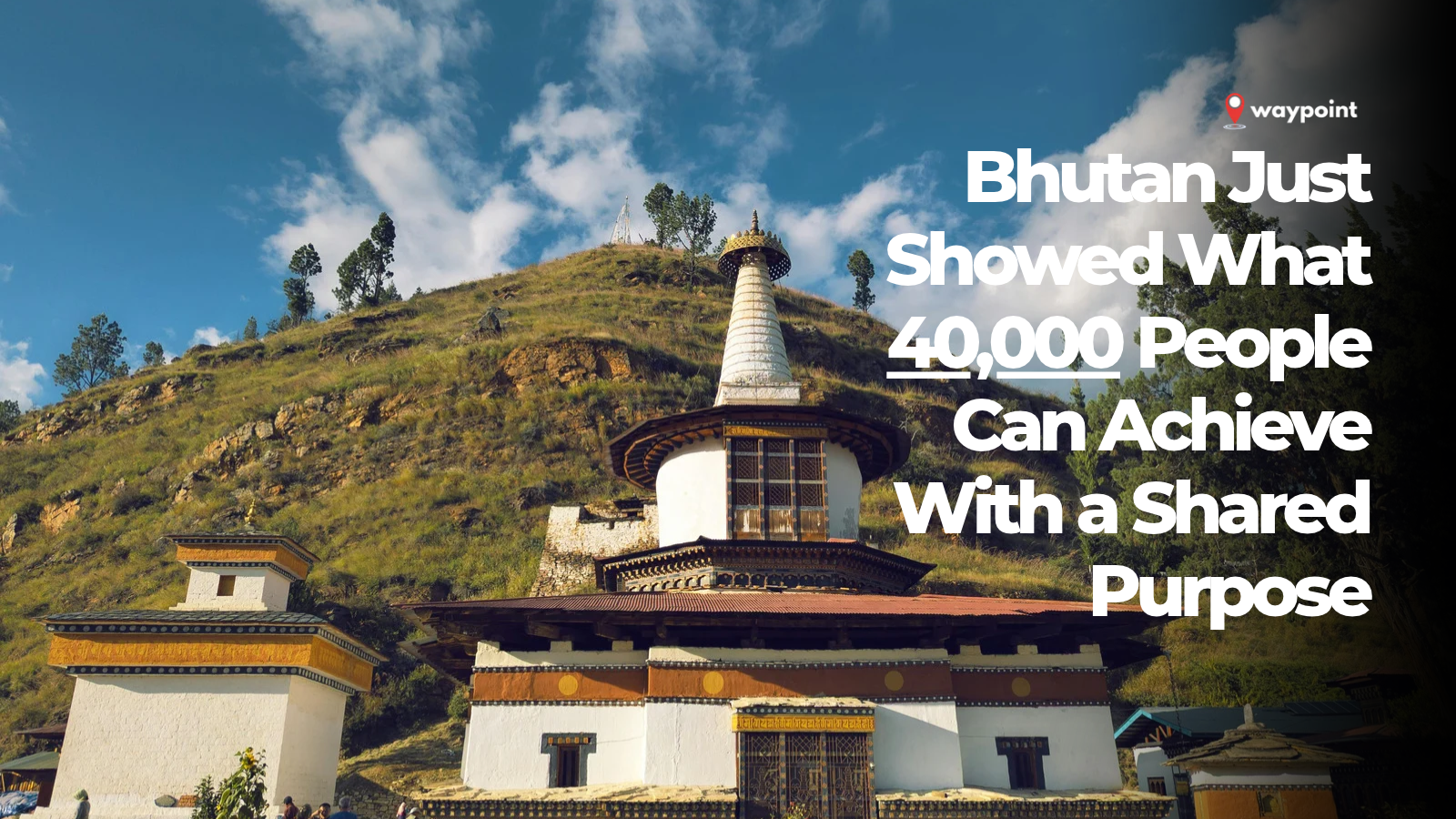

108 sacred monuments. 40,000 volunteers. One extraordinary day. And a powerful lesson about what happens when an entire nation moves with a shared purpose.
Waypoint | 2 November 2026 | Culture, Community & Global Perspectives
A Small Nation Makes a Remarkably Big Statement
On 1 November 2026, something extraordinary happened in the Himalayan kingdom of Bhutan.
Along a 12-kilometre stretch of the Mao Chhu River in southern Bhutan, approximately 40,000 volunteers came together to erect 108 Buddhist stupas in a single day.
Each monument stands approximately 15 metres tall.
Around 200,000 people reportedly gathered to witness the occasion, representing roughly a quarter of Bhutan’s population.
For a country with fewer than 800,000 residents, the scale of participation was remarkable.
But the most interesting part of this story isn’t the number of monuments constructed.
It’s what brought so many people together.
No championship trophy. No multimillion-dollar sporting prize. No celebrity concert.
Instead, thousands of people contributed their time and energy toward something they believed would benefit generations they might never meet.
In a world increasingly defined by individual achievement and commercial incentives, Bhutan offered a different perspective.
What if the greatest measure of progress isn’t what we accumulate individually, but what we build together?
Why 108? The Meaning Behind Bhutan’s Extraordinary Achievement
In Buddhist traditions, the number 108 carries deep spiritual significance.
It appears throughout Buddhist practice, including prayer beads, meditation traditions, and teachings concerning the human experience.
The monuments constructed in Gelephu are known as Jangchub Chortens, or stupas of enlightenment.
They are not simply architectural structures.
They represent spiritual aspirations, collective merit, and the pursuit of wisdom and compassion.
The 108 stupas form part of Project 108, a major spiritual initiative associated with the development of Gelephu Mindfulness City.
The monuments are positioned along the river, creating a symbolic procession across the landscape.
Importantly, the achievement was not the result of spontaneous construction.
Months of preparation, engineering, coordination, and planning preceded the event.
Volunteers assembled the external structures in approximately 12 hours.
It was a demonstration of what disciplined preparation and collective participation can accomplish.
And perhaps that is the first lesson worth remembering.
Extraordinary outcomes rarely happen in a single day. They become visible in a single day because of everything that happened before it.
Gelephu Mindfulness City: Can a Nation Build an Economy Around Happiness?
The 108 stupas are part of something considerably larger.
Gelephu Mindfulness City is an ambitious development initiative envisioned by His Majesty King Jigme Khesar Namgyel Wangchuck.
The project aims to establish a new economic centre in southern Bhutan while remaining grounded in the country’s cultural identity, environmental values, and philosophy of Gross National Happiness.
For decades, Bhutan has attracted international attention for challenging the assumption that economic growth alone determines national success.
Its Gross National Happiness philosophy places importance on broader measures of well-being, including cultural preservation, environmental sustainability, good governance, and quality of life.
Gelephu Mindfulness City represents an attempt to bring these principles into a modern economic development model.
The vision includes opportunities in sustainable industries, education, technology, tourism, financial services, and international investment.
It also addresses a difficult reality.
Bhutan faces significant economic pressures, including youth unemployment and the migration of skilled citizens seeking opportunities overseas.
The challenge is therefore not simply to preserve Bhutan’s traditions.
It is to create an economy in which future generations can thrive without feeling compelled to abandon their homeland.
That ambition deserves attention.
But it also raises an important question.
Can a country successfully combine spiritual values, environmental responsibility, and international commercial competitiveness?
The answer will depend on implementation, investment, employment creation, and long-term economic results.
The construction of 108 stupas does not prove that Gelephu Mindfulness City will succeed economically.
What it demonstrates is something different, but equally important.
The project has already inspired extraordinary collective participation.
And that is a meaningful starting point.
The Real Achievement Wasn’t Construction. It Was Community.
Consider what it takes to mobilise 40,000 volunteers.
People must understand the purpose.
They must believe their participation matters.
They must trust that their contributions form part of something larger.
And perhaps most importantly, they must feel that the project belongs to them.
These principles apply far beyond religious or national initiatives.
They are equally relevant to community organisations, sporting associations, schools, businesses, and grassroots movements.
Too often, organisations confuse attendance with engagement.
A thousand people attending an event does not necessarily mean a thousand people feel connected to its purpose.
Similarly, a community with 10,000 registered members is not necessarily stronger than one with 500 genuinely engaged participants.
Real community is not simply a collection of individuals.
It is a network of people who recognise that their participation contributes to something meaningful.
Bhutan’s Project 108 offers a compelling illustration of this distinction.
The volunteers were not merely spectators watching history unfold.
They were participants helping to create it.
What the Global Sports Industry Can Learn From Bhutan
At first glance, Buddhist stupas and sporting communities might seem unrelated.
But both depend on something fundamental: human participation.
Sport has an extraordinary ability to bring people together across generations, nationalities, cultures, and economic backgrounds.
Yet the modern sports industry increasingly measures success through commercial indicators.
How many tickets were sold?
How much sponsorship revenue was generated?
How many followers did the event attract?
How much did participants spend?
These measurements are important for financial sustainability.
But they do not tell the whole story.
A successful sporting ecosystem should also ask different questions.
Did participants develop meaningful relationships?
Did young people discover opportunities?
Did the event strengthen its local community?
Did volunteers gain experience and confidence?
Did the programme create something that will continue after the event ends?
And perhaps most importantly, did people leave feeling that they belonged?
Bhutan’s extraordinary mobilisation reminds us that participation itself can be one of the most valuable outcomes.
The sporting world would benefit from remembering that.
Beyond Events: Building Communities That Last
There is another important distinction between organising an event and building a movement.
Events have starting times and finishing times.
Movements create continuity.
A tournament might last three days.
A community can last decades.
A festival might attract thousands of visitors.
A meaningful programme can transform the opportunities available to future generations.
The challenge is connecting individual experiences into something sustainable.
This is particularly relevant in emerging sporting markets, where enthusiasm can grow faster than the infrastructure required to support it.
Facilities are constructed.
Tournaments are launched.
Communities appear.
But without continuity, coordination, and long-term engagement, much of that initial momentum can disappear.
Sustainable development requires more than infrastructure.
It requires pathways for participation, learning, leadership, and continued involvement.
Bhutan’s Project 108 demonstrates the potential of a shared vision to bring people together.
The next challenge, for Bhutan and for any organisation building a community, is sustaining that participation beyond a single extraordinary moment.
Why This Matters to Waypoint
At Waypoint, we believe that participation should be the beginning of a journey, not the end of a transaction.
Whether someone joins a sporting event, learns a new skill, volunteers at a community programme, or helps organise a tournament, that experience can become part of something larger.
The goal is not simply to record participation.
It is to create meaningful connections between people, programmes, opportunities, and communities.
This philosophy shapes how we approach the development of sporting ecosystems.
A player should be able to progress from a first experience to structured learning, community involvement, competition, and potentially leadership.
A coach should have opportunities to develop beyond individual lessons.
A facility should become more than a collection of courts.
And an event should contribute to a community that continues growing long after the final participant has gone home.
Technology can help make these connections possible.
But technology alone cannot create purpose.
That must come from people.
Waypoint exists to help communities turn participation into lasting journeys.
Explore the platform at waypoint.fan.
Bhutan and the Future of Purpose-Driven Development
Bhutan’s approach offers an important perspective for countries and organisations seeking to balance economic development with social well-being.
It challenges the assumption that progress must always be defined by scale, speed, or financial returns.
But purpose and profitability do not have to be opposing forces.
A sustainable initiative needs resources.
A community needs infrastructure.
An ambitious national development project needs investment.
The more interesting question is whether economic activity can be designed to support broader human objectives rather than displace them.
Gelephu Mindfulness City is an ambitious attempt to explore that possibility.
Its ultimate success remains uncertain.
Large-scale developments face complex challenges involving financing, infrastructure, governance, environmental protection, and long-term economic viability.
But the events of 1 November have already demonstrated something worth recognising.
When people believe in a common purpose, they can achieve extraordinary things together.
The Next Generation Should Inherit More Than Buildings
The 108 stupas will stand as physical monuments to a remarkable collective achievement.
But their greatest legacy may not be architectural.
It may be the example they set for future generations.
Thousands of people chose to contribute to something larger than themselves.
They demonstrated that community participation can exist beyond personal reward.
And they showed how cultural identity can become a source of collective strength rather than an obstacle to modern development.
For the next generation of Bhutanese citizens, that may prove to be a particularly meaningful lesson.
A nation does not become stronger simply because it constructs more buildings.
It becomes stronger when its people believe they have a meaningful role in shaping its future.
The same principle applies to sporting communities, educational institutions, businesses, and societies everywhere.
The Waypoint Perspective: Every Journey Begins With Participation
The story of Bhutan’s 108 stupas is ultimately a story about people.
People who believed.
People who participated.
People who contributed.
And people who came together to create something that none of them could have accomplished alone.
That is the foundation of every meaningful community.
At Waypoint, we see sport as one of the most accessible ways to create those connections.
A single game can introduce strangers.
A coaching programme can develop confidence.
A tournament can bring communities together.
And a well-designed sporting ecosystem can create opportunities that extend far beyond the court.
But those outcomes require more than simply organising activities.
They require intention, continuity, and a willingness to invest in people.
Bhutan has offered the world a remarkable reminder of what collective purpose can accomplish.
The challenge for the rest of us is deciding what we want to build together.
Because the most meaningful achievements are rarely the ones we accomplish alone.
Build Something Meaningful With Waypoint
For Players and Communities
Your sporting journey should be more than a series of games.
Discover opportunities to participate, learn, compete, and connect through Waypoint.
For Coaches, Clubs and Facilities
Build programmes that create lasting engagement rather than one-off participation.
Explore how Waypoint connects coaching, community activities, events, and facility operations.
For Event Organisers and Community Leaders
Turn your next event into the beginning of a longer journey.
Waypoint helps connect registration, participation, competition, and ongoing community development within a shared digital ecosystem.
For Brands and Partners
Support sporting initiatives that create meaningful participation and long-term community value.
Explore opportunities to collaborate with Waypoint in developing connected sporting ecosystems across different markets.
Discover Waypoint: waypoint.fan
Every journey begins somewhere. Make yours count.
Sources and References
- Gelephu Mindfulness City – Project 108 Official Website
Supports the 1 November 2026 event, 108 Jangchub Chortens, approximately 40,000 volunteers, the tradition of zhābto, and Project 108’s connection to Gelephu Mindfulness City.
https://108.gmc.bt/ - Associated Press – Thousands of Volunteers Build 108 Stupas in Bhutan
Supports the construction of the external structures in roughly 12 hours, approximately 40,000 volunteers, around 200,000 attendees, the significance of the Jangchub Chortens, and the wider goals of Gelephu Mindfulness City.
https://apnews.com/article/385a0eadc9a8d391f726b24957f9d394 - Gelephu Mindfulness City – Official Website
Supports the vision for Gelephu Mindfulness City as a new economic centre combining Bhutanese values, sustainability, spirituality, technology, and economic development.
https://www.gmc.bt/ - Royal Bhutanese Embassy – Gross National Happiness
Supports the explanation of Bhutan’s Gross National Happiness philosophy and its focus on sustainable socioeconomic development, cultural preservation, environmental protection, and good governance.
https://www.mfa.gov.bt/rbedelhi/bhutan-at-glance/gross-national-happiness/ - World Bank – Bhutan Overview
Supports the discussion of Bhutan’s economic and employment challenges, including youth unemployment and the migration of skilled Bhutanese seeking opportunities overseas.
https://www.worldbank.org/ext/en/country/bhutan