
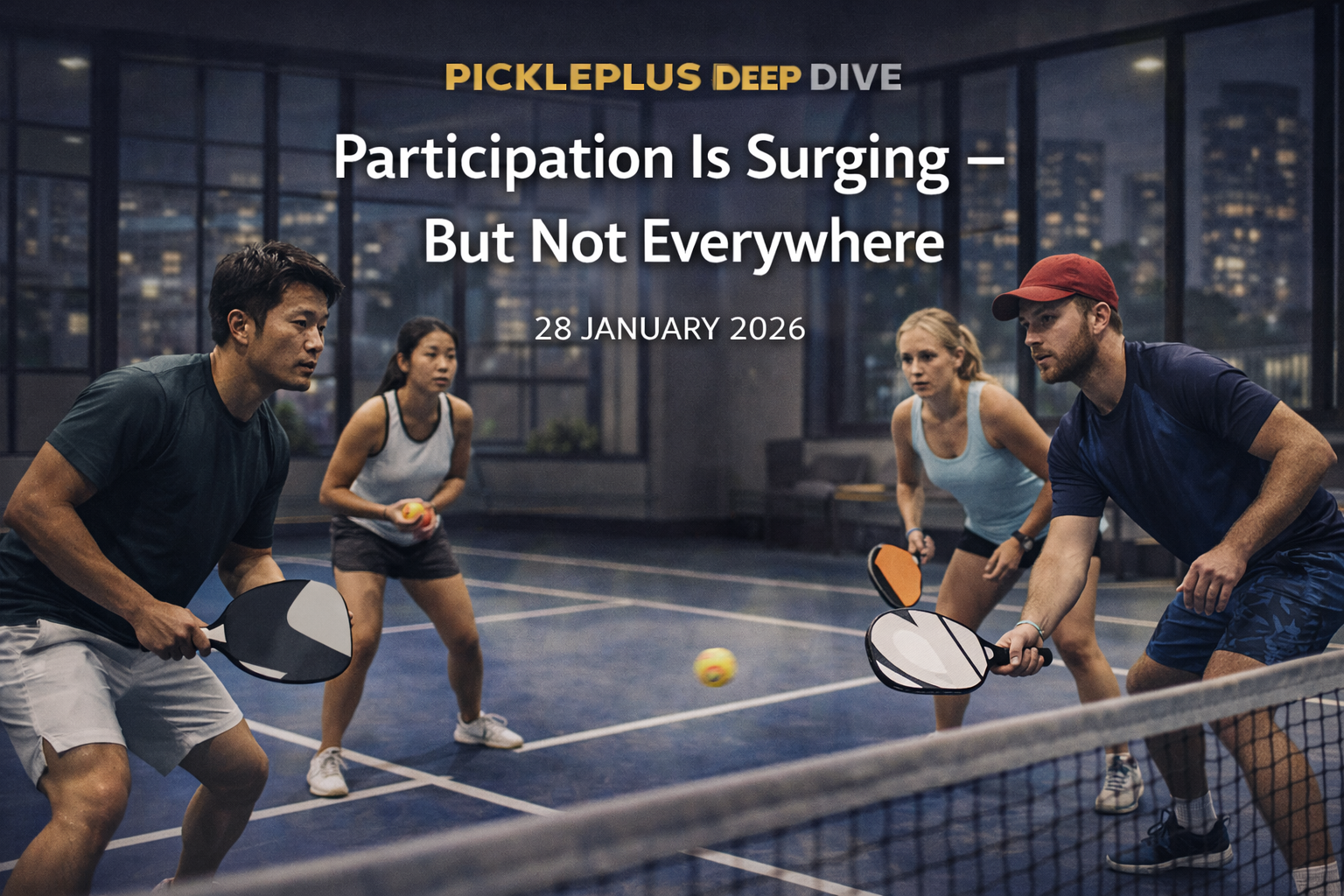

Pickleball participation is undeniably rising in 2026 — but the growth is uneven. While some regions and player segments are accelerating, others are plateauing. Understanding where growth concentrates — and why — reveals what will sustain the sport long term.
Growth Is Real — But It’s Not Uniform
Recent data confirms what players already feel:
- More people are discovering pickleball
- Entry barriers remain low
- First-time participation continues to rise
However, this headline hides an important truth:
Not all markets — or players — are growing at the same pace.
Growth is clustered, not universal.
Where Growth Is Accelerating
Pickleball participation is strongest in areas with:
- Indoor facilities
- Programmed play
- Reliable court access
- Social and league structures
These environments encourage:
- Repeat play
- Skill progression
- Community formation
Growth here is compounding, not just additive.
Where Growth Is Slowing
In contrast, participation is flattening in areas that rely on:
- Temporary outdoor courts
- Shared-use scheduling
- Unmanaged free play
- Inconsistent access
In these markets:
- New players try the sport
- But struggle to continue
- Drop-off increases after initial exposure
Interest exists — retention does not.
Urban vs Suburban: A Key Divide
Suburban and lower-density regions often show:
- Easier court conversion
- Fewer noise conflicts
- More flexible scheduling
Dense cities face:
- Space constraints
- Regulatory friction
- Competition from other sports
This explains why participation growth appears stronger on paper than it feels on the ground in major cities.
Asia’s Growth Looks Different — On Purpose
In much of Asia:
- Participation numbers grow slower initially
- But retention is stronger
- And access is more controlled
Asia’s growth model prioritises:
- Indoor venues
- Paid but predictable access
- Structured sessions
This results in fewer casual drop-ins — but more committed players.
Why Facility Access Explains the Gap
The common denominator across uneven growth:
Access consistency
Where players can:
- Book courts easily
- Play year-round
- Join programmes or leagues
Participation deepens.
Where access is uncertain:
- Players disengage
- Growth stalls
- Communities fragment
Facilities don’t just enable growth —
they shape its quality.
What the Numbers Don’t Show (Yet)
Headline participation data often counts:
- Sign-ups
- First-time plays
- App registrations
It does not always capture:
- Frequency of play
- Long-term retention
- Community attachment
The next phase of pickleball analysis will focus less on how many
and more on how often.
What to Watch Next
- Indoor vs outdoor participation split
- Repeat play metrics
- Retention beyond 90 days
- Programme and league growth
- Urban facility expansion
These signals will matter more than raw participation totals.
Remember:
“Pickleball is growing — but where it grows best tells the real story.”
Continue Your Pickleball Journey
https://pickleplus.io
https://pointflow.pickleplus.io
🏓 Join the Frenship Cup (Singapore)
Sign up for the Frenship Cup, taking place on 28 February 2026.
https://docs.google.com/forms/d/e/1FAIpQLSeC3UWkUPVJ0i9IbP0uHwLs1yZsMrnT-obEhw9q3iqJbwdaZQ/viewform