
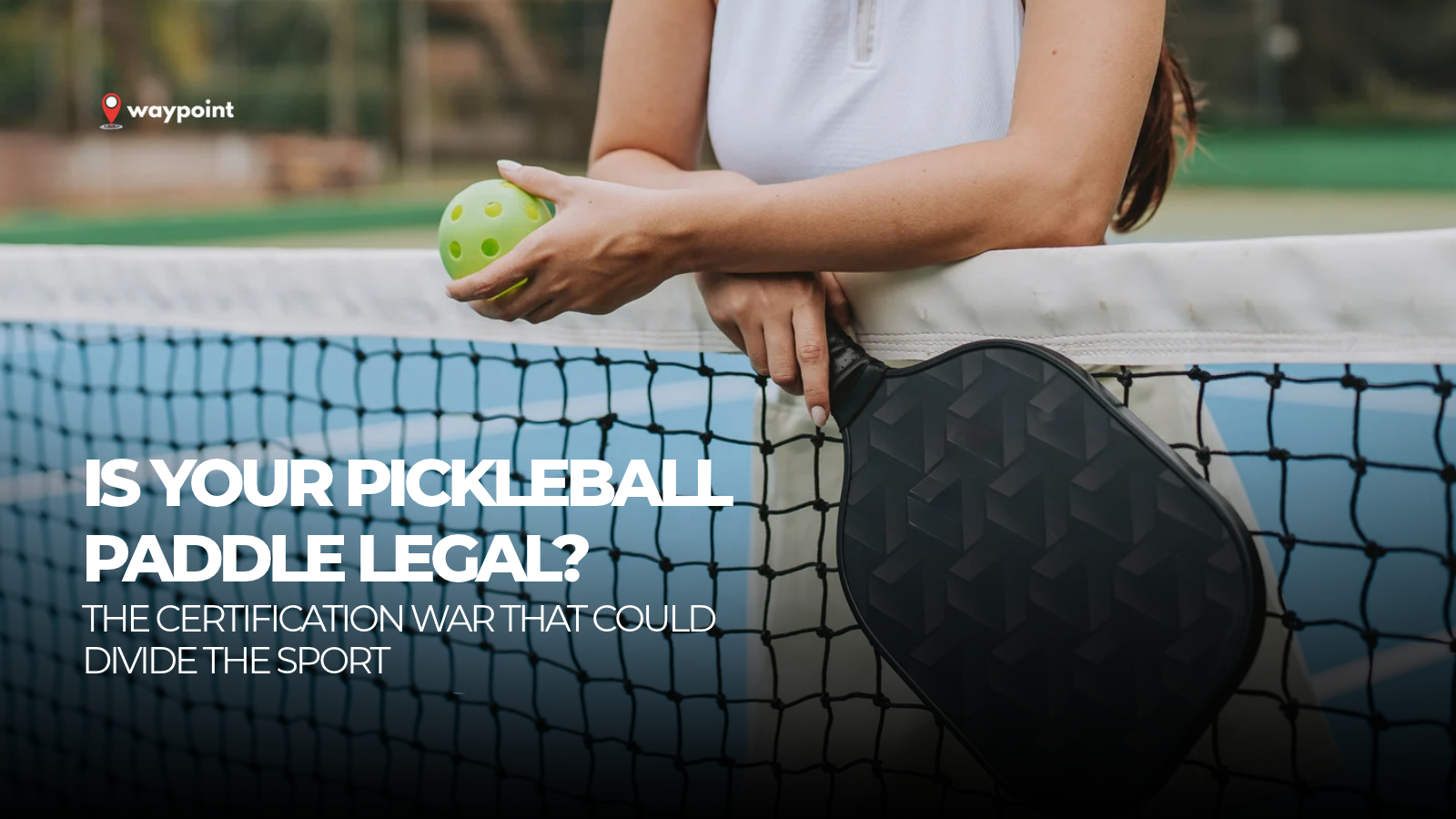

Two governing bodies. Two certification systems. Millions of players caught in the middle. Is pickleball creating unnecessary barriers to its own growth?
Imagine spending $250 on a premium pickleball paddle, training for months, travelling overseas to compete, and discovering that your paddle isn’t approved for the tournament you’ve entered.
Not because it’s necessarily dangerous.
Not because you’ve deliberately broken any rules.
But because the organisation running the tournament recognises a different certification standard.
Welcome to one of pickleball’s increasingly complicated problems.
As the sport continues its remarkable international expansion, a fundamental question is emerging:
Who actually gets to decide whether your paddle is legal?
And perhaps more importantly, should there be more than one answer?
THE BATTLE BETWEEN TWO CERTIFICATION SYSTEMS
For decades, USA Pickleball (USAP) has played a central role in establishing equipment standards for the sport.
Its certification system has become widely recognised across recreational, amateur and professional competitions, including events associated with the APP Tour.
But the emergence of the United Pickleball Association of America (UPA-A), associated with the PPA Tour and Major League Pickleball, has introduced another major certification framework.
Today, manufacturers face two systems with different testing requirements, certification processes and commercial structures.
For players, the consequences are increasingly significant.
A paddle approved under one system may not necessarily qualify for every competition organised under the other.
UPA-A certification is required for professional divisions across its designated competitions, including the PPA Tour and Major League Pickleball.
Many amateur divisions continue to accept USAP-approved paddles, although individual event requirements can differ.
This means players must increasingly understand not just the rules of pickleball, but the equipment policies of the organisations running their competitions.
For a sport that prides itself on accessibility, that’s a worrying direction.
THE CALL FOR ONE UNIVERSAL STANDARD
UPA-A President Jason Aspes has reportedly called for the two organisations to work towards a unified paddle certification system.
His argument is straightforward.
Maintaining two competing standards creates unnecessary costs for manufacturers and confusion for players.
Manufacturers seeking access to competitions governed by both systems may need to complete separate certification processes.
Those expenses become part of the economics of manufacturing and selling paddles.
And ultimately, some of those costs may be passed on to consumers.
Aspes has also raised serious concerns about the integrity of the existing certification landscape, including allegations involving USA Pickleball’s certification practices.
Those allegations should be treated as allegations, not established findings, unless supported by independent evidence.
Nevertheless, the broader issue deserves attention.
When equipment certification becomes a source of commercial and institutional competition, who is protecting the interests of the players?
THE HIDDEN COST OF CERTIFICATION
Consider the economics.
According to UPA-A’s published 2026 certification information, manufacturers face an annual brand fee of US$10,000 and a standard certification fee of US$3,000 per paddle model.
Additional charges apply for expedited testing and certain resubmissions.
For established international manufacturers, these costs may be manageable.
For emerging brands, smaller manufacturers and companies operating in developing pickleball markets, they can represent significant barriers to entry.
Now imagine a manufacturer producing several models, each with different specifications.
Certification costs can quickly accumulate before accounting for research, development, manufacturing, distribution and marketing.
And that’s before considering the requirements of another certification system.
The result?
Larger manufacturers may be better positioned to absorb compliance costs, while smaller competitors face difficult commercial decisions.
This creates a legitimate concern about whether the certification landscape could unintentionally favour established brands.
Equipment standards are essential.
But the cost of compliance should be proportionate, transparent and justified by measurable benefits to the sport.
Certification should protect competition, not restrict competition.
WHAT ABOUT ASIA?
This issue becomes even more complicated when we look beyond the United States.
Pickleball is expanding rapidly across China, Singapore, Malaysia, Vietnam, Indonesia, India and other Asian markets.
New manufacturers are emerging.
Local brands are developing increasingly sophisticated equipment.
Tournament organisers are building regional competition circuits.
Yet much of the equipment certification framework remains centred on American organisations.
Consider a paddle manufacturer in China.
The company may have the engineering expertise, manufacturing capability and technology to produce an excellent competition paddle.
But entering international markets could require navigating multiple certification processes, paying substantial fees and understanding different tournament requirements.
For smaller brands, that can become a significant obstacle.
Meanwhile, an amateur player in Singapore might purchase a paddle approved for local competition, only to discover different eligibility requirements when entering a professional event overseas.
The issue is no longer simply about paddle performance.
It’s about the international infrastructure supporting the sport.
And as pickleball becomes increasingly global, the question becomes unavoidable:
Should the future of international pickleball equipment standards be determined exclusively by competing American organisations?
Or should there be a more inclusive framework that recognises the interests of manufacturers, players and tournament organisers worldwide?
WHY CERTIFICATION STILL MATTERS
To be clear, the solution is not to eliminate equipment certification.
Quite the opposite.
Modern pickleball paddles are becoming increasingly sophisticated.
Manufacturers are experimenting with new core materials, foam technologies, surface treatments and construction methods.
These developments can significantly influence power, spin, control and durability.
Without meaningful equipment standards, technological advantages could undermine competitive fairness.
There are also legitimate concerns about paddles changing performance characteristics through use, manufacturing inconsistencies or structural deterioration.
A paddle that meets specifications when manufactured may not necessarily perform identically after extensive use.
These are real engineering and sporting challenges.
But they also reveal an important distinction.
Certifying a paddle model is not the same as verifying the condition and compliance of an individual paddle.
A certification mark alone cannot guarantee that every paddle remains compliant throughout its lifespan.
This is where the industry should be looking towards the future.
THE NEXT EVOLUTION: SMARTER, MORE TRANSPARENT CERTIFICATION
Imagine a different system.
A manufacturer submits a paddle for testing against clearly published technical standards.
The results are recorded in a verifiable digital database.
Each approved model has an identifiable certification record.
Players can check its status before entering a tournament.
Tournament organisers can confirm which equipment is permitted under their event rules.
Manufacturers can track certification validity, model variations and testing history.
Eventually, technologies such as NFC chips, QR codes and digital equipment passports could help connect physical paddles to their certification records.
But there is an important technical limitation.
A digital identifier can establish which paddle or model is registered. It cannot independently prove that the physical paddle has not been modified or that its performance remains within legal limits.
That still requires appropriate physical inspection and testing.
The real opportunity is therefore to combine reliable testing with transparent digital records.
Not to replace scientific certification with technology, but to make certification information more accessible, traceable and useful.
And perhaps most importantly, to make it easier for players to understand.
THE BIGGER PROBLEM: PICKLEBALL IS GROWING FASTER THAN ITS INFRASTRUCTURE
The certification debate is part of a much larger challenge facing pickleball.
The sport has experienced extraordinary growth in participation, investment and commercial interest.
But its underlying infrastructure remains fragmented.
Different tournament systems.
Different rankings.
Different registration platforms.
Different equipment standards.
Different player databases.
Different approaches to coaching, development and competition.
For professional organisations, some degree of differentiation is inevitable.
But for ordinary players, excessive fragmentation creates unnecessary complexity.
A player shouldn’t need to become an expert in organisational politics simply to enter a tournament.
A manufacturer shouldn’t face unnecessary duplication simply to participate in the international market.
And a tournament organiser shouldn’t have to navigate disconnected systems to provide a professional experience.
The next phase of pickleball’s development cannot depend entirely on attracting more players.
It must also involve making the sport easier to participate in.
WHERE WAYPOINT FITS INTO THE FUTURE
At Waypoint, we believe the next stage of pickleball’s growth requires something more fundamental than another tournament circuit or another governing organisation.
It requires better-connected infrastructure.
Our vision is to create a platform where players, organisers, facilities, coaches and brands can participate in a more connected sporting ecosystem.
A place where players can build their sporting identities, discover opportunities, register for competitions and follow their development.
Where organisers can manage tournaments, communicate requirements and operate events more efficiently.
Where brands can connect with communities and build relationships beyond individual product sales.
And where information becomes easier to access, understand and verify.
Equipment certification presents another important opportunity for this connected approach.
Imagine being able to check the applicable equipment requirements when registering for a tournament.
Or having access to verified paddle certification records through a digital equipment passport.
Or enabling organisers to communicate exactly which paddle standards apply to each division before players commit their time and money.
These are the kinds of capabilities we believe the industry should work towards.
Waypoint is not seeking to replace recognised certification authorities.
Instead, we believe technology can help connect existing standards, reduce confusion and support more transparent processes.
And where appropriate, new testing and verification frameworks could eventually complement the existing certification landscape.
The objective isn’t to create another layer of bureaucracy. It’s to remove unnecessary complexity from the sport.
ONE SPORT. DIFFERENT STANDARDS. WHAT COMES NEXT?
The disagreement between USAP and UPA-A may ultimately lead to cooperation.
Or the two organisations may continue developing their respective systems independently.
Either outcome will have consequences.
But the discussion should not be limited to which organisation controls certification.
It should focus on what the sport actually needs.
Fair and scientifically defensible equipment standards.
Transparent certification processes.
Reasonable costs for manufacturers.
Clear information for players.
And international systems capable of supporting the sport’s continued expansion.
Pickleball has reached a stage where its future cannot be determined solely by what happens on the court.
The decisions being made about governance, equipment, technology and infrastructure will shape the next generation of the sport.
And those decisions should serve the entire pickleball community.
Not just the organisations competing for control.
THE WAYPOINT PERSPECTIVE
At Waypoint, we’re building towards a simpler and more connected future for pickleball.
One where technology helps players spend less time navigating fragmented systems and more time enjoying the sport.
Whether you’re a player, tournament organiser, facility operator, coach or equipment manufacturer, we believe you should have access to better tools, better information and better opportunities.
Because growing pickleball isn’t just about bringing more people onto the court.
It’s about building an ecosystem that makes them want to stay.
Discover Waypoint: waypoint.fan
Waypoint — Every Player. Every Journey. One Connected Future.
JOIN THE CONVERSATION
Should pickleball have one universal paddle certification standard?
Should independent international testing organisations play a bigger role?
And would you trust a digital equipment passport that allows you to verify your paddle’s certification status?
We’d love to hear your thoughts.
Because the future of pickleball should belong to everyone who plays it.
Sources and References
- UPA-A – 2026 UPA-A Certification
https://upaa.unitedpickleball.com/paddle-testing/2026-upa-a-certification/ - UPA-A – Paddle Testing and Certification
https://upaa.unitedpickleball.com/paddle-testing/ - USA Pickleball – Approved Equipment Database
https://equipment.usapickleball.org/ - USA Pickleball – Spin Rate Test Update, 2026
https://usapickleball.org/usap-news/equipment-news/update-regarding-the-usa-pickleball-spin-rate-test-and-implementation-timeline/ - UPA-A President Jason Aspes – “How USA Pickleball Quietly Lost Their Credibility,” 16 October 2026
https://upaa.unitedpickleball.com/blog/how-usa-pickleball-quietly-lost-their-credibility/ - The Dink – “One Sport, One Paddle Standard? UPA-A’s President Calls for a Unified Certification,” 16 October 2026
https://www.thedinkpickleball.com/upa-a-president-calls-for-one-paddle-certification-standard/