
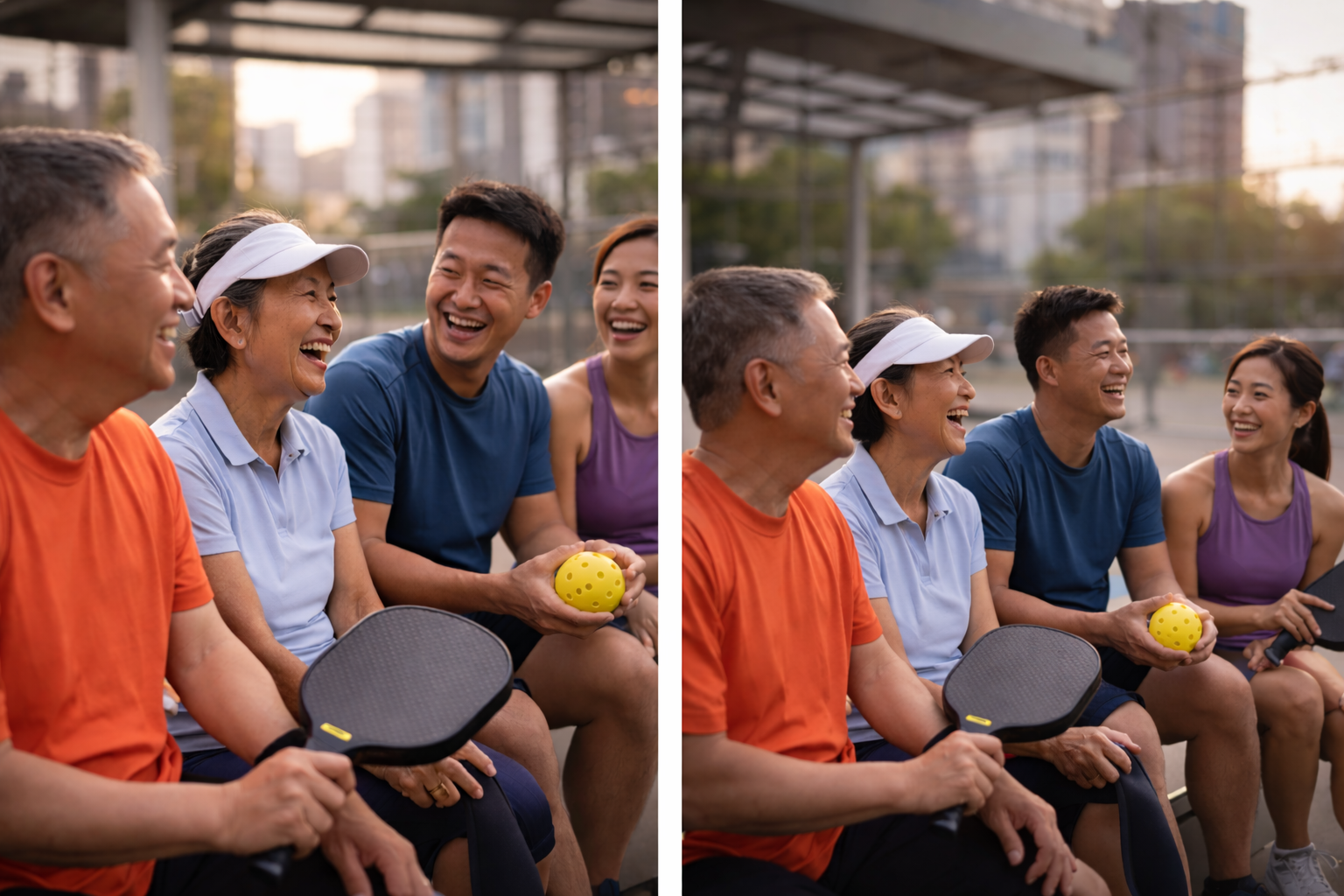

Pickleball’s rise across Asia is no longer anecdotal. Over the past three to five years, the sport has moved from niche curiosity to structured participation across multiple countries — supported by a growing number of courts, tournaments, and organised play groups.
This growth is not accidental. It reflects a structural alignment between pickleball and Asia’s urban, social, and participation realities.
The Growth, in Numbers (Why This Is No Longer Speculative)
Across Asia, indicators now point to critical mass, not early adoption.
Based on aggregated data from clubs, organisers, and regional federations:
- Hundreds of active pickleball clubs now operate across Southeast Asia and Greater China
- Dozens of formal tournaments are held annually across Singapore, Malaysia, Thailand, China, Japan, and Korea
- Player participation has crossed into the tens of millions, with some estimates placing the broader recreational base well beyond that
- Major cities are now supporting weekly leagues, corporate play, and age-group competitions rather than one-off events
The shift from “occasional tournaments” to recurring formats is the key signal of sustainability.
Asia Didn’t “Discover” Pickleball — It Recognised It
Many sports struggle to gain traction in Asia because they require:
- Long technical development
- Purpose-built facilities
- High cost of entry
- Narrow age appeal
Pickleball succeeds because it removes these constraints.
From first exposure, players can:
- Rally within minutes
- Participate socially without prior skill
- Play across generations
- Compete without full commitment
This matters in regions where sport participation is often socially driven and time-compressed.
Urban Density Favors Fast-Start Sports
Asian cities are dense, expensive, and short on discretionary time. Sports that thrive here tend to:
- Fit into 60–90 minute windows
- Share or repurpose space
- Support high utilisation per square metre
- Allow mixed-ability participation
Pickleball fits these requirements unusually well.
A single venue can support:
- Beginners, intermediates, and advanced players on the same day
- Coaching, leagues, and social play in parallel
- Corporate sessions during weekdays
- Community play during evenings and weekends
This flexibility explains why court counts and booking utilisation have risen quickly once pickleball is introduced.
Tournament Growth Signals Ecosystem Maturity
The number of tournaments matters less than how they are structured.
Across Asia, tournaments are increasingly:
- Tiered by skill and age
- Integrated with leagues and rankings
- Supported by local sponsors and venues
- Repeated annually or seasonally
This transition from “event-based” to “calendar-based” competition indicates that pickleball has moved beyond novelty and into organised sport territory.
Community Forms Before Competition — And That’s the Advantage
Unlike many Western sports models, pickleball’s Asian growth has not been led by elite professionals.
Instead, it has been driven by:
- Workplace communities
- Social play groups
- Informal coaches and organisers
- Mixed-ability sessions
Competition emerges organically after community forms — not before. This reverses the traditional pyramid and dramatically lowers attrition.
Cultural Compatibility Reduces Drop-Off
Pickleball’s social norms align well with Asian cultural patterns:
- Turn-taking and shared space
- Respectful play
- Cooperative learning
- Group belonging
These reduce intimidation and encourage:
- Older players to continue
- Newcomers to stay
- Women to participate
- Returning athletes to re-engage
This compatibility is one of the sport’s least discussed — but most powerful — growth drivers.
What This Means for Players Right Now
For players across Asia, pickleball offers:
- A sport that scales with commitment
- A social structure that encourages continuity
- Competitive pathways without exclusion
- A realistic path to long-term participation
As participation increases, standards rise — without forcing players out.
🔹 Continue This Inside Pickleplus
Understanding the scale and momentum of pickleball across Asia explains the trend.
Staying connected to sessions, communities, and personal participation requires structure.
Players can track activity, communities, and engagement history inside Pickleplus, their central player passport connecting play, people, and progress.
Why Asia May Shape Pickleball’s Global Future
Asia is not just adopting pickleball — it is stress-testing a different growth model.
One that prioritises:
- Participation over spectacle
- Community over hierarchy
- Retention over hype
If pickleball’s next global phase is defined by sustainability, Asia will not simply be a growth region — it will be a reference point.