

Pickleball’s growth is no longer anecdotal. By early 2026, participation data from clubs, facilities, and equipment sales across multiple regions points to a clear conclusion: pickleball is still expanding, but the nature of that growth is changing.
The question is no longer whether pickleball is growing — it’s how sustainable and meaningful that growth actually is.
Participation Is Up — But Not Evenly
Across North America and Asia, overall participation continues to trend upward, but growth is no longer uniform.
- Urban indoor facilities are seeing the strongest gains
- Casual and social play is expanding faster than competitive play
- Younger demographics (18–35) are entering the sport at higher rates than in previous years
What’s notable is that growth is increasingly infrastructure-driven, not purely organic. Regions that invest in indoor courts, lighting, and structured programming see significantly higher retention rates than those relying on shared or temporary spaces.
Asia Is Emerging as a Growth Multiplier
While North America remains the largest market by volume, Asia is contributing disproportionately to new player growth.
Key drivers include:
- High population density and indoor facility demand
- Strong crossover from badminton and table tennis
- Rapid adoption by private clubs, schools, and corporate leagues
In several Asian cities, pickleball is not competing with tennis — it is being positioned as a new category of social sport, lowering the barrier to entry and accelerating adoption.
Equipment Sales Tell a More Nuanced Story
Paddle and ball sales continue to rise, but not at the same pace as new player registrations.
This suggests two things:
- New players are entering more cautiously, often borrowing or renting equipment
- The market is shifting from impulsive purchases to more educated buying decisions
Consumers are increasingly comparing materials, durability, and play style suitability rather than buying the cheapest or most advertised option. This shift favours brands that prioritise transparency and long-term performance over hype.
Retention Is the Real Test in 2026
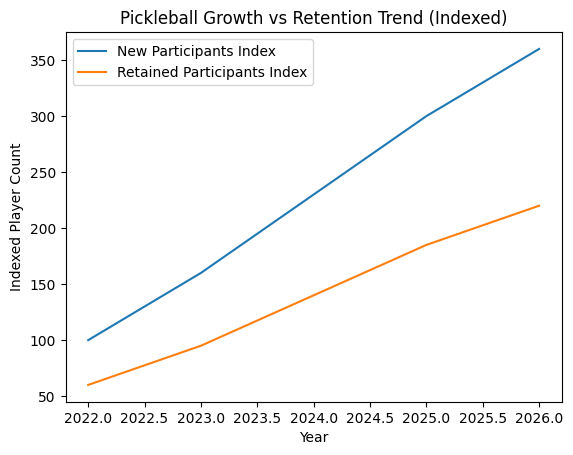
The most important metric is no longer participation — it’s retention.
Data from clubs and leagues shows:
- Players who receive structured onboarding are far more likely to stay active
- Social leagues retain better than open play alone
- Coaching, even at a basic level, dramatically improves long-term engagement
In other words, pickleball’s future growth depends less on viral awareness and more on how well new players are supported after their first few sessions.
Growth Is Slowing — And That’s Healthy
Headline growth rates are moderating compared to the explosive spikes of earlier years. This is not a warning sign — it’s a sign of market maturation.
A slower, more structured growth phase allows:
- Facilities to plan sustainably
- Coaches to focus on development, not volume
- Communities to form around play, not novelty
Pickleball is transitioning from a trend into an ecosystem.
What the Numbers Actually Mean
The data tells a clear story:
- Pickleball is still growing
- Growth is becoming more regional, structured, and intentional
- Retention, not awareness, will define the next phase
The sport’s trajectory in 2026 will be shaped not by how many people try pickleball once — but by how many choose to make it part of their lives.
That distinction will determine which regions, clubs, and brands truly thrive in the years ahead.t tackling them.