
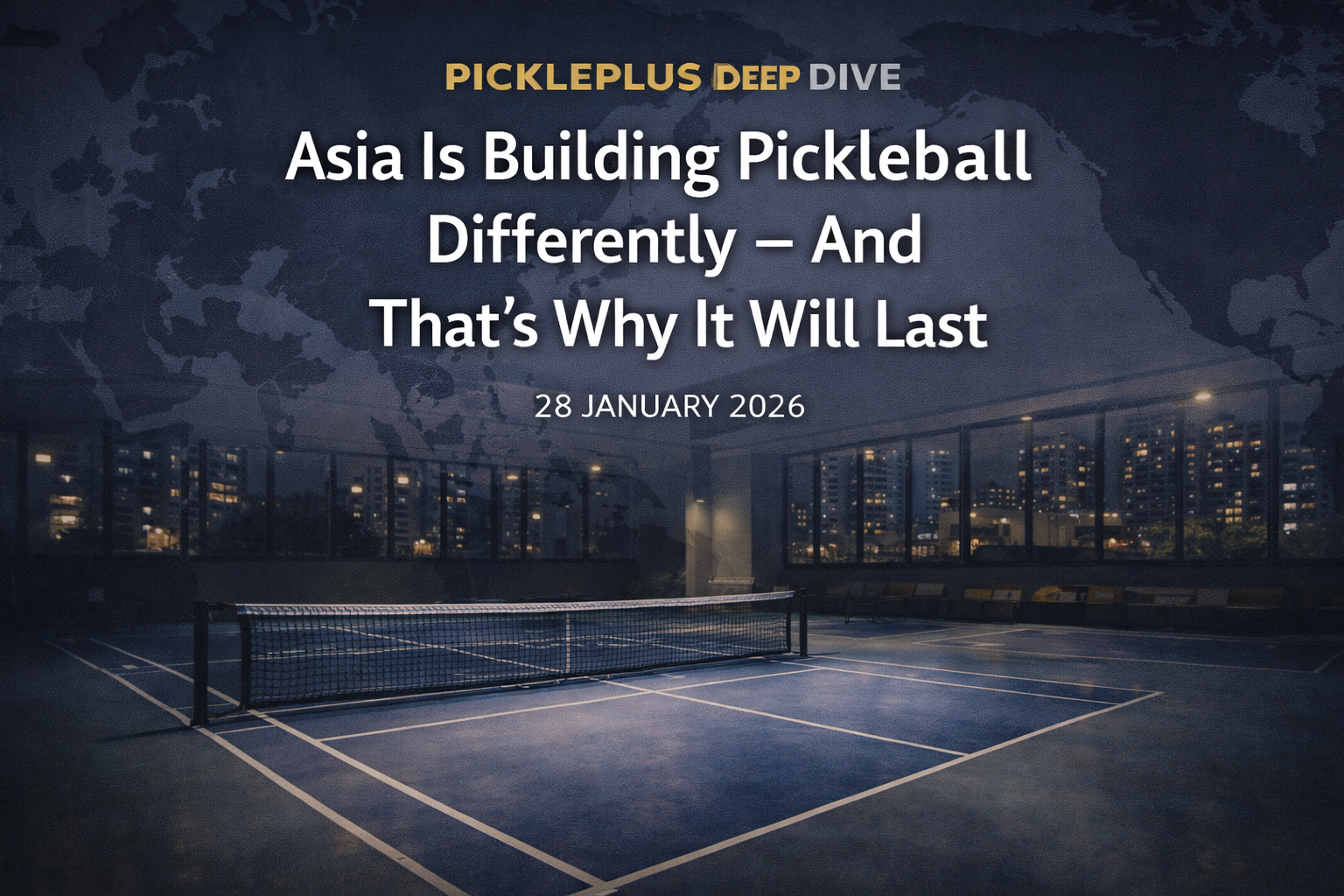

Pickleball’s growth in Asia looks quieter than in the US — and that’s precisely why it may be more sustainable. Instead of hype-led expansion, Asia is prioritising infrastructure, indoor facilities, and programmed access. This deliberate approach positions the region for long-term durability.
Asia Didn’t Skip the Hype Phase — It Bypassed It
In many Western markets, pickleball followed a familiar arc:
- Viral growth
- Public court conversions
- Rapid participation spikes
- Followed by friction
Asia took a different route.
Growth has been:
- Controlled
- Indoor-first
- Commercially structured
- Institutionally cautious
This is not hesitation.
It is intentional sequencing.
Infrastructure Comes First in Dense Cities
Asian cities share common realities:
- Limited land
- High population density
- Noise sensitivity
- Strong regulatory oversight
These constraints force early decisions:
- Indoor facilities over outdoor retrofits
- Paid access over unmanaged free play
- Scheduling over spontaneity
Where space is scarce, systems matter early.
Programmed Play Beats Open Chaos
Across Asia, pickleball access is increasingly:
- Session-based
- Membership-linked
- Coach-supported
- Time-boxed
This does three things:
- Reduces conflict over space
- Improves player experience
- Makes facilities economically viable
Free-for-all models struggle in dense cities.
Programmed access scales.
Why Asia Is Moving Indoors Faster
Indoor pickleball solves multiple problems at once:
- Noise control
- Weather reliability
- Surface consistency
- Year-round programming
This accelerates:
- League formation
- Coaching pipelines
- Event hosting
- Community retention
Indoor-first is not a luxury in Asia.
It is a prerequisite.
Pickleball Is Being Treated as a Product
In Asia, pickleball is increasingly framed as:
- A lifestyle offering
- A social product
- A wellness activity
- A commercial service
This leads to:
- Tiered pricing
- Bundled experiences
- Corporate engagement
- Higher retention per player
Recreation is respected — but structure sustains it.
Quiet Growth Is Strong Growth
Asia’s pickleball story lacks viral moments — and that’s a strength.
What’s growing instead:
- Permanent facilities
- Repeat players
- Organised communities
- Professional operations
The absence of noise does not signal weakness.
It signals stability.
What the Rest of the World Can Learn
Asia demonstrates that:
- Popularity does not guarantee longevity
- Infrastructure determines access
- Paid models can still be inclusive
- Early discipline prevents later backlash
These lessons will matter globally as cities densify.
What to Watch Next in Asia
- Purpose-built indoor venues
- Mall and commercial partnerships
- Membership and charge-card models
- Structured leagues and ladders
- Coaching and youth pipelines
These signals matter more than social metrics.
Remember:
“Asia didn’t slow pickleball down — it built it to last.”
Continue Your Pickleball Journey
https://pickleplus.io
https://pointflow.pickleplus.io
Join the Frenship Cup (Singapore)
Sign up for the Frenship Cup, taking place on 28 February 2026.
https://docs.google.com/forms/d/e/1FAIpQLSeC3UWkUPVJ0i9IbP0uHwLs1yZsMrnT-obEhw9q3iqJbwdaZQ/viewform