
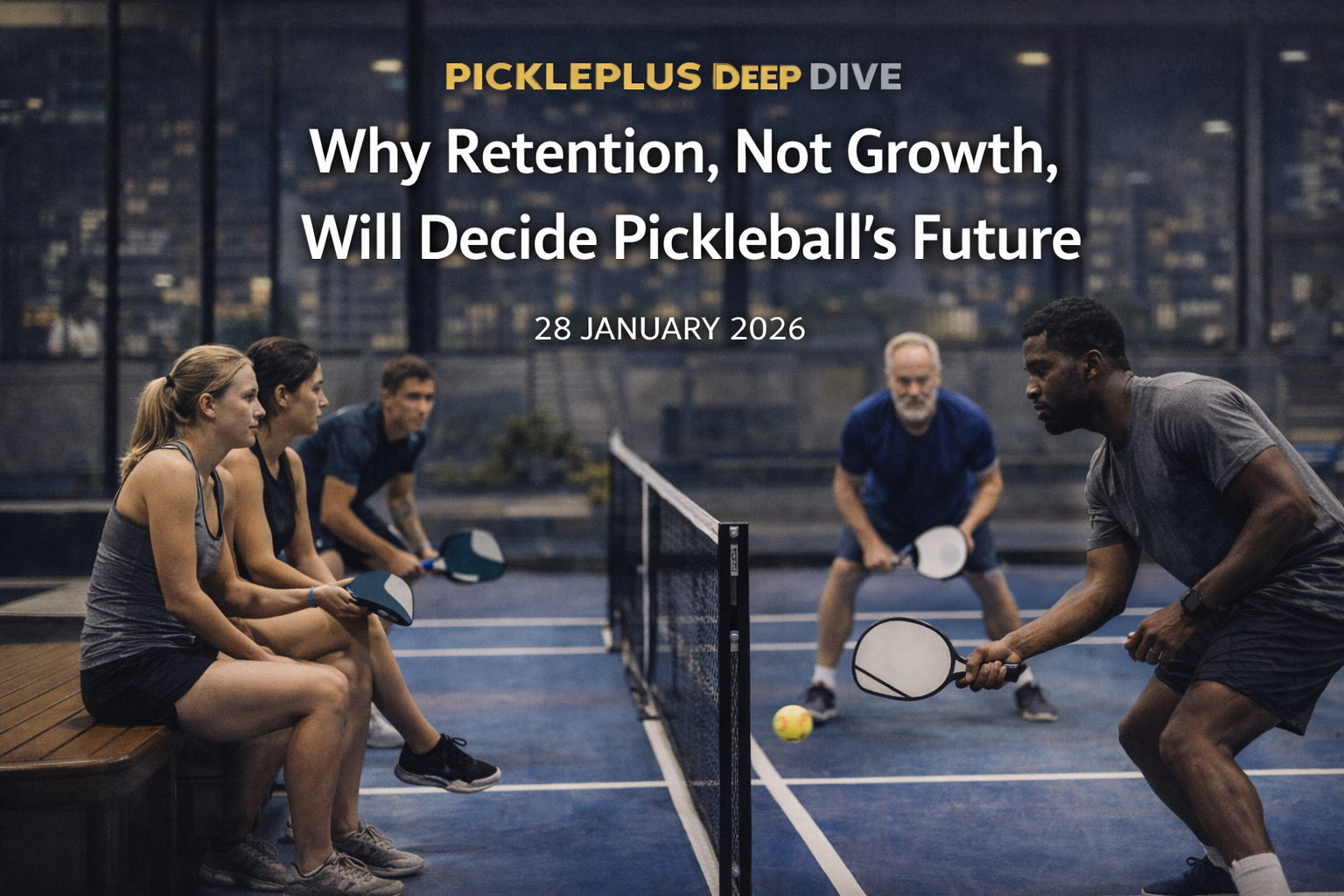

Pickleball participation continues to rise, but growth alone does not guarantee longevity. The next phase of the sport will be decided by retention — who keeps playing, how often, and why. Facilities, community design, and structured programming now matter more than discovery.
Growth Brings People In — Retention Keeps Them
The early success of pickleball came from:
- Easy entry
- Low cost
- Social appeal
- Rapid discovery
This created impressive participation numbers.
But participation is a moment.
Retention is a relationship.
Sports that fail to convert one into the other stall — regardless of how strong the initial surge looks.
The Silent Drop-Off Problem
In many markets, the pattern is consistent:
- Players try pickleball
- Enjoy the first few sessions
- Struggle to find consistent access
- Drift away within months
This drop-off rarely appears in headline data.
Sign-ups stay high.
Actual play frequency quietly declines.
Why Retention Is Harder Than Growth
Retention requires solving harder problems:
- Reliable court access
- Fair matchmaking
- Skill-appropriate play
- Social belonging
- Time efficiency
Growth can be driven by awareness.
Retention depends on experience quality.
Facilities Are Retention Engines
The strongest retention correlates with:
- Indoor or permanent courts
- Predictable schedules
- Programmed sessions
- Leagues and ladders
- On-site community presence
Where facilities are unstable:
- Play becomes sporadic
- Communities fragment
- Motivation fades
Retention follows consistency, not novelty.
Community Beats Competition
For most players:
- Winning is secondary
- Belonging is primary
Retention improves when:
- Players feel welcomed
- Skill gaps are managed
- Social friction is reduced
- Progress feels visible
Unstructured play favours the confident.
Structured communities retain the majority.
Asia’s Advantage in Retention
Many Asian markets prioritise:
- Session-based play
- Membership access
- Coach-facilitated groups
- Smaller, consistent communities
This results in:
- Slower initial growth
- Stronger long-term engagement
- Higher repeat play rates
Asia’s model trades hype for habit —
and habit is what sustains sports.
Why Platforms Matter in the Retention Phase
As pickleball matures:
- Tracking matters
- Progress matters
- Identity matters
Players who:
- See their journey
- Understand their level
- Feel recognised
are far more likely to stay.
Retention is psychological as much as logistical.
What the Industry Must Shift Toward
The next phase requires a mindset change:
- From acquisition → engagement
- From access → experience
- From volume → value
The question is no longer:
“How many people are trying pickleball?”
It is:
“How many are still playing six months later?”
What to Watch Next
- Repeat play metrics
- Membership and programme growth
- League participation
- Drop-off after 90 days
- Community-led facility models
These indicators will matter more than raw participation numbers.
Remember:
“Growth gets attention. Retention decides whether a sport survives.”
Continue Your Pickleball Journey
https://pickleplus.io
https://pointflow.pickleplus.io
🏓 Join the Frenship Cup (Singapore)
Sign up for the Frenship Cup, taking place on 28 February 2026.
https://docs.google.com/forms/d/e/1FAIpQLSeC3UWkUPVJ0i9IbP0uHwLs1yZsMrnT-obEhw9q3iqJbwdaZQ/viewform