

INTRODUCTION
The most common complaint in pickleball today is simple and familiar.
There are not enough courts.
Players feel it when they queue. Clubs cite it when sessions overflow. Municipalities use it to justify expansion plans. On the surface, the conclusion seems obvious: build more courts and the problem disappears.
However, when you look closer, the evidence tells a different story.
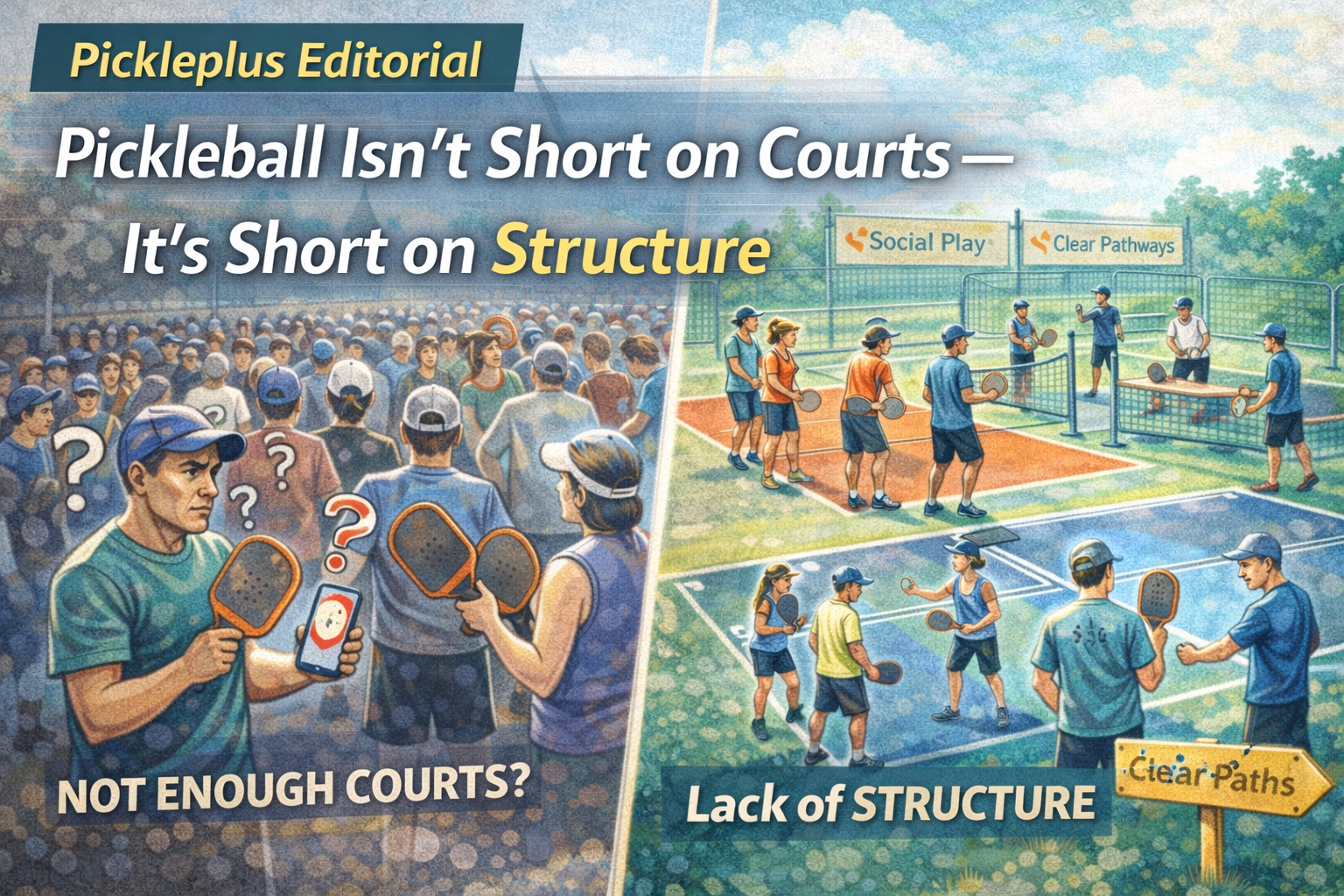
Pickleball does not primarily suffer from a lack of courts. It suffers from a lack of structure.
WHY THE COURT SHORTAGE NARRATIVE PERSISTS
Court scarcity feels real because friction is real.
Players encounter overcrowded sessions, mismatched games, and limited access during peak hours. These experiences naturally point to infrastructure as the culprit.
Yet many facilities show a contradictory pattern:
- Courts sit underutilised during off-peak hours
- Sessions run at full capacity without clear purpose
- Players rotate frequently without progressing
The issue is not total court count. It is how court time is organised and allocated.
WHAT STRUCTURE ACTUALLY MEANS IN PRACTICE
Structure is not bureaucracy.
It includes:
- Clear session intent
- Defined entry and progression pathways
- Appropriate matchmaking
- Separation between social, developmental, and competitive formats
Without these elements, courts become shared spaces with conflicting goals. Social players, improving intermediates, and competitive players all compete for the same time, often in the same sessions.
This collision creates frustration regardless of how many courts exist.
WHY MORE COURTS OFTEN FAIL TO SOLVE THE PROBLEM
Adding courts increases capacity but does not resolve misalignment.
When structure is absent, new courts simply replicate existing inefficiencies. Sessions remain crowded at peak times, mismatches persist, and churn continues. The experience improves briefly before friction returns.
In many cases, facilities expand faster than their systems mature.
As a result, scale amplifies confusion instead of clarity.
THE REAL COST OF POOR STRUCTURE
When structure breaks down, several predictable outcomes follow.
Players:
- Plateau earlier
- Feel unseen or mismatched
- Drift between sessions without direction
Coaches:
- Spend time managing expectations instead of development
- Struggle to demonstrate progress
- Burn out under inconsistent demands
Operators:
- See high participation but low retention
- Face constant pressure for expansion
- Misdiagnose systemic issues as capacity problems
These costs accumulate quietly.
WHY STRUCTURE MATTERS MORE AS PICKLEBALL MATURES
Early-stage growth tolerates chaos.
As pickleball matures, tolerance decreases. Players expect clarity. They want to know where they belong, what a session is designed to do, and how they move forward.
Other sports experienced the same transition. Infrastructure mattered early. Systems mattered later.
Pickleball is now firmly in the second phase.
WHAT STRUCTURED ECOSYSTEMS DO DIFFERENTLY
Well-structured environments:
- Allocate courts by purpose, not just availability
- Design sessions with explicit outcomes
- Guide players toward appropriate formats
- Reduce friction without adding space
These ecosystems often appear calmer despite handling the same or greater volume. The difference lies in coordination, not construction.
WHY THIS CONVERSATION FEELS UNCOMFORTABLE
Structure forces prioritisation.
It requires saying:
- This session is not for everyone
- This format has a specific role
- This pathway requires patience
These boundaries can feel exclusionary at first. In reality, they reduce frustration by aligning expectations.
The discomfort comes from change, not from harm.
WHAT THIS MEANS FOR THE FUTURE OF PICKLEBALL
Pickleball will continue building courts. Infrastructure still matters.
However, the next phase of growth depends far more on how courts are used than on how many exist. Systems that organise participation intelligently will outperform those that rely on expansion alone.
The sport does not need endless space.
It needs clearer design.
FINAL THOUGHT
When pickleball players say there are not enough courts, they are often describing a deeper issue.
They are describing confusion, congestion, and misalignment.
Courts are visible.
Structure is not.
Yet structure determines whether growth feels energising or exhausting. As pickleball matures, the ecosystems that recognise this distinction will shape the sport’s future more than any construction project.
CONTINUATION PATHS
Players who sense this mismatch often want better visibility into where they fit within the broader ecosystem and how participation connects to progression.
Pickleplus exists to help players contextualise identity, participation, and development over time:
https://pickleplus.io
For coaches and operators, diagnosing structural issues requires seeing patterns across weeks and months rather than isolated sessions.
Tools like Pointflow were built to surface those longer-term signals:
https://pointflow.pickleplus.io
Some players prefer environments that already separate session intent clearly rather than relying on ad-hoc allocation.
Events such as the Frenship Cup (Singapore, 28 February 2026) reflect that structured approach:
https://docs.google.com/forms/d/e/1FAIpQLSeC3UWkUPVJ0i9IbP0uHwLs1yZsMrnT-obEhw9q3iqJbwdaZQ/viewform