


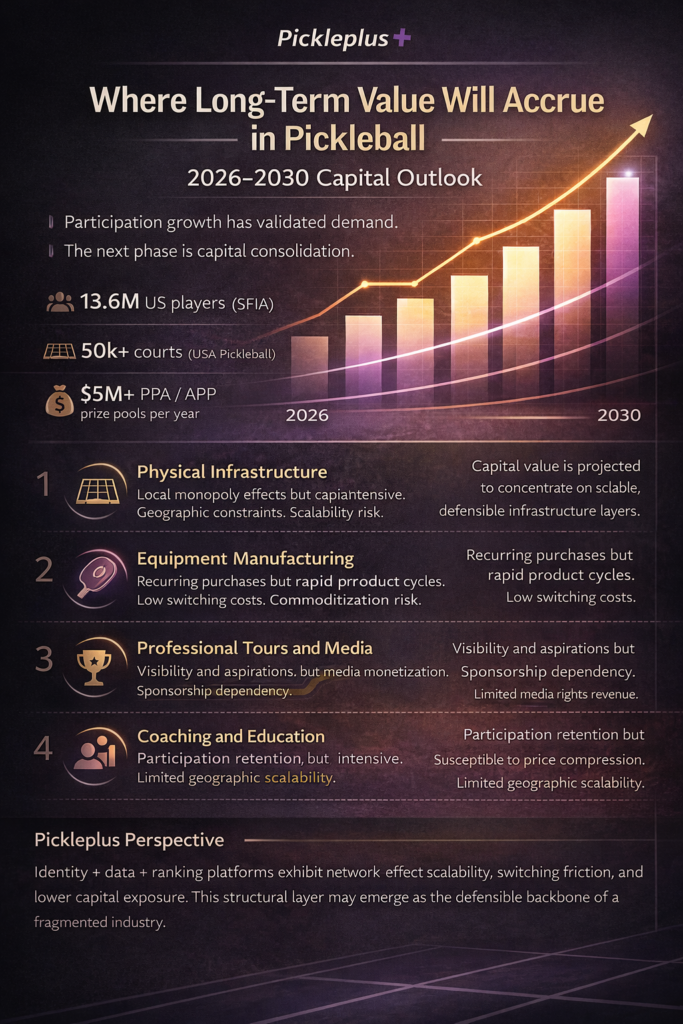
Note: According to SFIA’s 2024 Topline Participation Report, an estimated 19.8 million Americans participated in pickleball in 2024, representing a sustained multi-year growth trend. Another industry survey suggests that nearly 48.3 million U.S. adults have played the sport at least once in the past year. Broader global estimates place total worldwide engagement — people who have tried pickleball — in the 80–120 million range, although these figures include casual and one-off play rather than formal active participation.
Executive Context
Pickleball has transitioned from recreational curiosity to structured growth market within less than a decade. Participation metrics, infrastructure expansion, professionalisation of tours, and private capital inflows have collectively repositioned the sport within investor discourse. However, high participation growth does not automatically translate into durable enterprise value.
Emerging sports typically progress through identifiable phases: participation acceleration, infrastructure expansion, commercial experimentation, and eventual consolidation. The relevant question for investors is not whether pickleball will continue to grow. It is where long-term defensible value will accrue between 2026 and 2030.
Participation and Infrastructure Data
According to the Sports & Fitness Industry Association (SFIA), pickleball participation in the United States reached 13.6 million players in 2023, representing a 223 percent increase over three years (SFIA Participation Report, 2024 – https://www.sfia.org/reports/participation-reports).
USA Pickleball’s Places2Play database lists more than 50,000 courts nationwide, more than doubling since 2020 (USA Pickleball, 2024 – https://usapickleball.org/places2play/).
Professional prize pools have also expanded. The PPA Tour reports aggregate purses exceeding USD 5 million annually in recent seasons (PPA Tour, 2024 – https://www.ppatour.com/), while the APP Tour has similarly increased total prize distributions and event scale (APP Tour, 2024 – https://www.theapp.global/).
Private equity participation has accelerated since 2022, with capital deployed into professional tours, facility chains, and related infrastructure assets. Investment participation from institutional sports capital groups has signaled confidence in long-term growth.
The data confirms demand. The next question concerns capital durability.
Industry Layers: A Capital Allocation Framework
To assess long-term value creation, it is useful to deconstruct pickleball into five primary economic layers:
- Physical Infrastructure (courts and clubs)
- Equipment Manufacturing
- Professional Tours and Media
- Coaching and Education
- Identity, Data, and Competition Architecture
Each layer differs in capital intensity, scalability, margin profile, and defensibility.
Layer 1: Physical Infrastructure
Courts and facilities are capital-intensive and geographically constrained. Indoor buildouts in North America are often estimated between USD 25,000 and USD 60,000 per court depending on conversion complexity and lease structure. Asian markets vary significantly depending on property ownership models.
Infrastructure benefits from tangible asset backing and local monopoly effects. However, it faces:
• High fixed cost exposure
• Localised competition risk
• Utilisation sensitivity
• Limited geographic scalability without substantial capital
Boutique fitness and indoor climbing markets demonstrated similar expansion patterns before margin compression in oversupplied urban areas.
Infrastructure can be attractive, but it is not infinitely scalable without disciplined site selection and retention systems.
Layer 2: Equipment Manufacturing
Paddle innovation cycles are accelerating. Carbon layering, thermoforming, and spin surface technology are driving differentiation. Equipment benefits from global distribution potential and recurring purchase cycles.
However, risks include:
• Low switching costs
• Rapid commoditisation
• Marketing-driven rather than utility-driven loyalty
• Increasing competition from private label manufacturers
Without brand moats or patent defensibility, long-term margin compression is common in sporting goods categories.
Layer 3: Professional Tours and Media
Professional tours generate visibility, sponsorship alignment, and aspirational pathways. Prize pools have increased meaningfully, and media exposure has expanded via streaming and selective broadcast agreements.
However, media monetisation remains developing relative to established global sports. Until broadcast rights form a significant recurring revenue base, tours remain partially dependent on sponsorship concentration and capital injections.
Historically, sports ecosystems stabilise when media rights exceed sponsorship reliance. Pickleball is not yet at that stage.
Layer 4: Coaching and Education
Coaching benefits from participation growth and provides recurring revenue at the local level. However, coaching markets are labour-intensive and susceptible to pricing compression as supply increases.
Certification alone does not create defensibility. Structured pathways, measurable development systems, and ecosystem integration are required to avoid commoditisation.
This layer supports engagement but does not inherently create scalable global value without integration.
Layer 5: Identity, Data, and Competition Architecture
This layer remains underdeveloped relative to participation growth.
As multiple tours, leagues, and age-group categories expand, ranking fragmentation increases. Players often lack unified classification across ecosystems. Data portability and verified match history remain inconsistent.
In maturing sports ecosystems, identity and competition architecture often become the most defensible layer. Tennis has global ranking systems; golf has structured handicap indices; esports platforms integrate identity and ranking across events.
This layer exhibits:
• Network effects
• Cross-geography scalability
• Lower capital intensity
• High switching costs once adopted
• Regulatory alignment potential
For investors evaluating long-term defensibility, this layer may present structural advantage.
Regional Capital Dynamics: North America and Asia
Although North America remains the most mature pickleball market in terms of participation tracking and infrastructure density, Asia represents a structurally distinct growth environment with different capital implications.
The United States has already moved through the acceleration phase of participation growth. With approximately 19.8 million active participants in 2024 according to the Sports & Fitness Industry Association (SFIA, 2024), and more than 50,000 courts listed nationwide (USA Pickleball, 2024), infrastructure density in major metropolitan areas has increased substantially. Professional tours have scaled prize pools, private equity has entered selectively, and event visibility has expanded through streaming and broadcast experimentation.
As infrastructure density rises, incremental court expansion in established markets naturally produces lower marginal returns. In similar recreational sport cycles, including boutique fitness and indoor climbing, oversupply in urban clusters typically precedes margin compression and consolidation. The United States is not yet in a contraction phase, but early indicators suggest that operational differentiation will increasingly determine capital efficiency.
Asia, by contrast, remains earlier in its infrastructure development curve. Unified participation reporting equivalent to SFIA does not yet exist across the region, which makes precise measurement difficult. However, observable growth patterns include rapid mall-integrated court conversions in China, accelerating private club formation in Singapore and Malaysia, and growing cross-border tournament participation without fully harmonised ranking systems.
Urban density across major Asian cities introduces a fundamentally different unit economics profile. Markets such as Guangzhou, Shanghai, Singapore, Jakarta, and Kuala Lumpur combine high population concentration with vertically integrated retail and mixed-use property development. Historically, Asian recreational sport concepts have scaled efficiently when embedded within commercial real estate ecosystems, particularly when aligned with lifestyle positioning rather than purely suburban land models.
The implication for capital allocation is sequencing asymmetry. North America appears to be entering a structural refinement phase in which margin resilience, utilisation optimisation, and media monetisation discipline become central. Asia, on the other hand, may still offer expansion-stage infrastructure growth, particularly in high-density metropolitan corridors. However, Asia also presents regulatory heterogeneity, lease structure variability, and federation fragmentation that increase execution complexity.
From an investment perspective, the most durable opportunity in Asia may not lie solely in replicating court density models observed in North America. Instead, early integration of identity systems, ranking normalisation, and cross-border competition architecture could reduce long-term fragmentation costs. Markets that embed structural cohesion earlier often avoid the inefficiencies that later require consolidation.
The divergence between North America and Asia is therefore not simply geographic. It reflects different stages of ecosystem maturity. Capital strategies that recognise this sequencing difference are likely to outperform undifferentiated replication models.
Comparative Industry Perspective
Emerging sports such as mixed martial arts and esports demonstrated early-stage capital concentration in headline areas such as prize money and media rights. Over time, value accrued in structured platforms, ranking systems, and ecosystem integration providers rather than solely in event-level economics.
Boutique fitness similarly experienced early infrastructure expansion followed by consolidation around scalable brands with digital integration.
Pickleball appears positioned at the transition point between expansion and structural refinement.
The Pickleplus Perspective
From a structural standpoint, pickleball between 2026 and 2030 will likely experience:
Short-term (2026–2027):
Stabilisation of prize inflation and selective infrastructure consolidation in oversupplied markets.
Mid-term (2027–2028):
Greater emphasis on ranking normalisation, verified participation records, and digital integration across tours and facilities.
Long-term (2028–2030):
Value concentration around platforms that unify identity, competition architecture, and performance data across physical infrastructure.
The contrarian view is that participation can remain strong even if professional prize growth moderates. Durable ecosystems are not defined by headline purse figures, but by structural alignment between participation, identity, and monetisation.
The thesis is not that infrastructure or tours lack value. It is that long-term defensibility increasingly favours scalable identity and data layers that sit above fragmented physical assets.
Strategic Implications for Capital
For US investors, the opportunity may lie in scalable technology layers that integrate across independent facilities and tours rather than competing in localised court markets.
For Asian capital, early-stage infrastructure growth remains attractive in high-density urban markets, but long-term defensibility will depend on system integration rather than court count alone.
Capital allocation decisions should prioritise:
• Recurring revenue models
• Network-effect scalability
• Cross-border applicability
• Alignment with regulatory and federation structures
• Margin resilience under participation volatility
Disciplined scaling often outperforms headline expansion.
Ecosystem Infrastructure Consideration
As the sport matures, unified digital identity and verified competition records become increasingly important. The Pickleplus Passport operates as a persistent player identity layer linking match history, classification, and tournament participation across environments.
Performance intelligence and structured ranking architecture further strengthen ecosystem coherence. Platforms such as PointFlow and Forge provide measurable development tracking and scalable tournament management frameworks, supporting the identity layer that underpins long-term structural stability.
https://pointflow.pickleplus.io
https://forge.pickleplus.io
These infrastructure components illustrate the type of scalable architecture that may become increasingly central as the market consolidates.
Forward Outlook
Pickleball remains in a growth phase. However, participation acceleration alone does not determine enterprise durability. Between 2026 and 2030, value is likely to concentrate in layers that exhibit scalability, defensibility, and integration across fragmented ecosystems.
Headline growth validates demand.
Infrastructure determines permanence.
Data Sources Referenced
Sports & Fitness Industry Association Participation Report (2024)
https://www.sfia.org/reports/participation-reports
USA Pickleball Places2Play Database (2024)
https://usapickleball.org/places2play/
PPA Tour Official Information (2024)
https://www.ppatour.com/
Association of Pickleball Professionals (APP) Tour Information (2024)
https://www.theapp.global/