
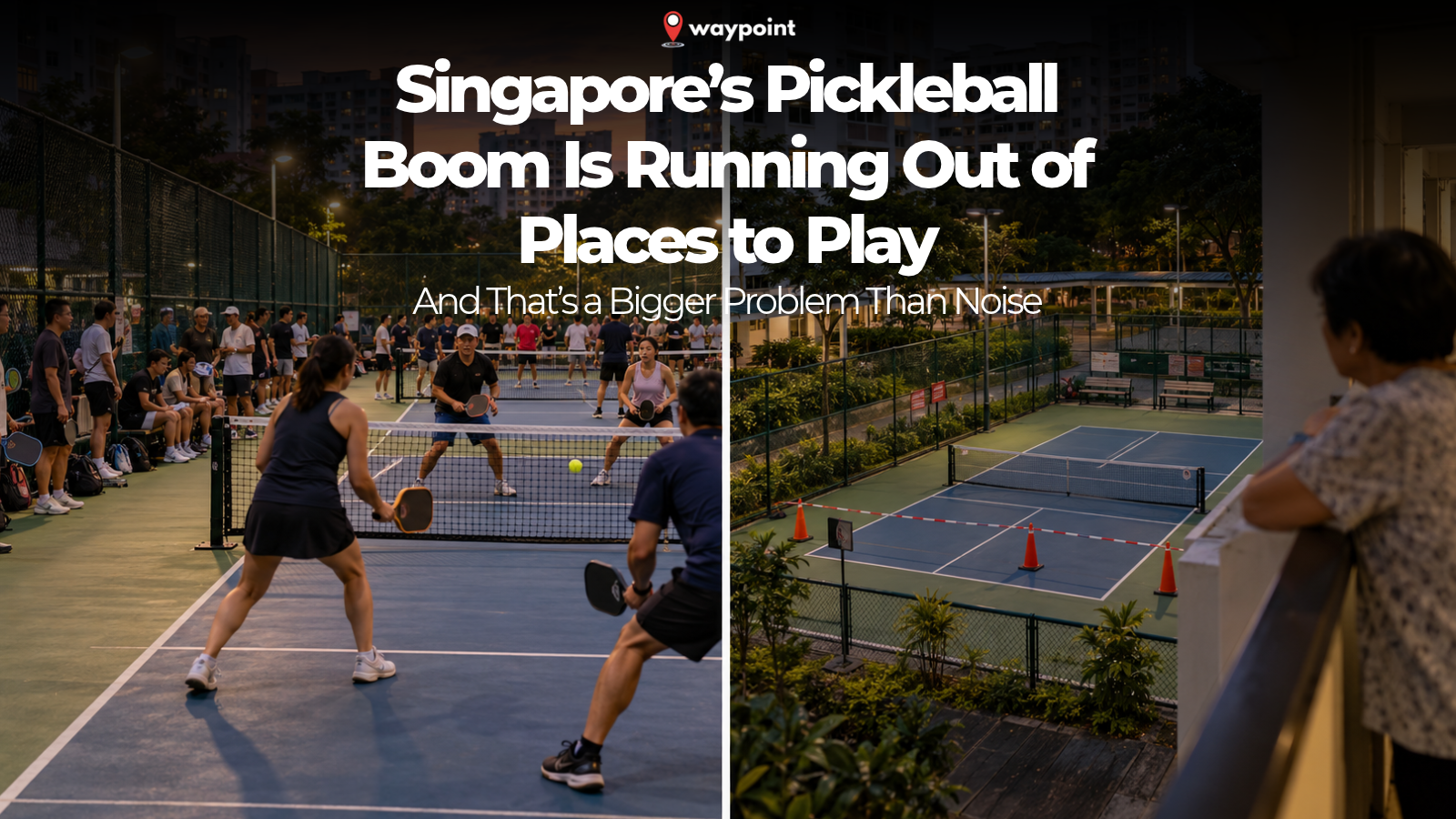

As Sengkang introduces new restrictions on pickleball, Singapore faces an uncomfortable question: What happens when a sport grows faster than the infrastructure supporting it?
28 October 2026 | Singapore | Sports & Industry
Singapore’s pickleball boom has been celebrated as a remarkable sporting success story. Courts are increasingly busy, new communities are forming, and players of all ages are discovering a sport that is accessible, social and relatively easy to learn.
But something interesting is happening.
The more popular pickleball becomes, the harder it may be for some Singaporeans to find somewhere to play.
And the latest developments in Sengkang suggest that Singapore’s pickleball industry is approaching an important crossroads.
Nine Courts, Thousands of Residents, and One Growing Problem
From 1 November 2026, Sengkang Town Council will prohibit pickleball at selected residential courts while restricting play at nine designated courts to between 10am and 7.30pm.
The decision follows resident feedback, surveys and on-site assessments considering noise levels, court layouts and proximity to homes.
Sengkang is not alone.
Other residential estates across Singapore have introduced restrictions, reduced playing hours or experimented with quieter equipment to address similar concerns.
At first glance, this appears to be another story about residents complaining about pickleball.
But look a little deeper, and a much larger issue emerges.
Singapore may be producing pickleball players faster than it is producing suitable places for them to play.
Residents Aren’t the Problem. Neither Are the Players.
It is tempting to frame this situation as a conflict between enthusiastic pickleball players and residents who simply want peace and quiet.
But that would miss the point.
Residents have legitimate reasons to be concerned about repetitive noise, particularly when courts are located directly beneath residential blocks.
Unlike some other recreational activities, pickleball produces a distinctive, repetitive impact sound that can travel through residential environments.
Equally, players have legitimate reasons to want accessible, affordable facilities where they can enjoy a sport that promotes physical activity and social interaction.
Neither side is necessarily wrong.
The real issue is that many residential multi-purpose courts were never designed to accommodate the intensity and frequency of organised pickleball activities.
A space originally intended for occasional recreation can quickly become a heavily utilised sporting venue.
What happens when dozens of players begin organising regular sessions, coaching activities and competitive games in spaces that were never intended for such concentrated usage?
Eventually, something has to give.
And increasingly, that something is access.
Pickleball’s Success Is Exposing an Infrastructure Gap
Pickleball has several characteristics that make it particularly attractive in Singapore.
It is relatively easy to learn, accommodates different age groups, encourages social participation and requires less space than tennis.
These advantages have helped accelerate participation.
However, rapid growth creates its own challenges.
More players mean greater demand for courts.
Greater demand leads to longer booking queues, competition for desirable playing hours and increased pressure on shared facilities.
When suitable facilities are unavailable or unaffordable, players naturally gravitate towards accessible public spaces.
And when those spaces are located close to residential buildings, conflicts become increasingly difficult to avoid.
This creates a potentially damaging cycle.
Popularity increases demand. Demand places pressure on facilities. Complaints lead to restrictions. Restrictions concentrate demand on fewer available courts.
Without intervention, the problem risks becoming self-reinforcing.
The irony is that pickleball could become a victim of its own popularity.
Building More Courts Is Necessary, but It Isn’t Enough
The obvious solution is to build more dedicated pickleball facilities.
And Singapore will likely need additional suitable venues if participation continues to grow.
Indoor courts, converted commercial spaces, industrial locations and appropriately designed community sporting facilities could all play a role.
But simply building more courts without understanding how they will be used introduces another problem.
Commercial facility operators already face substantial operating costs, including rent, staffing, utilities and maintenance.
A facility might experience overwhelming demand during weekday evenings and weekends while struggling to fill courts during weekday mornings and afternoons.
This creates a difficult commercial equation.
High demand does not automatically translate into sustainable profitability.
The industry needs to understand not just how many people want to play, but when, where, how frequently and at what price.
It also needs to recognise that not every player wants the same experience.
Some want casual social games.
Others want structured coaching, competitive matches, leagues or family activities.
A sustainable facility must find ways to serve these different communities while maintaining reasonable utilisation throughout the week.
That requires more than courts.
It requires better organisation, programming and information.
What If We Started Treating Pickleball as an Ecosystem?
Perhaps the most important lesson from Sengkang is that pickleball cannot continue growing sustainably through fragmented, short-term solutions alone.
The sport needs a more coordinated approach involving players, facility operators, coaches, communities and public agencies.
Imagine a system where facility operators could better understand participation patterns across different locations.
Where players could discover suitable venues and organised sessions without relying entirely on scattered messaging groups.
Where underutilised court hours could be filled through beginner programmes, school partnerships, senior activities and corporate events.
Where tournament organisers could identify suitable venues and schedule competitions without unnecessarily disrupting regular recreational users.
And where participation data could help decision-makers understand which communities genuinely require additional sporting infrastructure.
These capabilities would not eliminate noise complaints or remove the need for appropriate facility design.
But they could help make better use of existing resources while informing future development.
The question should no longer be simply:
“Where can we squeeze in another pickleball court?”
It should be:
“How do we create a sustainable environment where pickleball can grow without creating unnecessary conflict?”
That is a fundamentally different conversation.
The Next Phase of Pickleball Will Be About Sustainability, Not Popularity
Singapore is not the only market confronting the consequences of rapid pickleball growth.
Across Asia and other developing pickleball markets, participation is expanding while operators, organisers and communities work to establish sustainable models.
The industry’s early growth has largely been driven by enthusiasm.
People discover the sport, introduce their friends, form groups and organise games.
But enthusiasm alone cannot sustain an industry indefinitely.
Eventually, the sport needs infrastructure, professional management, consistent programming and viable commercial models.
It also needs to demonstrate that pickleball can coexist responsibly with surrounding communities.
For Singapore, this may mean a combination of dedicated facilities, carefully managed public courts, noise-conscious equipment and better utilisation of existing sporting infrastructure.
The answer is unlikely to be one universal solution.
Different neighbourhoods and communities will require different approaches.
But the underlying principle remains the same.
A successful sporting industry must create value not only for its players, but also for the communities in which it operates.
Where Waypoint Fits Into the Solution
This is precisely the kind of industry challenge that inspired the development of Waypoint.
Rather than viewing pickleball as a collection of disconnected courts, tournaments, coaching programmes and player groups, Waypoint approaches the sport as a connected ecosystem.
The platform brings together player participation, facility management, coaching programmes, competitions and community engagement within a shared digital infrastructure.
For players, the objective is to make discovering activities, joining programmes and participating in the sport simpler.
For facility operators, it is about improving scheduling, managing programmes, understanding participation and building sustainable communities.
For coaches and organisers, it means connecting training, events and player development rather than operating everything independently.
And as participation data becomes more comprehensive, it can provide useful insights into how sporting facilities are being used and where opportunities for improvement may exist.
Importantly, technology alone cannot solve Singapore’s pickleball infrastructure challenges.
Better facility planning, responsible behaviour, community consultation and appropriate noise management remain essential.
But technology can help connect the different pieces.
And that is where meaningful progress becomes possible.
Waypoint’s vision is simple: Connect the people, places and opportunities that allow sport to grow sustainably.
Singapore Has an Opportunity to Get This Right
The restrictions in Sengkang should not be interpreted as evidence that pickleball is failing.
If anything, they demonstrate how quickly the sport has become part of Singapore’s recreational landscape.
But they also provide an important warning.
Popularity without planning creates pressure.
Growth without coordination creates inefficiency.
And infrastructure without sustainable operating models creates long-term challenges.
Singapore has an opportunity to move beyond reacting to individual complaints and begin developing a more coordinated approach to pickleball participation.
One that respects residents.
Supports players.
Creates opportunities for coaches and businesses.
And gives facility operators a realistic chance of achieving financial sustainability.
Because the future of pickleball should not depend on how many temporary lines can be painted onto existing courts.
It should depend on how intelligently we build the ecosystem around the sport.
The next challenge for Singapore pickleball isn’t attracting more players.
It’s making sure the players we already have still have somewhere to play.
Be Part of the Next Chapter of Pickleball
At Waypoint, we believe the future of sport is not just about building more facilities. It is about connecting players, communities, programmes and opportunities into an ecosystem that works better for everyone.
Whether you are a player looking for your next game, a coach building your community, a facility operator seeking better utilisation, or an organisation exploring the future of sporting infrastructure, we want to connect with you.
Discover Waypoint: waypoint.fan
Better connections. Better participation. A more sustainable future for sport.
Discussion: Should Singapore invest in more dedicated pickleball facilities, or should the priority be making better use of existing sporting spaces?
What do you think?
Sources and References
- The Straits Times – “Pickleball to be limited to 9 courts under Sengkang Town Council after residents’ survey,” 23 October 2026
Read the Straits Times report - CNA – “Singapore’s pickleball boom brings growing pains,” 9 September 2025
Read CNA’s report on Singapore’s pickleball growth - CNA – “50 multipurpose courts to be built over next 5 years for badminton, pickleball,” 5 March 2026
Read CNA’s report on the 50 new courts - The Straits Times – “Over 700 pickleball noise complaints in HDB estates since 2024,” September 2025
Read the Straits Times report on pickleball noise complaints - The Straits Times – “Pickleball noise causes tension in some estates as the sport gains popularity,” 11 September 2025
Read the Straits Times report on residential noise concerns - CNA – “More private multi-sports venues open across Singapore to meet rising demand,” 12 July 2026
Read CNA’s report on private sports facilities