
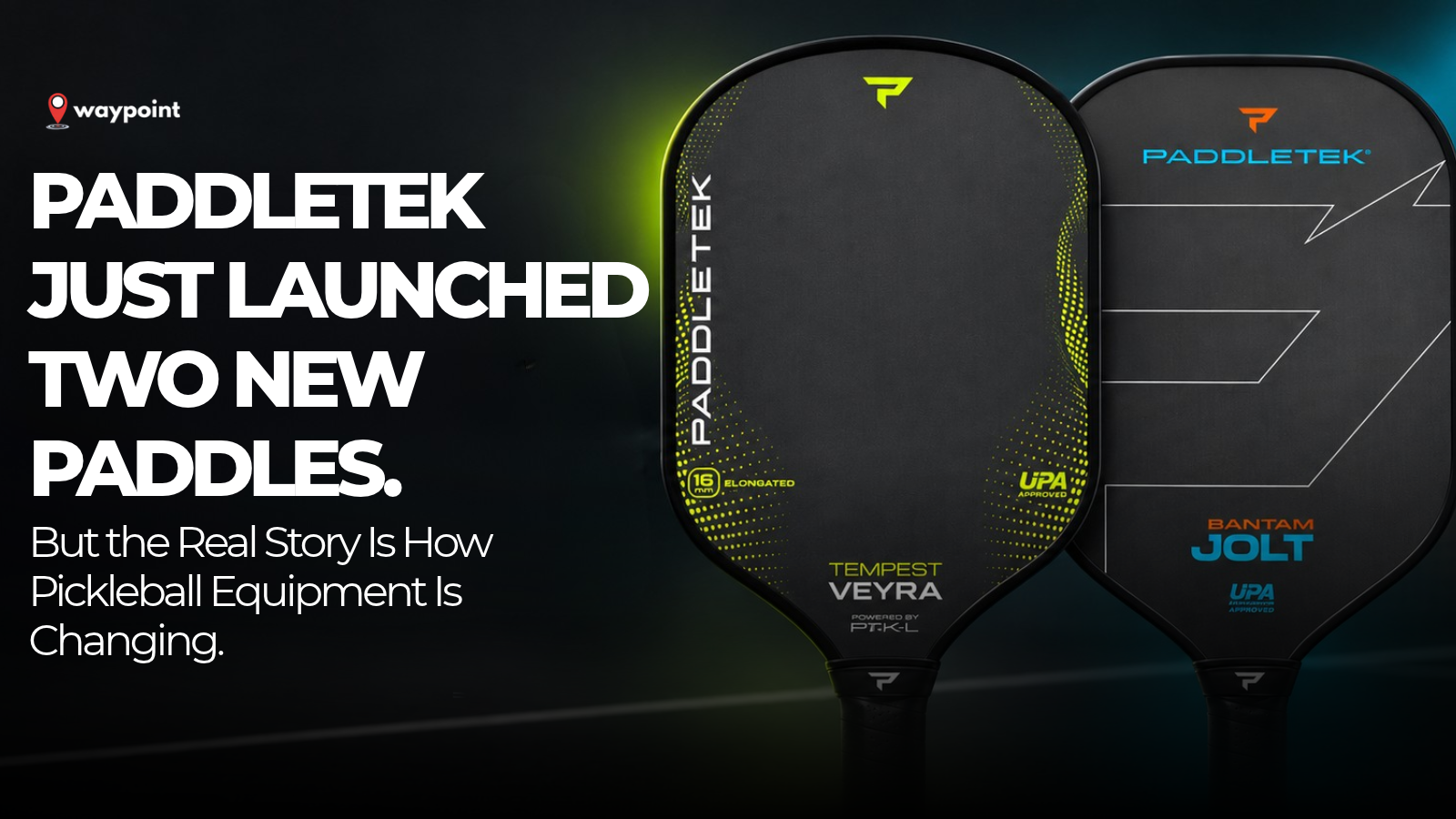

The Bantam Jolt and Tempest Veyra signal another shift in pickleball technology. But will better paddles actually make us better players?
Published: 2 November 2026 | Waypoint Sports & Equipment
The pickleball equipment industry has a new obsession: foam.
For years, manufacturers competed over carbon fibre surfaces, honeycomb cores, thermoforming, paddle shapes and increasingly powerful constructions.
Now, another technological shift is gathering momentum.
Paddletek has introduced two new models, the Bantam Jolt and Tempest Veyra, bringing different approaches to foam-core construction into two of its established paddle families.
Both are designed to deliver modern performance, but they target distinctly different playing preferences.
One prioritises aggressive power.
The other emphasises control, stability and a more predictable response.
And together, they raise an interesting question.
Are we entering an era where the best pickleball paddle is no longer the most powerful one, but the one that best understands how you play?
Two New Paddles. Two Different Philosophies.
Paddletek has built its reputation around equipment used by recreational players and some of the world’s leading professionals.
Its Bantam family has traditionally appealed to players seeking power, while the Tempest family has emphasised control and all-court performance.
The new releases continue that distinction, but introduce updated internal constructions intended to change how the paddle interacts with the ball.
Both models feature 16 mm foam-based cores and micro-textured T700 raw carbon fibre hitting surfaces.
Both are available in elongated and widebody shapes.
But beneath those similarities are two different approaches to generating performance.
Bantam Jolt: Power With More Forgiveness
Launch price: US$224.99
The Bantam Jolt is designed for players who enjoy dictating points.
Its central innovation is Paddletek’s FlexCore technology, which combines an expanded polypropylene (EPP) foam centre featuring a scored grid structure with a supportive EVA foam perimeter.
The grid is designed to compress and rebound during ball contact, delivering responsive energy return while increasing the sensation of the ball remaining on the paddle face.
In practical terms, Paddletek is attempting to combine three characteristics that aggressive players often want:
- Powerful drives and attacking shots.
- Increased ball engagement for spin generation.
- A larger, more forgiving effective hitting area.
The elongated model measures 16.5 inches by 7.5 inches, providing additional reach and leverage.
The widebody version measures 16 inches by 8 inches, offering a broader hitting surface and potentially greater forgiveness during fast exchanges.
Professional player Christian Alshon is among the athletes associated with the new Jolt.
But there is an important distinction between a paddle being designed for power and a paddle actually improving a player’s attacking game.
More power is only useful when it remains controllable.
Players who already struggle with excessive pop, rushed volleys or inconsistent resets may find that increasing their equipment’s power does not solve their underlying problems.
In some cases, it may amplify them.
The real test for the Bantam Jolt will be whether its redesigned core delivers enough predictability to make aggressive play more sustainable.
Tempest Veyra: Is Control Becoming the New Competitive Advantage?
Launch price: US$179.99
While the Jolt targets aggressive players, the Tempest Veyra takes a different approach.
It uses a full-foam construction with integrated dampening rods positioned along the paddle’s perimeter.
These elements are designed to improve stability, expand the effective sweet spot and produce a softer, more controlled impact sensation.
The goal is not simply to reduce power.
It is to make the paddle’s response more predictable across different types of shots.
That distinction matters enormously in modern pickleball.
At higher competitive levels, points are rarely won through power alone.
Players must constantly transition between aggressive drives, controlled blocks, delicate dinks, defensive resets and sudden counterattacks.
A paddle that performs exceptionally during full swings but becomes difficult to manage during soft exchanges can create problems.
The Veyra attempts to address this balance.
The JW and Jorja Johnson Connection
The Tempest Veyra also has an interesting professional background.
JW Johnson and Jorja Johnson spent time experimenting with different paddle brands before settling on an unreleased design associated with PIKKL.
Following Paddletek’s acquisition of PIKKL in July 2026, that design has emerged commercially as the Tempest Veyra.
The Johnson siblings have demonstrated how effective controlled, adaptable pickleball can be at the highest levels.
Their equipment preferences highlight an important development.
Professional players are not necessarily looking for maximum power. They are looking for equipment that allows them to execute their complete game.
That includes the ability to generate pace when necessary without sacrificing control during delicate exchanges.
JW uses an elongated configuration, while Jorja favours a widebody shape.
Their choices also demonstrate that even players competing at the highest level may prefer different paddle geometries.
There is no universally correct shape.
There is only the shape that works best for the individual.
Bantam Jolt vs Tempest Veyra: Which Paddle Should You Choose?
On paper, the distinction is relatively straightforward.
| Feature | Bantam Jolt | Tempest Veyra |
| Price | US$224.99 | US$179.99 |
| Core | FlexCore EPP grid with EVA perimeter | Full foam with perimeter dampening rods |
| Thickness | 16 mm | 16 mm |
| Surface | Micro-textured T700 carbon fibre | Micro-textured T700 carbon fibre |
| Shapes | Elongated / Widebody | Elongated / Widebody |
| Primary focus | Power and attacking performance | Control and all-court versatility |
| Potential audience | Aggressive players | Players seeking balanced performance |
However, specifications alone cannot tell the complete story.
Swing weight, twist weight, balance, grip size and individual technique all influence how a paddle performs.
A widebody paddle may offer greater stability but sacrifice some reach.
An elongated paddle may provide additional leverage but feel less manoeuvrable during rapid exchanges.
Even two paddles with identical thicknesses can produce dramatically different sensations.
Players should therefore be cautious about choosing equipment based entirely on professional endorsements or marketing descriptions.
The best paddle is not necessarily the one your favourite professional uses. It is the one that helps you execute your own game more consistently.
The Bigger Story: Pickleball’s Equipment Arms Race
The arrival of these two paddles reflects a much larger transformation.
Pickleball equipment has evolved rapidly as manufacturers compete to deliver increasingly sophisticated performance characteristics.
Carbon fibre technology, perimeter weighting, foam structures and new manufacturing techniques are changing expectations.
However, the industry faces an interesting contradiction.
As equipment becomes more advanced, choosing the right paddle may actually become more confusing.
Players are presented with increasingly technical terminology.
They are told about dwell time, energy return, twist weight, swing weight, surface friction and core deformation.
Yet many players still struggle to answer the most basic question:
Will this paddle actually help me play better?
This is where the industry needs to evolve beyond product launches.
Equipment selection should increasingly be connected to measurable player development.
For example, a player struggling with defensive resets may benefit from greater stability and a more predictable response.
Another player who lacks attacking penetration may prefer additional energy return.
But neither improvement should be assumed simply because a manufacturer advertises those characteristics.
The answer depends on the player.
Why Better Equipment Does Not Automatically Mean Better Pickleball
There is a tendency in modern sport to believe that equipment upgrades translate directly into performance improvements.
Sometimes they do.
Often, the relationship is more complicated.
Consider a player who consistently attacks too early.
A more powerful paddle may make those attacks faster.
But it will not necessarily improve shot selection.
Similarly, a player who struggles to transition between hard and soft shots may benefit from a more forgiving paddle.
However, equipment alone cannot correct poor preparation, excessive grip tension or inefficient movement.
These are technical and decision-making challenges.
This distinction becomes especially important as paddles become more expensive.
Players should consider three questions before upgrading:
1. What problem am I trying to solve?
Is the issue insufficient power, inconsistent control, limited reach or difficulty handling fast exchanges?
2. Is the problem caused by my equipment or my technique?
A new paddle may help, but a coaching session could sometimes deliver a greater improvement.
3. Can I measure the difference?
Rather than relying entirely on initial impressions, players should test equipment through repeatable drills and realistic match situations.
An equipment upgrade should ideally produce improvements that players can recognise and reproduce.
The Future of Pickleball Is About More Than Paddles
Paddletek’s latest releases illustrate how quickly equipment technology is progressing.
But innovation in pickleball should not stop at manufacturing.
The next stage of the sport’s development must also include better coaching, player information, structured competitions and more accessible opportunities to improve.
Imagine an environment where players can track their development, understand their playing characteristics, participate in suitable competitions and discover equipment that complements their abilities.
Instead of purchasing the latest paddle simply because a professional uses it, players could make more informed decisions based on their own progression.
This is part of the broader future that Waypoint is working towards.
Discover Your Game With Waypoint
The pickleball industry is producing increasingly sophisticated equipment.
Waypoint believes the player experience should evolve alongside it.
Waypoint is building a connected sports ecosystem that brings together players, coaching, competitions, facilities, communities and equipment discovery.
Whether you are purchasing your first paddle, preparing for a tournament or looking to improve your competitive performance, the goal is to make your sporting journey easier to navigate.
Find the Right Equipment for Your Game
Interested in the latest paddle technology?
Waypoint aims to connect equipment discovery with the wider player experience, helping players explore products and make more informed decisions as its ecosystem develops.
Explore the Waypoint platform:
Train Smarter. Play Better.
A better paddle can complement your game.
Better technique and decision-making help you make the most of it.
Through the wider Metazone Sports and Waypoint ecosystem, players can discover structured coaching, player development opportunities and competitive experiences.
Whether your goal is improving your third-shot drop, developing a more reliable attack or becoming more comfortable under pressure, progress begins with understanding your game.
Explore your next step at https://waypoint.fan/academy
Join the Waypoint Community
Pickleball is growing rapidly across Asia and beyond.
But a successful sporting ecosystem requires more than equipment sales.
It needs communities, coaches, facilities, events and opportunities that connect players at every level.
Waypoint is developing the infrastructure to bring these elements together.
Players, coaches, clubs, event organisers and sporting brands are invited to discover how they can participate.
Your next paddle might change how you hit the ball. Your next opportunity could change where the game takes you.
Discover Waypoint:
https://waypoint.fan/communities
Final Thoughts: The Best Paddle Is the One That Works for You
The Bantam Jolt and Tempest Veyra represent two compelling directions in modern paddle design.
One explores how foam technology can make aggressive power more accessible.
The other focuses on delivering a controlled, stable response without abandoning attacking potential.
Neither approach is inherently superior.
And neither guarantees better performance.
Ultimately, the most important question is not which paddle has the most advanced technology.
It is whether that technology helps you make better decisions, execute your shots more consistently and enjoy the game.
Because the future of pickleball will not be determined by equipment alone.
It will be determined by what players learn to do with it.
Waypoint — Your Game. Your Journey. Your Next Move.
Sources and References
- Paddletek – Bantam Jolt & Tempest Veyra Launch Page
https://www.paddletek.com/pages/bantam-jolt-tempest-veyra - Paddletek – Bantam Jolt Elongated
https://www.paddletek.com/products/bantam-jolt-elongated - Paddletek – Bantam Jolt Widebody
https://www.paddletek.com/products/bantam-jolt-widebody - Paddletek – Tempest Veyra Elongated
https://www.paddletek.com/products/tempest-veyra-elongated - Paddletek – PIKKL Acquisition Announcement, June 25, 2026
https://www.paddletek.com/blogs/news/paddletek-group-announces-landmark-move-agreement-to-acquire-pikkl-and-signing-of-jw-jorja-julie-johnson-and-hurricane-tyra-black