

For years, pickleball has been described as one of the fastest-growing sports in the world. But there is a difference For years, pickleball has been described as one of the fastest-growing sports in the world. But there is a difference between a sport being played internationally and having a truly global competitive ecosystem.
The first-ever MLP Nations Cup gave us an early look at what that second stage could look like.
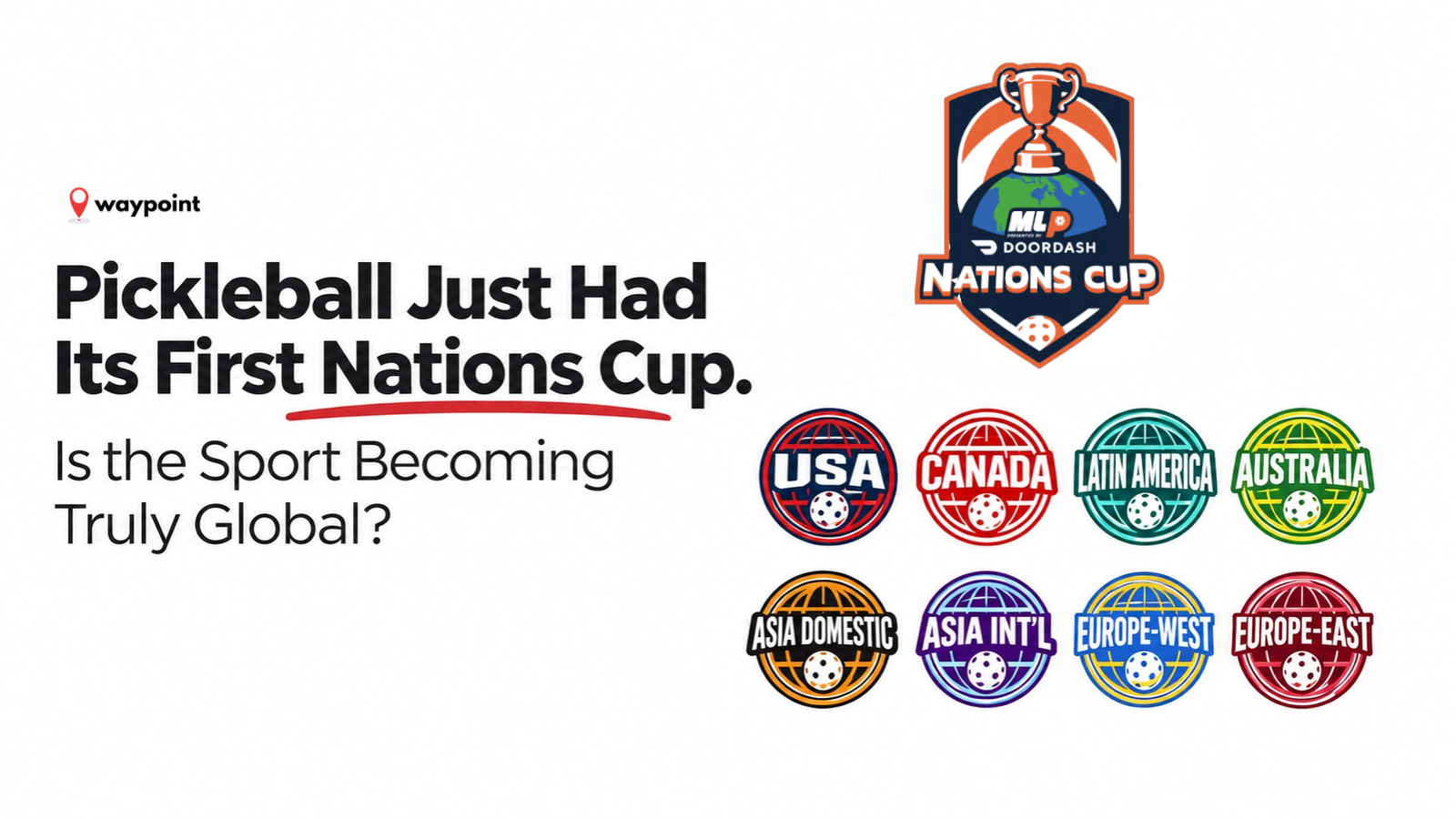
From October 30 to November 1, the inaugural event took place at Brookhaven Country Club in Farmers Branch, Texas. It brought together USA, Canada, Latin America, Australia, Asia Domestic, Asia International, Europe West and Europe East.
As the official Nations Cup event page confirms, the tournament also served as the kickoff to the 2026 Opendoor Pickleball World Championships.
The competition followed Major League Pickleball’s familiar coed team format. According to MLP’s official tournament schedule, the eight teams were split into two groups of four.
Each team played three group matches across Friday and Saturday. The top two teams from each group then advanced to Sunday’s semifinals.
By the end of the weekend, Team USA had become the first MLP Nations Cup champion.
But the trophy only tells part of the story.
Asia Domestic nearly handed USA its only defeat. Latin America recovered from an opening loss to reach the final. Australia won two of its three group matches and still failed to advance.
For a tournament built around international pickleball, the group stage may have told us just as much as the final.
Asia Domestic and Australia Made the Fastest Starts
The first day immediately challenged some of the obvious expectations.
As the Day 1 results and standings show, Asia Domestic opened Group A with a 3–1 win over Europe West. They followed it with a 3–0 sweep of Canada.
Those two wins gave Asia Domestic a perfect 2–0 record after Friday. Their announced roster included players representing China, India, Vietnam and Chinese Taipei.
USA had played only once at that point. The Americans opened their tournament with a 3–1 win over Canada.
Group B produced a similar surprise.
According to Pickleball.com’s Day 1 standings, Australia beat Asia International 3–1 and Europe East 3–1.
That gave Australia a 2–0 start and the early lead in Group B. Europe East sat at 1–1, while Latin America and Asia International were still looking for their first wins.
After the opening day, the two unbeaten group leaders were Asia Domestic and Australia.
Then Saturday changed almost everything.
USA Survived Its Biggest Test
USA began Saturday by sweeping Europe West 3–0.
That set up a meeting with undefeated Asia Domestic for control of Group A.
It became one of the closest matches of the entire tournament.
The published results show that USA won women’s doubles 13–11. Asia Domestic then responded with an 11–6 win in men’s doubles and a 14–12 win in the first mixed doubles game.
USA took the second mixed game 11–4, which forced the tournament’s first DreamBreaker.
The Americans eventually won the DreamBreaker 21–18. That gave them a 3–2 match victory and a perfect 3–0 group record.
As the final group standings confirm, Asia Domestic finished second at 2–1 and still qualified for Championship Sunday.
Europe West ended its tournament with a 3–1 win over Canada. That left Europe West third in Group A at 1–2, while Canada finished fourth at 0–3.
Latin America Turned Its Tournament Around
Group B became far more complicated.
Latin America had started the tournament with a 3–0 loss to Europe East.
On Saturday, however, the team completely changed its position.
The match results show that Latin America swept Asia International 3–0. They then produced another 3–0 sweep, this time against previously unbeaten Australia.
Those two wins turned an 0–1 start into a 2–1 group-stage finish.
Europe East also finished at 2–1. They beat Latin America and Asia International, while their only loss came against Australia.
Australia ended with the same 2–1 record after its two Friday wins were followed by the loss to Latin America.
That left three teams tied on match record.
The final Group B standings published by Pickleball.com placed Latin America first, Europe East second and Australia third.
As a result, Australia missed Championship Sunday despite winning two of its three matches.
For a first international edition, that was an encouraging sign. Several regions were already close enough that one result could completely reshape the standings.
Asia International’s Record Doesn’t Tell the Whole Story
Asia International finished at the bottom of Group B with an 0–3 record.
They lost 3–1 to Australia, 3–0 to Latin America and 3–1 to Europe East.
But their results do not tell the whole story.
As MLP Asia explained in its team announcement, Asia International brought together players from across the new MLP Asia ecosystem.
The announced lineup included Lingwei Kong of the Dragon Warriors, Macy Ybañez of Manila Helios, Hong Kit Wong of the Hong Kong Cannons, Rika Fujiwara of THE DOTS TOKYO, Jimmy Liong of the Malayan Stripes and Tama Shimabukuro of the Viet Panthers.
Tama had already joined the team as a late roster change. Pickleball.com reported before the tournament that the 15-year-old replaced Vietnam’s Hien Truong.
Then the team lost another player before competition began.
Macy Ybañez could not travel to the event because of visa issues. In an Instagram post before the tournament, she explained that she would not be able to join Team Asia International despite being selected for the team.
That meant Asia International entered the event without one of the six players originally announced for its roster.
Why Asia International Still Mattered
The timing is important.
According to MLP Asia’s Nations Cup announcement, its inaugural season begins on November 13.
That means Asia International competed in Texas before the regional league had even played its first official season.
So the team was not necessarily proof of a fully developed Asian professional ecosystem.
It was a preview of one that is still being built.
Macy’s situation also highlighted another side of global sport. Having players from different countries is only the beginning.
Players also need visas, travel access, professional pathways and regular opportunities to compete internationally.
Those challenges matter if pickleball wants to grow beyond simply being played in many countries.
Four Teams Reached Championship Sunday
When group play ended, USA and Asia Domestic advanced from Group A.
Latin America and Europe East progressed from Group B.
As the semifinal announcement shows, USA’s 3–0 record gave it the top position in Group A. Latin America took first place in Group B after its Saturday turnaround.
That produced two cross-regional semifinals.
Asia Domestic faced Latin America, while USA played Europe East.
According to the Nations Cup championship recap, Latin America beat Asia Domestic 3–1.
The win continued a remarkable turnaround for a team that had started the weekend with a 3–0 loss.
USA also advanced past Europe East, setting up a USA versus Latin America final.
USA Finished the Job
The championship match was much more straightforward.
In Pickleball.com’s final recap, USA completed its undefeated weekend by sweeping Latin America 3–0.
The Americans won the three games 11–9, 11–1 and 11–6.
That made USA the first MLP Nations Cup champion.
Latin America fell short of the title, but their path to the final remained one of the best stories of the weekend.
They had been swept in their opening match. Two days later, they were playing for the championship.
USA, meanwhile, finished the entire tournament without a match loss.
What Did Each Team Show?
The final standings make more sense when you look at what each region actually showed.
USA remained the benchmark. According to MLP’s official roster announcement, the team included Ben Johns, Anna Bright, Kate Fahey, Tyra Black, CJ Klinger and Will Howells.
They went through the tournament undefeated.
Latin America showed resilience. They recovered from last place in Group B after their opening match and eventually reached the final.
Asia Domestic may have provided the clearest sign that the competition was not simply ceremonial. They started 2–0, reached the semifinals and forced USA into a DreamBreaker decided by only three points.
Europe East also reached the final four after finishing 2–1 in a tightly contested group.
Australia had perhaps the toughest exit. They started 2–0 and finished with the same 2–1 match record as Latin America and Europe East. However, the final Group B standings left them in third place.
Europe West finished 1–2, with its only win coming against Canada.
Canada ended the tournament 0–3, although its record included one notable moment. The detailed Day 1 results show that Canada beat USA 11–5 in the opening women’s doubles game before the Americans recovered to win the match 3–1.
Asia International also finished without a match victory.
However, they represented an Asian professional league that has not even begun its first season.
Put together, those results make the first Nations Cup more interesting than a simple USA victory.
So, Is Pickleball Becoming Truly Global?
That depends on what we mean by “global.”
If the question is whether pickleball is being played across different parts of the world, then yes.
The official Nations Cup overview positioned the tournament around eight regional teams spanning North America, Latin America, Europe, Asia and Australia.
But being played globally is not the same as having a balanced global professional ecosystem.
USA still brought some of the most established professional players in the sport. The team also went undefeated on home soil.
The United States continues to have a more developed professional infrastructure than many of the regions represented at the Nations Cup.
At the same time, the international teams were not simply there to fill the bracket.
Asia Domestic pushed USA into a DreamBreaker and reached the semifinals.
Latin America reached the final.
Europe East made the final four.
Australia won two matches and still could not advance.
The competitive gap has not disappeared.
But there is increasingly something on the other side of it.
The First One Had to Start Somewhere
The first MLP Nations Cup did not prove that pickleball has completed its transition into a truly global professional sport.
It probably was never going to.
Instead, it created a stage where players from different regional ecosystems could compete under the same format.
It also gave fans something larger than an individual player to support.
That matters for a sport that wants to grow beyond one dominant market.
Regional competitions create identity. They give fans another reason to follow players from outside their home market.
They can also create rivalries and stories that continue from one event to the next.
Over time, those events may give players and fans another reason to travel.
USA won the first MLP Nations Cup.
But the more interesting question may be what happens when these teams meet again after another year of regional leagues, international tournaments and player development.
Pickleball’s global journey is clearly not finished.
The first Nations Cup showed that it has properly begun.
Continue Your Journey
The first MLP Nations Cup showed just how quickly pickleball is growing beyond one region. From Asia and Europe to Latin America and Australia, new players, teams and competitions are helping shape the sport’s global future.
At Waypoint, we’re following the players, tournaments, teams and communities building what comes next.
Our Official Links
Find our website and official social media channels here:
🔗 https://linktr.ee/waypoint.fan
Every Journey Starts With a Waypoint.