
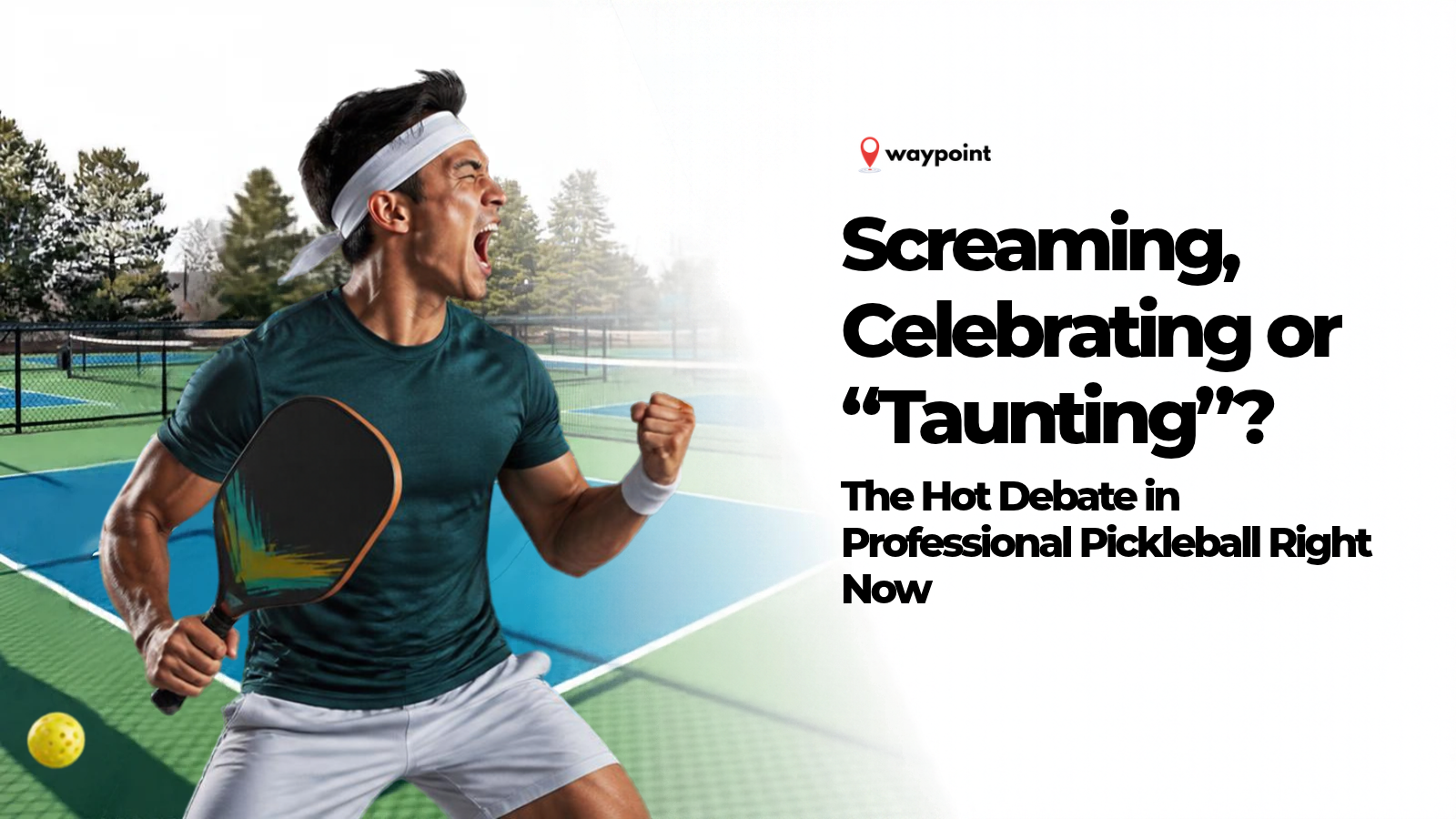

Professional pickleball can get loud. Players celebrate big points, yell during intense rallies and sometimes show a little tension across the net.
Recently, that became part of a bigger discussion after Jim Kloss published an opinion piece on Pickleball.com calling for the PPA to introduce a specific anti-taunting rule. His concern was not simply that players are making noise. He argued that repeated screams, sounds or gestures can cross a line when they appear to be directed at an opponent or used to provoke them.
The article quickly got people talking, including some of the professional players mentioned in the discussion.
What Sparked the Debate?
One of the main examples Kloss pointed to was Genie Bouchard’s match against Maria Ford at the PPA Chicago Cup. He described Ford as screaming after many points, sometimes toward Bouchard, and felt the repeated reactions affected the tone of the match. Bouchard eventually left without the usual paddle tap at the net.
Kloss also argued that the current UPA rules do not specifically define or prohibit “taunting,” which is why he proposed a separate rule. His version would consider things such as how often the behavior happens, how loud it is, whether it is directed at an opponent, whether it follows an opponent’s mistake and whether negative or profane language is involved. Referees would then have discretion to warn or penalize behavior they believed crossed into unsportsmanlike conduct.
Importantly, his argument is not that every celebration should be penalized. He distinguishes between normal displays of emotion and behavior he believes is intended to provoke another player.
That distinction is also where the debate becomes less straightforward.
Here’s How the Players Responded
Kate Fahey, who was mentioned in the article, responded directly to Kloss on X. She questioned why her yelling was being singled out while other players have spoken directly toward opponents at the net.
@pickleball_jim Appreciate the cover photo, Jim. But if you’re going to call me out for yelling but not the men who make it a point to trash talk at the net directly to their opponents, that’s “disingenuous”
— Kate Fahey (@katefahey6) October 14, 2026
Anna Bright also joined the conversation with a much shorter response:
“Go watch paint dry if you want to ELIMINATE screaming.”
@pickleball_jim Go watch paint dry if you want to ELIMINATE screaming
— Anna Bright (@annabright108) October 14, 2026
Their responses suggest that the disagreement is not simply about whether sportsmanship matters. It is also about what should actually count as taunting in the first place.
A scream after winning a long rally could simply be excitement. A fist pump could be celebration. A stare across the net might be part of the tension of the match. None of those automatically mean a player is trying to disrespect the person on the other side.
And professional sport has always had emotion. Players celebrate, get frustrated and react when something big happens. Pickleball is not really any different.
Is a Little Drama Actually a Bad Thing?
When Waypoint spoke with Lingwei Kong, she talked about enjoying the energy of women’s doubles, including the screaming and even a little bit of drama and chaos.
Lingwei was not responding to this particular debate, but her answer adds another perspective. For some players, that kind of energy is part of what makes competing fun.
It can also be part of what makes professional sport entertaining to watch. Rivalries, reactions and personalities give fans something to connect with beyond the score itself.
If the players involved understand that energy and are comfortable with it, a little screaming or drama does not necessarily mean something has gone wrong.
The conversation changes when it becomes personal.
When Does It Actually Go Too Far?
Professional pickleball already has rules for unsportsmanlike conduct. Under the current UPA-A rulebook, players can be sanctioned for audible or visible behavior that is abusive, threatening or degrading and directly targets another person, as well as other conduct that compromises the integrity of a match.
So there is already a clear line for behavior that becomes genuinely abusive or threatening. The harder part is everything that falls short of that. A loud scream after a winner, celebrating an opponent’s mistake, staring across the net or directing a reaction toward the other side may feel disrespectful to one person and like normal competitive emotion to someone else.
That grey area is part of what Kloss is trying to address with his proposed anti-taunting rule. He argues that “taunting” is not specifically defined in the current rules and suggests looking at things like frequency, volume, whether the behavior is directed at an opponent and whether it follows an opponent’s error. But even with those factors, there is still some judgement involved. Different players may have very different comfort levels, and the same reaction can come across differently depending on the match, the rivalry and what happened immediately before it.
Maybe that is why this debate is difficult to settle with one simple rule. Professional pickleball can have screaming, celebrations and a little drama while still expecting players to respect each other. The challenge is deciding when competitive emotion stops being part of the match and becomes something deliberately aimed at the person across the net.
What do you think? Where should professional pickleball draw that line?
Continue Your Journey
Want more stories, conversations and moments from the world of pickleball?
Follow Waypoint as we explore the players, events and communities shaping the sport.
Website
🌍 waypoint.fan
Instagram
📸 @waypoint.fan
Every journey starts with a Waypoint.