
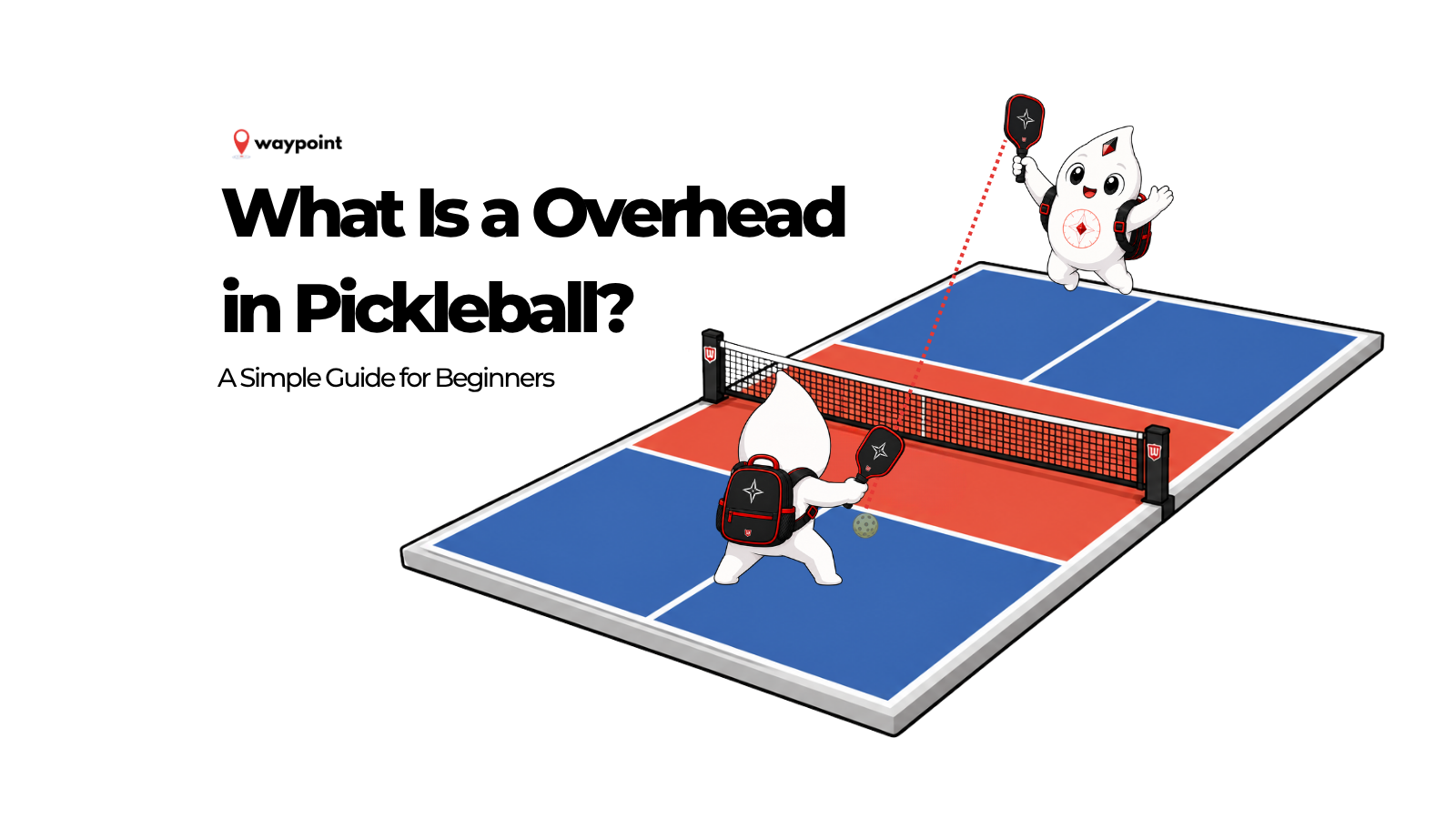

If your opponent sends the ball high into the air, you may have the chance to hit it back from above your head. This shot is called an overhead.
An overhead is often used to return a lob or another high ball. It can be one of the most powerful shots in pickleball, but control and positioning are just as important as hitting hard.
Here is what an overhead means, when to use one, and how to hit it safely and with more control.
What Is an Overhead in Pickleball?
An overhead is a shot hit from above your head, usually when your opponent sends up a lob or another high ball.
It is sometimes called an overhead smash because players often hit it firmly and direct the ball down into the opponent’s court.
Unlike a lob, which travels high through the air, an overhead is used to attack the high ball and send it back with pace or careful placement.
When Should You Hit an Overhead?
The best opportunity for an overhead usually comes when your opponent hits a lob that is too low or a ball that floats high enough for you to reach comfortably.
You may choose to hit an overhead when:
- The ball is above your head
- You have enough time to move into position
- You are balanced and can reach the ball comfortably
- The ball is not travelling too far behind you
- You can direct it safely into the court
Do not force the shot if you are reaching, falling backwards, or struggling to get underneath the ball. You can let it bounce and play the next shot from a more stable position.
Why Do Players Use Overheads?
Players use overheads to attack a high ball and put pressure on their opponents.
A good overhead can:
- Send the ball into open space
- Push an opponent farther back
- Aim the ball towards an opponent’s feet
- Make the next return more difficult
- Finish the rally
However, an overhead does not need to end the point immediately. Keeping the ball in the court and making your opponent move can be more effective than swinging as hard as possible.
Where Should an Overhead Go?
Useful targets include open space, a sharp angle, or the feet of an opponent.
During doubles, you can also aim between the two players to create confusion over who should return the ball.
If your opponents are standing near the baseline, hitting directly towards them may allow them to return the shot comfortably. Angling the ball away from them can force them to move and leave the court open for your next shot.
You do not need to aim directly at the lines. Choose a target with enough space around it so you can attack without making an unnecessary error.
How to Hit an Overhead
An overhead should feel controlled, even when you are hitting it firmly.
First, move your feet and position yourself underneath the ball. Turn slightly sideways rather than facing the net completely.
Raise your non-paddle hand towards the ball to help you track it and maintain your balance. Prepare your paddle behind your head, then contact the ball high and in front of your body.
Focus on these basics:
- Move into position early.
- Turn your body slightly sideways.
- Use your non-paddle hand to track the ball.
- Keep your eyes on the ball.
- Contact it high and in front of you.
- Swing firmly towards your target.
- Return to a balanced position.
You do not need an extremely large swing. A compact motion and clean contact will usually give you more control.
Can You Let the Ball Bounce First?
Yes. You do not always have to hit an overhead out of the air.
Hitting it before the bounce can create more pressure, but letting it bounce may give you more time if the lob is deep or difficult to reach.
After the bounce, move behind the ball and hit from a balanced position. The shot may have less power, but it is often safer than reaching backwards or rushing.
Can You Hit an Overhead in the Kitchen?
It depends on whether the ball has bounced.
If you hit the overhead before the ball bounces, it counts as a volley. You cannot be standing in the kitchen or touching the kitchen line when you hit it. Your momentum also cannot carry you into the kitchen afterwards.
If the ball bounces first, you are allowed to step into the kitchen and hit it.
An easy way to remember it is:
No bounce: Stay outside the kitchen.
Ball bounced first: You may step inside and play the shot.
Common Beginner Mistakes
Swinging as Hard as Possible
Power is useful, but hitting too hard can send the ball into the net or beyond the baseline.
Start with a controlled swing and focus on hitting a clear target.
Moving Backwards While Facing the Net
Backpedalling can make it difficult to stay balanced and see where you are going.
Turn sideways and shuffle back, or turn around and move towards the ball before setting up your shot.
Waiting for the Ball to Come Too Close
If the ball moves directly above or behind your head, controlling the shot becomes more difficult.
Move early so you can contact it slightly in front of your body.
Using Only Your Arm
Good positioning makes the overhead easier.
Use your feet to move underneath the ball and allow your body to support the swing instead of reaching with only your arm.
Aiming Directly at an Opponent
Hitting towards open space or an opponent’s feet is usually safer and more effective than aiming at their body.
Trying to Hit Every Lob Out of the Air
Some lobs are too deep or too difficult to reach safely.
Letting the ball bounce is often the better choice when you need more time.
Watching the Shot After You Hit It
Return to a balanced position immediately.
Your opponent may defend the overhead and send the ball back, so be ready for another shot.
What Should You Do If a Lob Goes Over Your Head?
Do not keep reaching backwards for a ball that has already travelled behind you.
Turn towards the baseline and move back to the ball. Let it bounce if needed, move behind it, and play your return from a stable position.
In doubles, communicate with your partner so both players know who is chasing the lob.
The goal is to reach the ball safely and stay in the rally. Not every lob needs to be returned with an overhead.
Quick Recap
An overhead is a shot hit from above your head, usually in response to a lob or another high ball.
It can be used to create pressure, move your opponents, or finish the rally. A good overhead depends on early movement, balance, clean contact, and smart placement.
You do not need to hit every overhead with maximum power. Moving into the right position and choosing a safe target will make the shot much more reliable.
Continue Your Journey
Love pickleball?
Discover more beginner guides, player stories, travel inspiration, and the latest from the community.
Website
🌍 https://waypoint.fan
Instagram
📸 @waypoint.fan
Every journey starts with a Waypoint.