

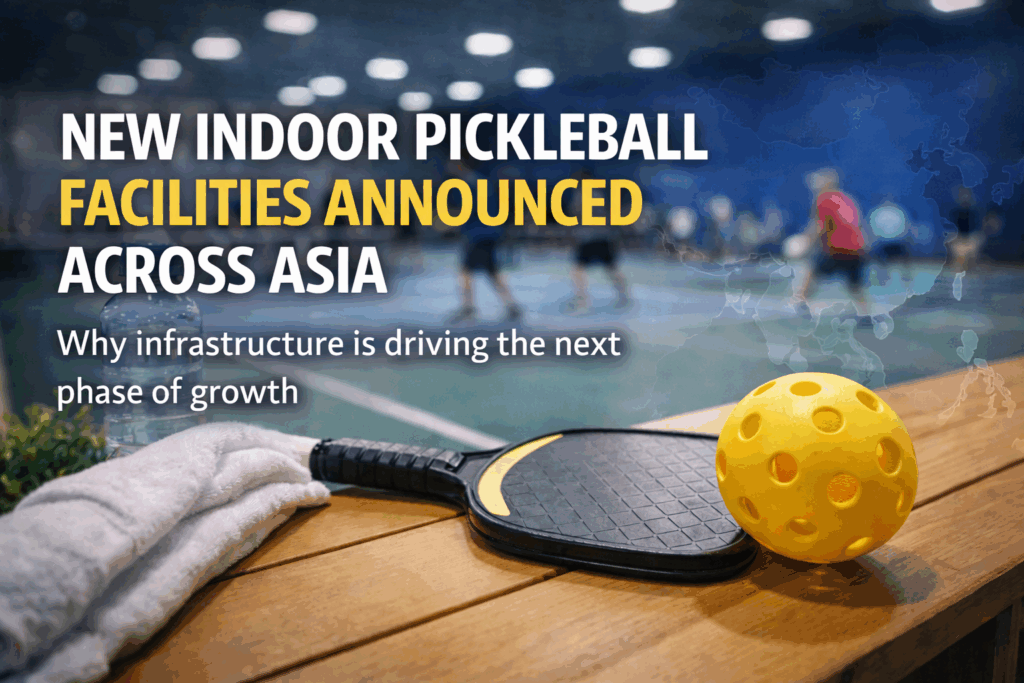
Indoor pickleball infrastructure across Asia is expanding at an accelerated pace, with new facilities announced in major cities throughout China, Southeast Asia, and East Asia. This surge reflects a deeper shift in how pickleball is being positioned — not as a temporary trend, but as a permanent, scalable urban sport.
More importantly, it highlights why Asia may define pickleball’s next growth phase.
Why Indoor Pickleball Facilities Are Expanding Now
Unlike early pickleball growth driven by outdoor courts and shared spaces, Asia’s expansion is intentionally indoor-first.
Key drivers include:
- Climate and weather consistency
- High urban density
- Commercial real estate partnerships
- Demand for year-round programming
- Corporate and school league adoption
Indoor facilities allow operators to control experience, scheduling, coaching quality, and monetisation — all critical for long-term sustainability.
Cities Leading the Indoor Pickleball Push
Recent announcements and developments point to momentum in:
- Tier-1 Chinese cities with converted industrial spaces
- Southeast Asian capitals integrating pickleball into lifestyle hubs
- Mixed-use developments combining fitness, F&B, and sport
- Private clubs positioning pickleball as a premium social sport
Unlike earlier markets, many of these facilities are launching with multiple courts, coaching programs, and league structures from day one.
Why Asia’s Indoor Model Is Different
Asia is not simply copying Western pickleball infrastructure.
Key differences include:
- Higher emphasis on programming over open play
- Stronger integration with schools and corporations
- Faster adoption of league and ranking systems
- Indoor courts treated as revenue engines, not amenities
This creates higher player retention and more predictable utilisation compared to casual outdoor setups.
What This Means for Players Right Now
For players, indoor expansion changes the experience immediately:
- More consistent playing conditions
- Greater access to coaching and structured sessions
- Increased league and tournament opportunities
- Clearer development pathways
Players entering through indoor facilities are more likely to stay engaged long-term.
What This Means for Clubs and Operators
For operators, indoor pickleball represents:
- Better revenue stability
- Higher lifetime value per member
- Stronger brand differentiation
- Easier talent development and event hosting
Facilities that launch with structure — not just courts — are seeing faster break-even timelines and stronger community formation.
The Bigger Picture: Infrastructure Shapes the Sport
Pickleball’s future in Asia will not be decided by how many people try it once, but by how many can play consistently, comfortably, and competitively.
Indoor infrastructure enables:
- Skill progression
- Professional coaching pipelines
- Media and streaming
- Sustainable leagues and tournaments
This is how a sport matures.
Asia’s approach suggests pickleball is entering its infrastructure-led growth era.