
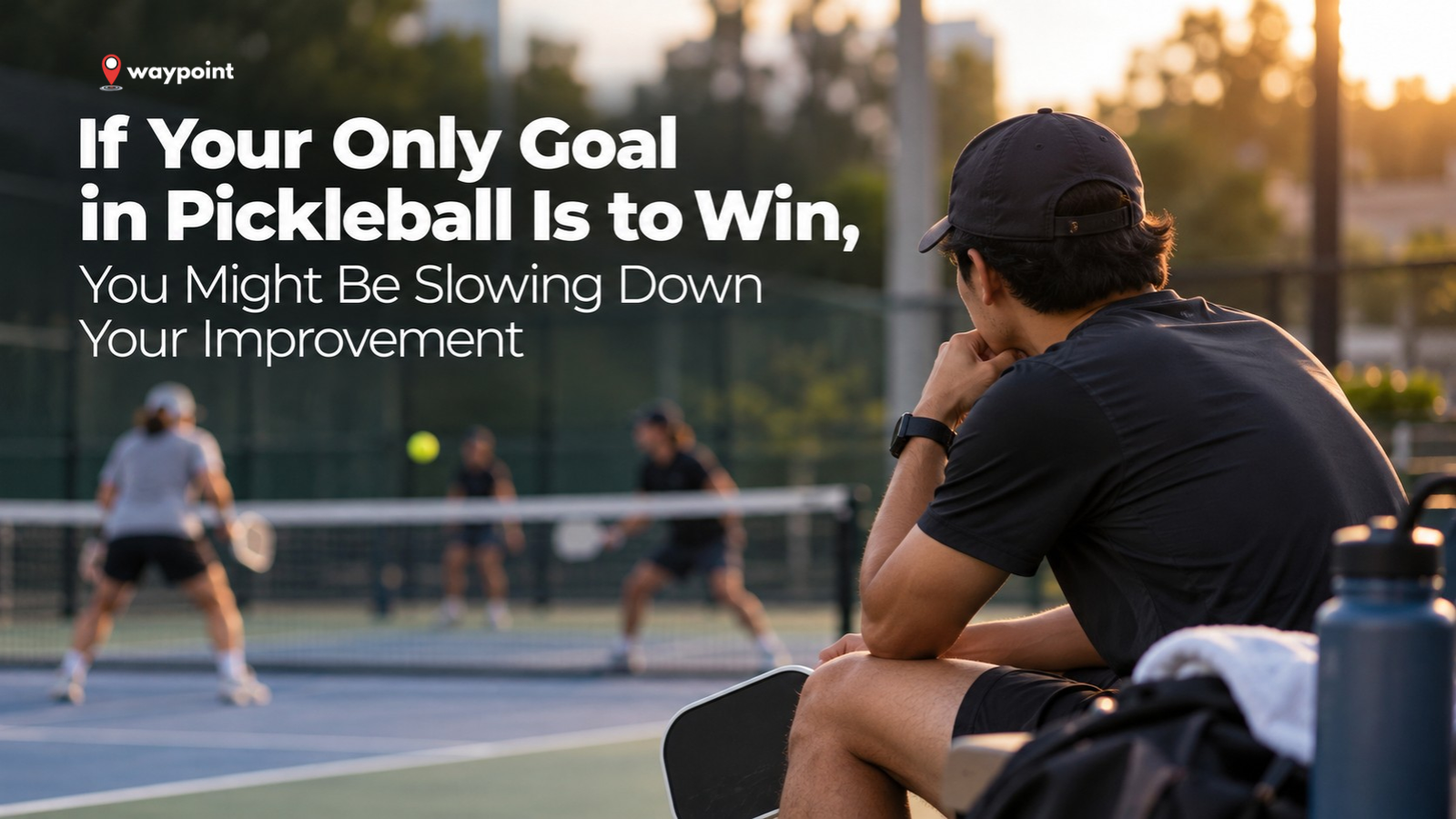

Winning feels good. But if every pickleball session is judged only by whether you won or lost, you might be missing the information that actually helps you become a better player.
You win three games in a row and leave the court feeling pretty good about yourself. Maybe your serve was working, your partner covered the middle well and your opponents made enough mistakes for you to take the match comfortably.
But did you actually improve?
That is a different question. Winning tells you what happened on the scoreboard, while learning requires you to understand why it happened, what stopped working when you were under pressure and which parts of your game still need attention.
Sometimes the match you lose gives you much better answers.
Winning and Improving Are Not Always the Same Thing
There is nothing wrong with wanting to win. Competition is part of what makes pickleball fun, and when you enter a tournament, winning is obviously the goal.
The problem comes when winning becomes the only way you measure whether a session was successful. If your only objective is protecting the score, you naturally start relying on what already works. You might run around a weak backhand, avoid the third-shot drop you are still learning or target the weaker opponent instead of giving yourself situations that actually challenge you.
Those choices may help you win today, but they do not necessarily help you become better tomorrow.
There is research behind that distinction. A 2016 meta-analysis of deliberate practice in sport found that deliberate practice accounted for about 18% of the differences in sports performance across the studies analysed. That does not mean practice explains everything, but it does support the idea that structured activities designed specifically to improve performance matter.
And that is very different from simply playing more games.
You can play pickleball four times a week and still spend most of those hours repeating the exact patterns you already trust. If nobody forces you to use the shot you avoid, it can stay weak for a very long time.
The Shots You Struggle With Are Giving You Information
Think about the last match where you felt uncomfortable.
Maybe someone kept attacking your backhand. Maybe your return kept landing short. Maybe you reached the kitchen but could not reset a hard ball. Or perhaps every time a dink rally lasted longer than a few shots, you became impatient and sped it up too early.
It is easy to leave that game thinking, I played badly.
A better question is: what did that match just show me?
One of the most useful ideas from motor-learning research is the Challenge Point Framework, which suggests that learning depends partly on the amount of useful information a task gives the learner. A task that is far too easy may not provide enough challenge, while one that is far beyond your ability may be too difficult to learn from effectively. The useful zone sits somewhere in between, where the task is difficult enough to expose what you need to adapt but still achievable for your current level.
That fits pickleball surprisingly well.
If you only play people you comfortably beat, you may leave with a great record without discovering very much about your game. A stronger opponent who repeatedly exposes the same weakness can be frustrating in the moment, but they may also be showing you exactly where your next improvement needs to come from.
The loss is not automatically valuable.
What you do with the information afterwards is.
Practice Is Where You Actually Work on the Problem
This is where simply playing more matches can become limiting.
A match gives you whatever situation happens to appear. You might only hit three difficult third-shot drops in an entire game, or perhaps your opponent never attacks the side you are trying to improve. That is not enough repetition to properly work through a weakness.
Focused practice lets you isolate it.
If your third-shot drop is inconsistent, you can deliberately repeat that situation. If your backhand reset keeps popping up, you can work specifically on that movement rather than waiting for the right ball to appear once every few rallies. Once the basic skill becomes more comfortable, you can make the practice less predictable by changing locations, speeds and situations.
There is research supporting that progression too. A 2024 systematic review and meta-analysis on contextual interference in motor learning found an overall advantage for more random and varied practice when researchers looked at how well skills transferred to new situations. Importantly, the benefit was much clearer in controlled laboratory studies than in real-world applied settings, so it would be too simplistic to say random practice is always better.
The practical takeaway is much more useful: do not choose between drills and games as though one is always superior.
Learn the movement. Repeat it enough to understand it. Then gradually make the situation more varied and game-like until you have to recognise when and how to use it under pressure.
This Is Why Waypoint Player Practice Exists
This is also the thinking behind Waypoint Player Practice.
A lot of players know they want to improve, but the difficult part is figuring out what to work on once they leave the court. You might know your third shots were bad or that your returns kept sitting up, but that still leaves the question: okay, what do I actually practice now?
Waypoint Player Practice is designed to make that next step clearer. Instead of presenting one huge random collection of drills, practice is organised through a progression from Foundation, into Core Skills, Advanced Skills and eventually Performance Practice, with drills covering areas such as serves, returns, third shots, dinks, volleys, footwork, doubles play and fitness.
The idea is not to replace playing matches.
It is to give you somewhere to go after the match has shown you what needs work.
If you notice that your serve breaks down when you try to add depth, you can work specifically on serving. If opponents keep catching you out during transition, you can focus on the skills involved in moving towards the kitchen. If your dinks are comfortable during a simple drill but fall apart once someone starts changing direction and pace, the next step is to practice in a more demanding situation.
That creates a much more useful cycle:
Play to discover the weakness. Practice to work on it. Then play again to see what changed.
That last part matters because drills are not the final goal either. Eventually, the skill has to survive a real rally, against a real opponent, when you do not know exactly where the next ball is going.
A Bad Practice Session Can Still Be a Good Learning Session
This is one of the harder things to accept when you are trying to improve.
Learning something new can temporarily make you look worse.
Your new drop might go into the net. Your backhand reset may sit too high. You might lose points because you are deliberately trying to reach the kitchen instead of staying comfortably at the baseline and driving everything.
That does not automatically mean the practice failed.
Research on motor learning repeatedly distinguishes between performance during practice and longer-term learning. The same 2024 contextual-interference research found that practice conditions which make immediate performance harder can sometimes produce better retention or transfer later, although the strength of that effect depends heavily on the setting.
In other words, looking good during every repetition is not always the point.
Sometimes the useful session is the one where you struggle enough to understand what is missing.
Change What You Count as a Win
This does not mean the scoreboard suddenly stops mattering.
It means it stops being your only measure.
Sometimes the win is finally recognising why your return keeps sitting up. Sometimes it is successfully hitting five backhand resets you normally avoid. Sometimes it is losing 11-8 to players who would have beaten you 11-3 a month ago.
There is even some evidence that focusing on mastery and improvement can coexist with better sporting performance. A 2024 systematic review and meta-analysis of achievement goals in sport found a small positive relationship between task-focused goals, where success is judged through mastery and improvement, and sporting performance. The relationship was modest, so this should not be interpreted as “focus on improvement and you will automatically win,” but it supports the idea that progress itself is a meaningful performance goal.
You still want to win.
You simply stop expecting the final score to tell you everything about whether you are getting better.
Play to Win. Learn From What Stops You.
When you are competing, compete.
Use your strongest patterns, make smart decisions and try to win the match.
But when you are trying to improve, pay attention to the moments that make you uncomfortable. If someone keeps beating you with the same shot, notice it. If you keep avoiding your backhand, ask yourself why. If you struggle every time you enter the transition zone, that is probably where some of your practice time needs to go next.
Then take that problem into focused practice, work through it and bring it back into the game.
Because the players who improve are not necessarily the people who leave every session with the best win-loss record. They are the people who leave understanding something about their game that they did not understand before.
A win tells you who won today. A weakness tells you what to work on tomorrow.
And eventually, learning how to fix it may help you win a lot more of those matches anyway.
Continue Your Journey
Not sure what to work on after your next game? Waypoint Player Practice helps turn the weaknesses you notice on court into structured practice, so you can work on individual skills and take them back into real play.
Our Official Links
Find Waypoint, Player Practice and our official social channels here:
🔗 https://linktr.ee/waypoint.fan
Every Journey Starts With a Waypoint.