
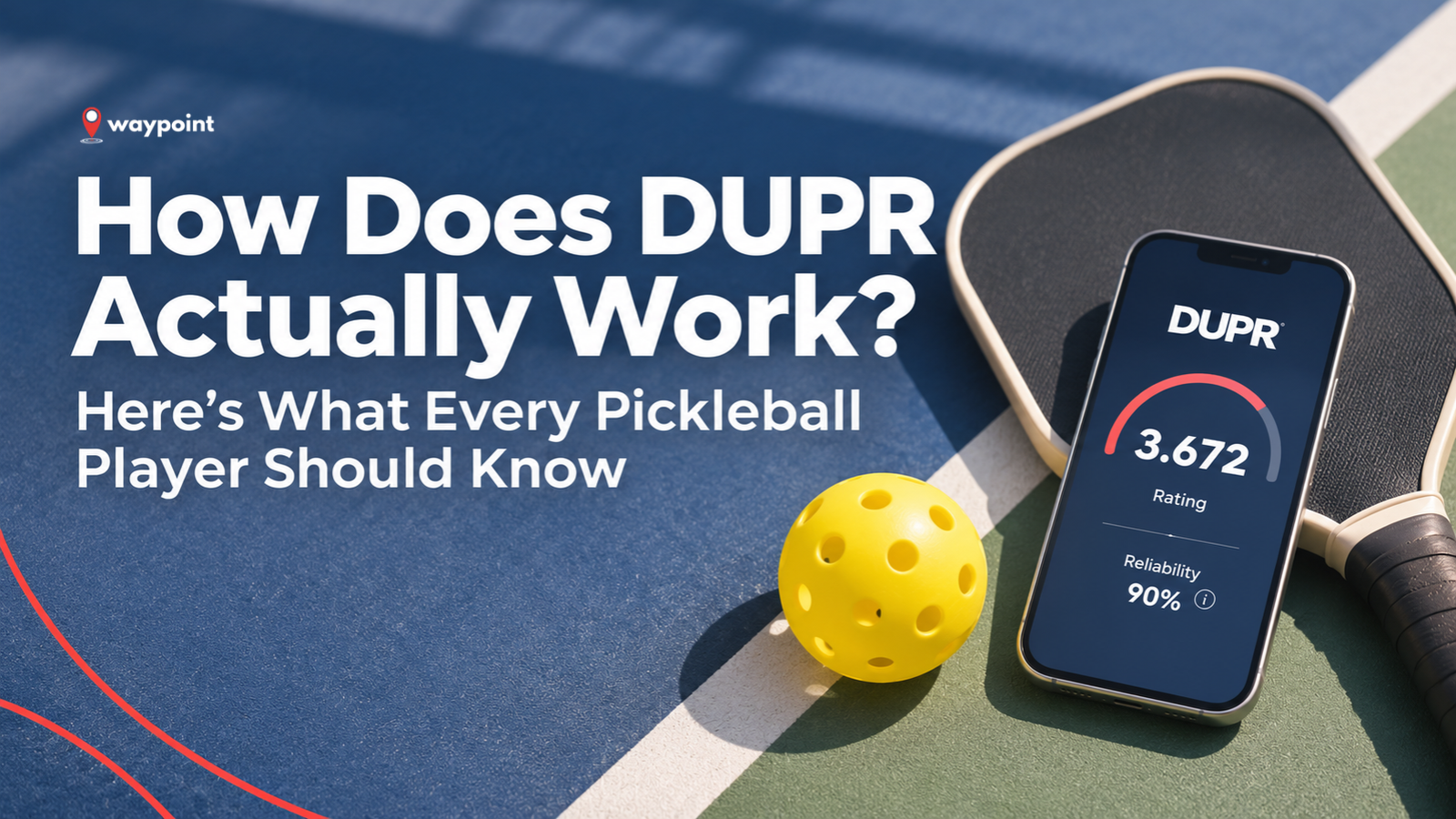

Ever wondered how your DUPR rating works? From match results and skill levels to rating changes, here’s how pickleball’s rating system works and why winning doesn’t always mean gaining points.
If you’ve been playing pickleball for a while, you’ve probably heard someone mention their DUPR rating. Maybe they’re a 3.0, a 3.5 or even a 4.0. But what do these numbers actually mean, and how does DUPR determine your skill level?
Here’s something that might surprise you: winning a pickleball match doesn’t always increase your DUPR rating. In certain situations, your rating can even decrease after a victory. To understand why, we first need to look at how the system works.
What Is a DUPR Rating?
DUPR stands for Dynamic Universal Pickleball Rating, a system designed to measure players’ skill levels using actual match results. Unlike self-assessment systems, DUPR calculates ratings based on recorded performances against other players.
According to DUPR’s official website, ratings range from 2.000 to 8.000, with higher numbers generally representing stronger competitive performance. Players have separate ratings for singles and doubles because the two formats require different skills.
The system helps players track their progress, find opponents of similar abilities and participate in competitions at suitable skill levels. However, your rating isn’t determined by how many matches you’ve won alone.
How Does DUPR Calculate Your Rating?
DUPR uses a modified Elo algorithm that compares your actual performance against what the system expected based on the players’ ratings.
According to DUPR’s rating explanation, four main factors influence your rating: performance against expectations, match type, recency and match volume.
The most important factor is how you perform compared to expectations. Before each match, DUPR predicts the expected score using the players’ ratings. If you score more points than expected, your rating may increase. However, scoring fewer points than predicted can cause it to decrease, even if you win.
Match type also matters. Verified tournament, league and club results generally have more influence than self-reported recreational games. Recent performances carry greater weight than older ones, while recording more matches helps make your rating more stable and accurate.
This explains why two players can win the same doubles match but experience different rating adjustments. Their individual match histories can affect how much their ratings change.
Why Doesn’t Your DUPR Always Increase After Winning?
This is one of the most confusing parts of DUPR, especially for beginners.
Imagine your team is expected to win comfortably against a slightly weaker team. You still win, but the score is much closer than predicted. Under DUPR’s performance-based system, your rating could decrease because you performed below expectations.
However, DUPR introduced an important algorithm update on November 4, 2026, changing how certain victories affect ratings.
According to DUPR’s November 24 announcement, when the rating gap between teams is at least 0.5 and the higher-rated team wins, everyone’s rating remains unchanged.
For example, imagine a doubles team with players rated 4.0 facing another team with players rated 3.3. Whether the stronger team wins 11–9 or 11–0, none of the four players’ ratings will change.
However, when teams are separated by less than 0.5, ratings can still change based on performance. A narrow victory against a slightly weaker team could still result in a rating decrease.
The update applies to singles, doubles, tournament matches and self-posted games.
Can Your DUPR Rating Increase Even If You Lose?
Surprisingly, yes. Because DUPR measures performance against expectations, losing a match doesn’t automatically mean your rating will decrease.
For example, imagine you’re playing against someone with a slightly higher rating. If DUPR expects you to lose by a wide margin but you keep the match close, you may have performed better than expected.
In that situation, your rating could increase despite losing. However, remember that the November 2026 update prevents rating changes when the higher-rated player wins with a rating advantage of at least 0.5.
This is why it’s important to understand that DUPR measures competitive performance, not simply wins and losses.
What Do DUPR Ratings Actually Mean?
DUPR uses a scale from 2.000 to 8.000 to represent different competitive levels. Players commonly describe themselves using ratings such as 3.0, 3.5, 4.0 and 4.5.
For example, a player rated 3.5 may generally compete at an intermediate level, while someone rated 4.5 typically plays at a more advanced competitive level.
However, these numbers are not fixed skill certifications. Your DUPR reflects your recorded match performances rather than a checklist of techniques you’ve mastered.
DUPR also displays ratings to three decimal places, such as 3.672, allowing players to see smaller changes over time.
What Is a DUPR Reliability Score?
Your DUPR profile displays another important number called the Reliability Score, which ranges from 1% to 100%.
While your DUPR rating estimates your playing ability, the Reliability Score indicates how dependable that estimate is.
According to DUPR’s official support guide, reliability considers factors such as match history, recent activity and the variety of partners and opponents you’ve played against.
For example, two players might both have a DUPR rating of 3.8, but one has 90% reliability while the other has 25%. The first player’s rating is more established, while the second player’s rating may change as more results are recorded.
A lower Reliability Score doesn’t mean someone is a worse player. It simply means DUPR has less dependable information about their current skill level.
How Do You Get Your First DUPR Rating?
Getting started is relatively simple. First, create an account through the official DUPR website or app. New players initially appear as NR, meaning Not Rated.
You can establish your rating by participating in eligible matches recorded through tournaments, clubs, leagues or self-posted games. Once your first valid match is recorded, DUPR can generate an initial rating.
However, one match isn’t enough to establish a highly reliable rating. DUPR recommends recording at least 10–15 matches to build a more dependable picture of your playing ability.
As you continue competing against different players, the system gathers more data and adjusts your rating accordingly.
Should You Worry About Your DUPR Rating?
Your DUPR rating can be useful for tracking improvement, finding suitable opponents and entering competitions. However, it’s important to remember that a rating is only one measure of your ability.
Two players with similar DUPR ratings may still have different strengths, playing styles and levels of experience. Your rating can also fluctuate as you record more matches, especially when you’re just starting out.
Rather than focusing entirely on reaching a certain number, use DUPR to understand your progress and identify opportunities to improve.
Ultimately, your DUPR reflects your recorded performance, but it doesn’t define everything about you as a pickleball player.
Continue Your Journey
Whether you’re working toward your first DUPR rating or aiming to reach the next skill level, every match is an opportunity to learn.
At Waypoint, we explore the techniques, competitions and communities that help pickleball players improve and enjoy the sport around the world.
Our Official Links
Find our website and official social media channels here:
https://linktr.ee/waypoint.fan
Every Journey Starts With a Waypoint.
Sources & References
- DUPR – How It Works: Understanding Your Pickleball Rating
https://www.dupr.com/how-it-works - DUPR – How Your DUPR Rating Is Calculated
https://www.dupr.com/post/how-your-dupr-rating-is-calculated - DUPR – Important Algorithm Update That Protects Your Wins (November 24, 2026)
https://www.dupr.com/post/dupr-algorithm-update-when-a-win-wont-change-your-rating - DUPR – What’s My DUPR? Check Your Rating and What Each Level Means
https://www.dupr.com/post/whats-my-dupr-check-your-rating-and-what-each-level-means - DUPR – What Is the Reliability Score?
https://dupr.zendesk.com/hc/en-us/articles/26872333542676-What-is-the-Reliability-Score - DUPR – Initialization: How Do I Get a DUPR Rating?
https://dupr.zendesk.com/hc/en-us/articles/20507969625364-Initialization-How-Do-I-get-a-DUPR-rating-How-do-unrated-NR-players-impact-rated-players