
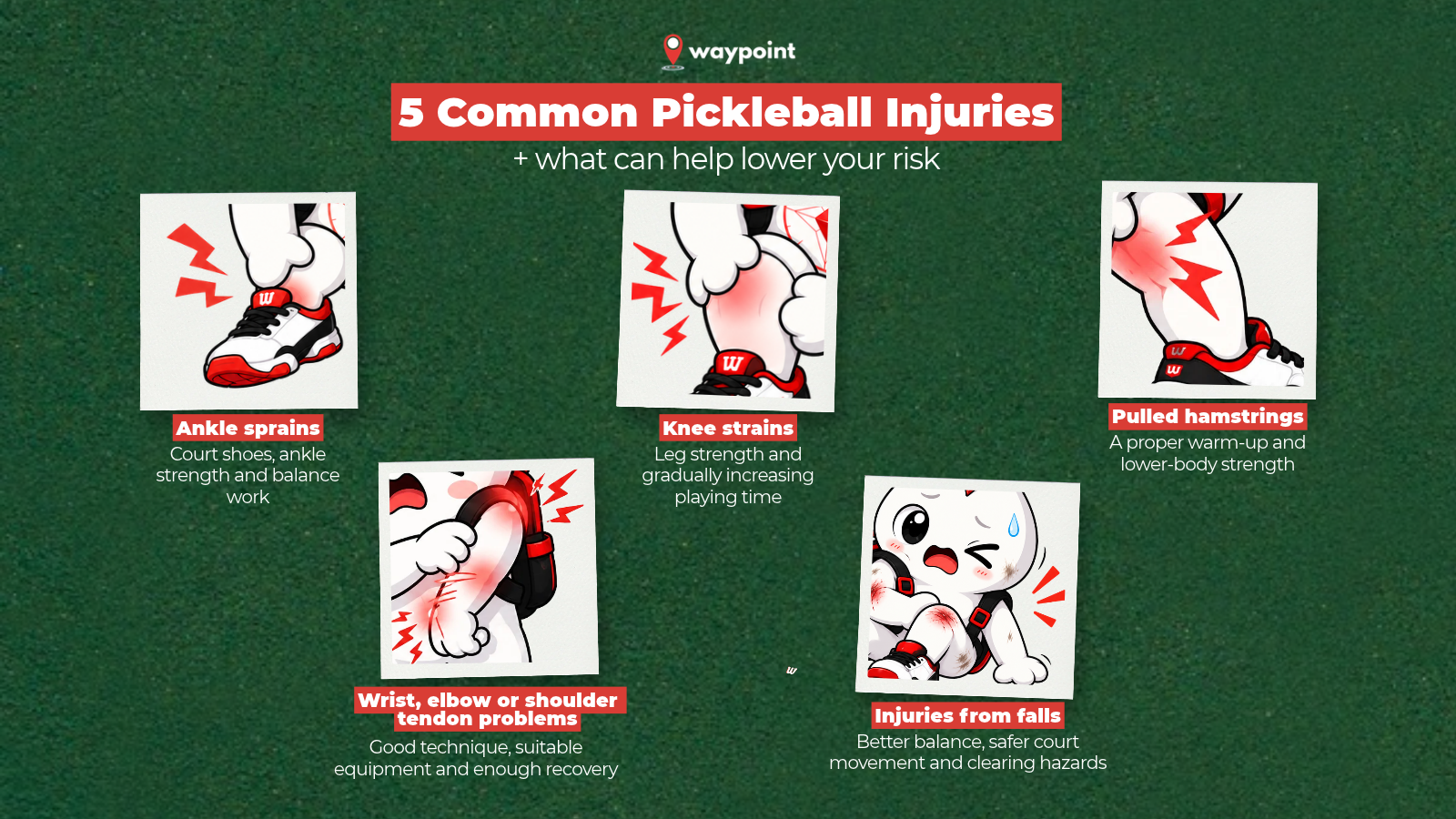

Pickleball might be played on a relatively small court, but your body still has to stop quickly, change direction, reach for low balls and repeat the same movements over and over. Injuries can happen suddenly during one awkward movement, or gradually after weeks of playing more than your body is used to.
Hospital for Special Surgery highlights several injuries its sports medicine specialists see in pickleball players, including ankle sprains, knee strains, pulled hamstrings, upper-body tendon problems and injuries caused by falls.
The good news is that many of the habits that help lower your risk are pretty simple. Warming up properly, building strength, wearing the right shoes, improving your technique and giving your body enough recovery time can all make a difference.
1. Ankle Sprains
Pickleball involves a lot of quick stops and side-to-side movement, so your ankles are constantly helping you change direction and stay balanced. An ankle sprain can happen when the ankle rolls or twists beyond its normal range, particularly during a sudden change of direction or awkward step. HSS describes ankle sprains as the most common pickleball injury seen by one of its sports medicine physicians and points to weak ankle-stabilizing muscles as one factor that can increase the risk.
Strengthening those muscles can help prepare your ankles for the movement required on court. Simple heel raises are one option: slowly rise onto your toes and lower yourself with control. Balance exercises can also help, while proper court shoes give you the support and traction needed for lateral movement. The American Academy of Orthopaedic Surgeons recommends pickleball or tennis shoes rather than footwear that is not designed for court movement.
2. Knee Strains and Irritation
Your knees also deal with a lot during pickleball. Pivoting, lunging and changing direction quickly all place demands on the joint, and players who already have knee arthritis may notice that those repeated movements aggravate it.
Building strength throughout the legs, including the muscles around your hips and glutes, can give your knees more support when you move. It also helps to increase your playing time gradually instead of going from very little activity to several long sessions in a week. HSS specifically recommends overall leg strengthening for knee protection, while AAOS advises players not to suddenly play much harder or longer than their bodies are ready for.
3. Pulled Hamstrings
A short ball can make you sprint forward without warning, while a sudden stop can ask the muscles at the back of your thigh to contract quickly. That is one reason hamstring strains can happen during pickleball, particularly when your muscles are not properly warmed up before play.
A good warm-up does not need to be complicated. Start with a few minutes of easy movement, then gradually add side steps, lower-body movements and gentle hitting before you play at full speed. HSS specifically connects pulled hamstrings with sudden stops on court and recommends warming the muscles before playing.
Strength matters here too. Regular lower-body training away from the court can make your legs better prepared for those quick bursts of movement. Just as importantly, avoid suddenly doubling or tripling the amount of pickleball you play if your body is not used to it.
4. Wrist, Elbow and Shoulder Tendon Problems
Not every pickleball injury happens in one obvious moment. Some problems build slowly through repetition.
Serves, drives, volleys and overheads repeatedly use the wrist, elbow and shoulder. If you are new to pickleball or suddenly start playing much more often, those repeated movements can irritate the tendons over time. HSS includes tendonitis of the wrist, elbow and shoulder among the overuse problems seen in pickleball players and recommends allowing recovery time between sessions, particularly for people who are new to racquet sports.
Technique and equipment matter too. You should not need to grip the paddle as tightly as possible throughout every rally, and constantly forcing shots with your arm can add unnecessary stress. Mayo Clinic specifically highlights proper equipment, appropriate grip size and proper mechanics as ways to reduce unnecessary stress on the hand, wrist and the rest of the body.
5. Injuries From Falls
Sometimes the paddle has nothing to do with the injury.
You might lose your balance while chasing a lob, trip over a stray ball or fall after reaching too far for a shot. When that happens, the natural reaction is often to put your hand out to catch yourself, which can lead to injuries of the hand, wrist or shoulder.
Wrist fractures are one injury to be aware of. Mayo Clinic notes that falling onto an outstretched hand is one of the most common ways a wrist is broken and specifically lists pickleball among activities where these fractures can occur.
This is where your on-court habits matter. Avoid blindly backpedaling for a lob, stop the rally when a stray ball enters the court and move your feet instead of constantly stretching beyond your balance. Working on balance away from the court can help too, with simple exercises such as controlled single-leg stands being one option recommended by HSS.
The Same Basics Help With More Than One Injury
The injuries are different, but a lot of the prevention advice overlaps.
A proper warm-up helps prepare your legs before sudden movements. Strength and balance work can make it easier to control your body when changing direction. Court shoes give you more appropriate support for lateral movement, while good technique can reduce the amount of unnecessary strain you place on your joints and tendons.
Recovery matters just as much. If you are new to pickleball, your body may need time to adjust to the movements even if you feel fit in other ways. Build up gradually instead of suddenly adding hours of play, and pay attention if pain starts getting worse rather than better.
The goal is not to worry about every possible injury while you are playing. It is to give your body a better chance of handling what the game asks it to do.
Quick Recap
| Common Injury | What Can Help Lower the Risk |
|---|---|
| Ankle sprains | Court shoes, ankle strength and balance work |
| Knee strains or irritation | Leg strength and gradually increasing playing time |
| Pulled hamstrings | A proper warm-up and lower-body strength |
| Wrist, elbow or shoulder tendon problems | Good technique, suitable equipment and enough recovery |
| Injuries from falls | Better balance, safer court movement and clearing hazards |
If an injury causes severe pain, significant swelling, difficulty putting weight on a leg, or you think something may be broken, it is better to get it checked rather than trying to keep playing. Head injuries also deserve attention, especially if symptoms such as confusion, blurry vision or unusual sleepiness appear after a fall.
Continue Your Journey
Want more practical pickleball tips, guides and training?
Explore Waypoint Academy and discover more ways to learn and improve your game.
Website
🌍 waypoint.fan
Instagram
📸 @waypoint.fan
Every journey starts with a Waypoint.