
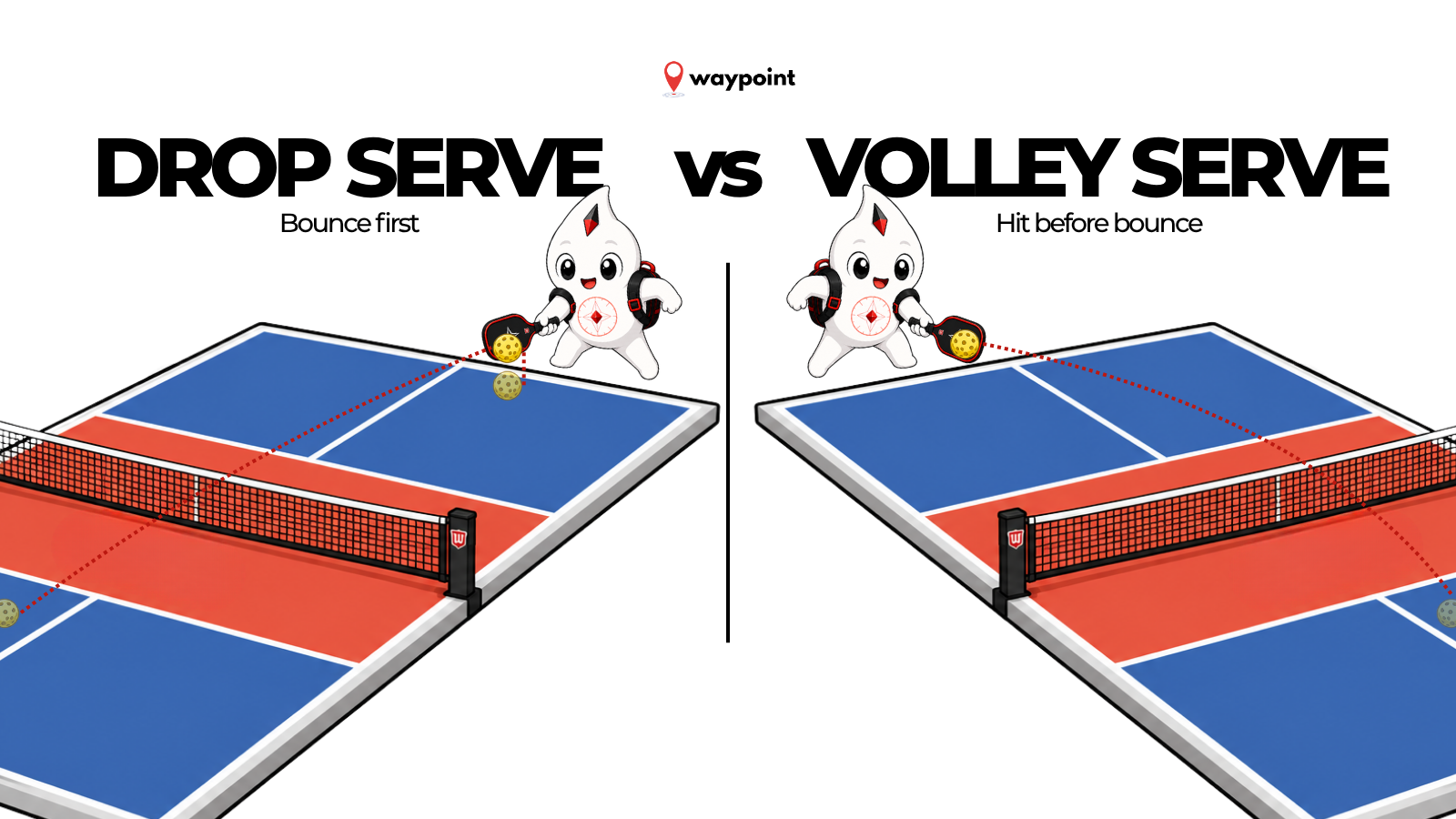

Pickleball gives you two ways to serve: the volley serve and the drop serve.
The easiest difference to remember is this: a volley serve is hit before the ball bounces, while a drop serve is hit after the ball bounces.
That sounds simple, but the rules are quite different. With a volley serve, most of the restrictions are about how you swing and where you contact the ball. With a drop serve, the important rules are mostly about how you release the ball before it bounces.
What Is a Volley Serve?
A volley serve is when you release the ball and hit it directly out of the air without letting it bounce first.
For the serve to be legal, there are three important things to remember:
- Your paddle must be moving upward.
When the paddle contacts the ball, it must be moving in a clear upward arc. - The paddle head cannot be above your wrist.
At contact, the highest point of the paddle head must clearly not be above the highest part of your wrist joint. - The ball cannot be above your waist.
You must contact the ball at or below waist height.
All three rules apply together. Hitting the ball below your waist does not automatically make the serve legal if your paddle is not also moving upward or the paddle head is too high.
A volley serve can be hit with either a forehand or backhand motion.
The easiest way to remember it is:
Upward swing → Paddle head not above wrist → Ball at or below waist
What Is a Drop Serve?
A drop serve starts differently. You release the ball, let it bounce on the playing surface, and then hit it.
Once the ball has bounced, the three volley-serve rules above do not apply. There is no rule requiring the paddle head to stay below your wrist, no waist-height contact rule, and no requirement to use the same upward serving motion.
Instead, you need to pay attention to how the ball is released.
- Release the ball from a natural, unaided height.
The official rule does not give a specific height such as your waist or shoulder. It simply says the ball must be released from a natural, unaided height. - Do not add force to the release.
You cannot throw the ball down, toss it upward, push it sideways, or otherwise propel it in any direction before hitting the serve. - Let the ball bounce before hitting it.
A drop serve is made by hitting the ball after it has bounced on the playing surface.
In simple terms:
Release it naturally, let gravity bring it down, let it bounce, then hit.
There is also no rule requiring you to hit the ball after exactly one bounce. The 2026 rulebook says there is no restriction on the number of bounces, and no restriction on where the ball bounces on the playing surface before you hit it. Most players will simply hit after the first bounce because that is the most practical way to serve.
Like the volley serve, a drop serve can be hit with either a forehand or backhand motion.
Drop Serve vs Volley Serve
Here is the easiest way to compare them:
| Volley Serve | Drop Serve | |
|---|---|---|
| Hit before or after bounce? | Before | After |
| Clear upward paddle arc? | Required | Not required |
| Ball at or below waist? | Required | Not required |
| Paddle head not above wrist? | Required | Not required |
| Natural, unaided drop? | Not a drop-serve requirement | Required |
| Can you throw or push the ball down? | Not a drop serve | No |
| Forehand or backhand? | Both allowed | Both allowed |
So the simplest difference is:
Volley serve = more rules about the swing and contact.
Drop serve = more rules about the release and bounce.
What Rules Apply to Both Serves?
Some rules stay the same whichever serve you choose.
For both serves, the ball must be released using only one hand or only the paddle. You also cannot deliberately manipulate the ball to add spin during the release, although some natural rotation is expected. You can still create spin when your paddle actually contacts the ball.
The release must also be visible to the receiver.
Your serving position also stays the same. When you hit the serve, at least one foot must be touching the correct serving area behind the baseline. Neither foot can be touching the court, including the baseline, and neither foot can be touching the ground outside the correct serving area.
And whichever serve you choose, the ball still has to travel diagonally into the correct service court and completely clear the opponent’s kitchen. It can touch the net on the way over and still be legal if it lands correctly.
Which Serve Is Easier for Beginners?
For some beginners, the drop serve feels easier because you can let the ball bounce first and focus on making clean contact. You also do not need to think about the volley serve’s wrist, waist, and upward-motion requirements.
Other players prefer the volley serve because once the timing becomes comfortable, releasing and hitting the ball in one motion can feel more natural.
Neither serve is automatically better. It is worth trying both and seeing which one you can perform most comfortably and consistently.
Can You Switch Between Them?
Yes. You do not have to commit to one serving style for the entire game.
You can use a volley serve at one point and a drop serve later. You simply need to follow the rules for whichever serve you are using at that moment.
If you hit the ball before it bounces, the volley-serve rules apply.
If you release it and hit it after it bounces, the drop-serve rules apply.
Common Serving Mistakes
Throwing the Ball Down on a Drop Serve
This is probably the biggest mistake to watch for.
You might think pushing the ball towards the ground will give you a nicer or higher bounce, but the rule specifically says the ball cannot be propelled in any direction.
For a legal drop serve, release it rather than throwing it.
Tossing the Ball Up Before a Drop Serve
The same rule applies in the opposite direction.
A drop serve is not a tennis-style toss followed by a bounce. Tossing it upward means you are adding force to the release.
For a drop serve, let the ball fall naturally instead.
Thinking the Waist Rule Applies to Both Serves
It does not.
The rule requiring contact at or below the waist applies to the volley serve. Those volley-specific contact rules do not apply once you are making a legal drop serve.
Thinking “Underhand” Is the Only Volley Serve Rule
It is easy to hear “pickleball serves are underhand” and think that is the whole rule.
For a volley serve, you actually need to remember all three requirements: the paddle must be moving upward, the paddle head must not be above your wrist, and the ball must not be above your waist at contact.
Adding Spin With Your Hand
You can create spin when the paddle hits the ball, but you cannot deliberately spin or manipulate the ball during the release before serving.
That rule applies to both types of serve.
Stepping on the Baseline
Switching from a volley serve to a drop serve does not change your foot position.
At least one foot must be grounded in the legal serving area, and neither foot can be touching the court when you hit the ball. Since the baseline is part of the court, touching it at contact is a fault.
So, Which One Should You Use?
If you are still learning, try both.
The volley serve lets you hit the ball directly from the release, but you need to keep the three contact rules in mind.
The drop serve removes those contact restrictions, but you need a clean release. Do not throw, push, or toss the ball. Release it naturally, let it bounce, and then hit.
Whichever one you choose, being able to serve legally and consistently is more useful than trying to make the motion complicated.
Quick Recap
For a volley serve:
- Paddle moving upward
- Paddle head not above the wrist
- Ball contacted at or below the waist
For a drop serve:
- Release from a natural, unaided height
- Do not propel the ball in any direction
- Let it bounce before hitting
The easiest way to remember the difference is:
Volley serve = rules around the swing.
Drop serve = rules around the drop.
Rule note: This article follows the 2026 USA Pickleball Official Rulebook. Other competitions may use a different rule set, so check the rules for the event you are playing. USA Pickleball notes that its official rulebook is the definitive rulebook for USA Pickleball play.
Continue Your Journey
Love pickleball?
Discover more beginner guides, player stories, training tips, and the latest from the community.
Website
🌍 waypoint.fan
Instagram
📸 @waypoint.fan
Every journey starts with a Waypoint.