

There are hundreds of pickleball drills online, so finding something to practice is rarely the problem. The harder part is knowing which drill actually makes sense for your game right now.
You might save a serve drill today, a dink drill tomorrow, then come across a footwork exercise that looks useful too. Before long, you have plenty of ideas but no real order to follow, and every practice session starts with the same question: What am I supposed to work on today?
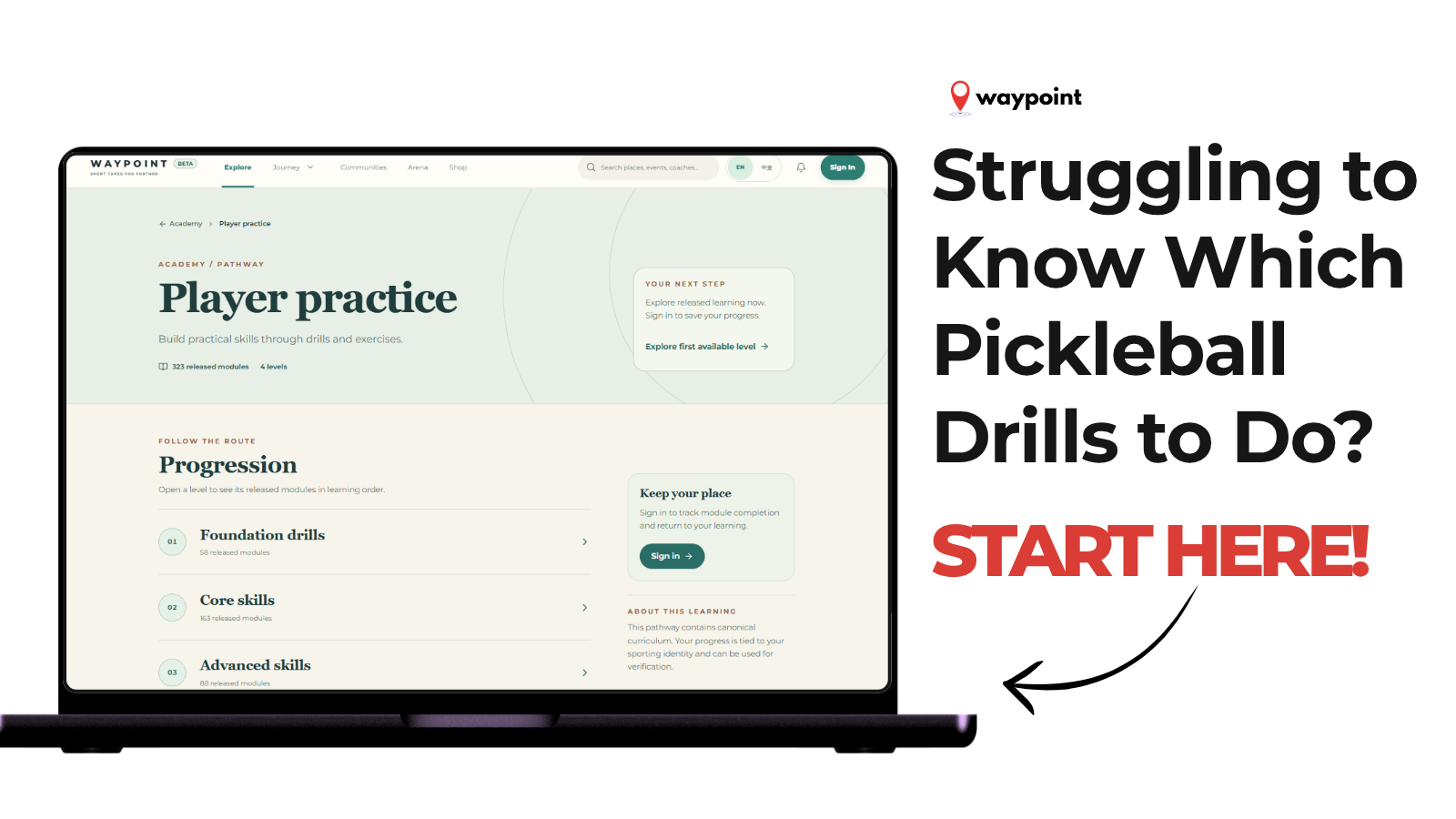
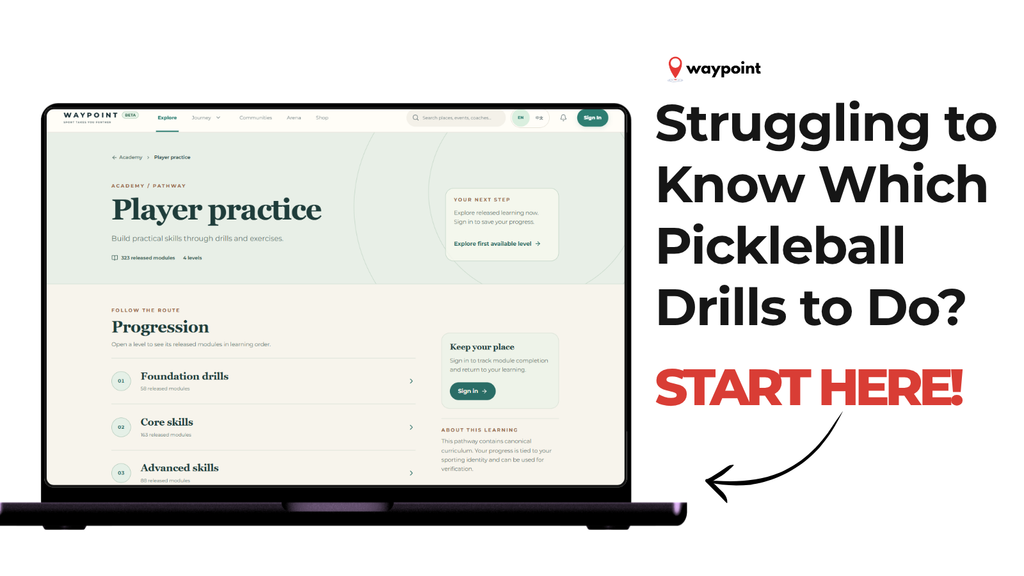
That is what the Player Practice Pathway in Waypoint Academy is designed to make easier. Instead of giving you one huge list of drills and leaving you to figure everything out yourself, Waypoint organizes 323 guided practice modules into four levels, giving you a clearer route from foundational skills to more advanced practice.
A Pickleball Practice Pathway You Can Actually Follow
The Player Practice Pathway is divided into four levels, with each one building towards the next:
1. Foundation Drills
Start with the movements, shots, and habits your game is built on.
2. Core Skills
Develop the skills you will use regularly during real points.
3. Advanced Skills
Move into more difficult techniques and situations as your game develops.
4. Performance Practice
Bring those skills together in more performance-focused practice.
There are currently 58 Foundation modules, 163 Core Skills modules, 88 Advanced Skills modules, and 14 Performance Practice modules. The point is not to rush through all 323 as quickly as possible. It is to give your practice an order, so instead of searching for a completely new drill every time you step on court, you can see where you are and what you could work on next.
The Foundation level alone moves through serves, returns, dinks, drives, volleys, kitchen movement, rally control, footwork, wall drills, touch, reaction, and more. Early modules include practices such as Deep Consistency Serve, Placement Targeting Serve, Deep Return, Backhand Return Focus, Cross-Court Return, and Return and Advance, before gradually moving into more involved situations.
What Happens When You Open a Practice?
This is where the pathway becomes more useful than a simple list of drill names.
When you open a module, Waypoint turns it into a guided practice. Using the Deep Consistency Serve module as an example, you are not simply told to stand at the baseline and hit a bunch of serves. The module first explains why depth matters, what you should pay attention to, how to perform the practice, and what to adjust when you try again.
Each practice follows a simple structure:
1. Understand the situation
You first learn why the skill matters in an actual game. For the Deep Consistency Serve, for example, the module explains how a short serve can make the return easier to attack, while a deeper serve can push the returner farther back.
2. Learn the idea
Before stepping onto the court, you are given something specific to focus on. That way, you know what a successful attempt should actually look or feel like instead of simply repeating the movement.
3. Try the practice
Then you take it onto the court. The module gives you clear instructions to follow, so you know where to stand, what to aim for, and what you are trying to accomplish.
4. Adjust and repeat
After trying it, you are given something to change or focus on during the next attempt. Rather than repeating the exact same thing again and again, you can use what happened during the practice to make a small adjustment.
That means each module is doing more than saying, “Do this drill 20 times.” It gives you context before you begin, something specific to focus on while you practice, and a clearer idea of what to change if the first few attempts are not working.
You Have an Actual Goal to Work Towards
The modules can also give you a measurable goal instead of leaving you to decide whether the practice went well.
For example, the goal in Deep Consistency Serve is to land 15 out of 20 serves in the back third of the court. There is an optional counter inside the practice where you can record whether each attempt counted, making it easier to see how consistently you are hitting the target.
That might sound like a small feature, but it changes the way the practice feels. Instead of serving for ten minutes and finishing without really knowing whether you improved, you have something specific to work towards.
Once you are finished, you can complete the module and see what practice comes next.
Your Progress Stays With You
If you sign in to Waypoint, your progress stays connected to your account. You can see how many modules you have completed overall and how far you have progressed through each of the four levels.
That means your next practice does not have to start with another search for something new. You can come back, see where you stopped, and continue building from there.
For someone trying to practice more consistently, that makes the pathway feel less like a collection of individual drills and more like an actual training journey.
How to Find the Player Practice Pathway
You also do not have to dig through the website to find it.
- Go to waypoint.fan
- Scroll down to Learn something new
- Select Player Practice Pathway
- Open a level and choose your next practice
If you are signed in, your completed modules and pathway progress will stay with your account, so the next time you come back, you can continue from where you left off.
Stop Guessing What to Practice Next
You probably do not need another folder full of saved pickleball drills. Having more drills does not always make it easier to know what your game actually needs.
What helps is having somewhere to start, a clear goal while you practice, and an idea of where to go next.
That is what the Player Practice Pathway is there for. Start with one module, follow the guided practice, complete it when you are ready, and keep building from there.
Your next pickleball practice is already waiting for you.
Continue Your Journey
Not sure what to work on next?
Explore the Player Practice Pathway and find your next guided practice.
Website
🌍 waypoint.fan
Instagram
📸 @waypoint.fan
Every journey starts with a Waypoint.