

If you are new to pickleball, one of the first questions you might have is: where am I actually supposed to stand when I serve?
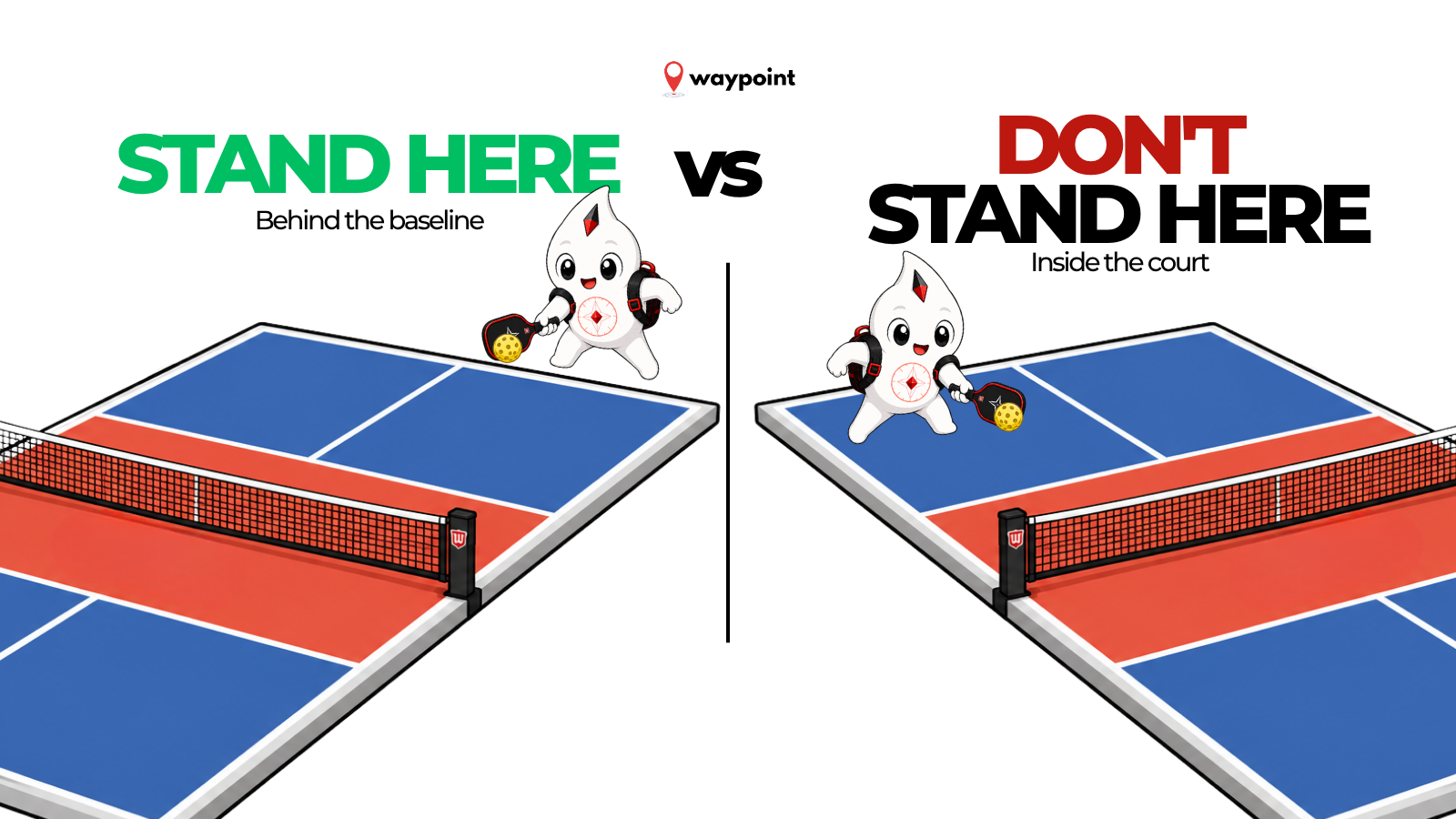
The simple answer is that you stand behind the baseline, on the correct side of the court.
From there, you serve the ball diagonally into the service court across from you.
There are a few rules about where your feet can go, but they are easier to understand once you look at the court.
Where Do You Stand When Serving?
When you serve, stand behind the baseline on the side you are serving from.
The baseline is the line at the very back of the court.
When you hit the serve, neither foot can touch the baseline or the court in front of it. At least one foot must be on the ground behind the baseline, while the other foot can be in the air.
So you do not need to stand far away from the court. You just need to make sure you are clearly behind the baseline when you hit the ball.
For beginners, standing a small step behind the line is usually easiest.
Where Can Your Feet Go?
You also need to stay behind your section of the baseline.
A simple way to picture it is to look at the two lines on either side of your service box: the centerline and the sideline.
Imagine those lines continuing straight back behind the baseline.
Your feet should stay between them when you serve.
So if you are serving from the right side, do not move too far towards the middle or too far outside the right sideline before hitting the ball.
You can remember it as:
Behind the baseline + behind your side of the court.
That is the beginner-friendly version of the official serving-area rule.
Which Side Do You Serve From?
The side you serve from depends on whether you are playing singles or doubles.
In Singles
In singles, your own score tells you which side to serve from.
If your score is even, serve from the right side.
If your score is odd, serve from the left side.
So:
0, 2, 4, 6 → Right side
1, 3, 5, 7 → Left side
For example, if your score is 4, you serve from the right. If your score is 5, you serve from the left.
In Doubles
In traditional doubles scoring, the game starts with the first server on the right side.
If the serving team scores a point, the same server switches to the other side and serves again. They continue switching sides each time their team scores while they still have the serve.
So it can look like:
Start on the right → Score → Move left → Score → Move right
The easiest way to remember singles is:
Even = Right
Odd = Left
Where Should the Serve Land?
The serve must travel diagonally across the court and land in the correct service court.
So if you are serving from one side, you are aiming for the service box diagonally opposite you.
The serve must also clear the kitchen, including the kitchen line.
If the serve lands on the:
- Sideline: In
- Centerline: In
- Baseline: In
- Kitchen line: Fault
That last one is important because the kitchen line is part of the kitchen, not the service court.
An easy way to remember it is:
Serve diagonally and get the ball past the kitchen line.
What Happens After You Score?
In traditional doubles scoring, the same player continues serving after their team scores a point.
The difference is that they switch sides before the next serve.
For example, imagine you begin serving from the right at 0-0-2.
Your team wins the rally and scores a point.
The score becomes 1-0-2, and you move to the left side to serve again.
If your team scores another point, you move back to the right.
You continue switching sides each time your team scores until your serving turn ends.
Where Should Your Partner Stand?
Your partner does not have to stand behind the baseline when you serve.
Only the server has specific rules about where they must stand. Your partner can stand anywhere on your team’s side of the net.
However, it is usually a good idea for your partner to stay near the baseline when your team is serving.
That is because of the two-bounce rule. After you serve, the receiving team lets the serve bounce and returns it. Your team must then let that return bounce before hitting it.
If your partner stands too far forward, a deep return can be difficult to play.
So while standing behind the baseline is not required for your partner, it is usually the easiest position to start from.
Server: Must stand behind the baseline.
Server’s partner: Can stand elsewhere, but usually stays near the baseline.
Common Beginner Mistakes
Stepping on the Baseline
Your foot cannot be touching the baseline when you hit the serve.
If you are worried about stepping on it, give yourself a little extra room and stand slightly farther back.
Standing Too Far to the Side
Being behind the baseline does not mean you can serve from anywhere behind the court.
Stay behind the part of the court you are serving from.
A useful way to check is to picture the centerline and sideline continuing straight back towards you.
Stay between them.
Serving Straight Ahead
A pickleball serve does not go straight across the court.
It must travel diagonally into the opposite service court.
Landing the Serve in the Kitchen
Your serve needs to clear the kitchen and its line.
If it lands on the kitchen line, the serve is a fault.
Forgetting to Switch Sides After Scoring
If your team scores while you are serving in traditional doubles scoring, you switch to the other side and serve again.
You do not stay in the same serving position.
Moving Forward Too Quickly
After you serve, you may be tempted to run towards the kitchen immediately.
But remember that your team has to let the return bounce because of the two-bounce rule.
Staying closer to the baseline at first gives you more space to play a deep return.
Quick Recap
You do not need to memorise a complicated set of lines to know where to serve from.
Just remember:
1. Stand behind the baseline.
2. Stay behind your side of the court.
3. Serve diagonally across the net.
4. Make sure the serve clears the kitchen.
And if your team scores while you are serving:
Switch sides and serve again.
The easiest way to remember it is:
Behind the baseline → Correct side → Serve diagonally
Once you understand those three things, knowing where to stand for your serve becomes much easier.
Continue Your Journey
Love pickleball?
Discover more beginner guides, player stories, travel inspiration, and the latest from the community.
Website
🌍 https://waypoint.fan
Instagram
📸 @waypoint.fan
Every journey starts with a Waypoint.