
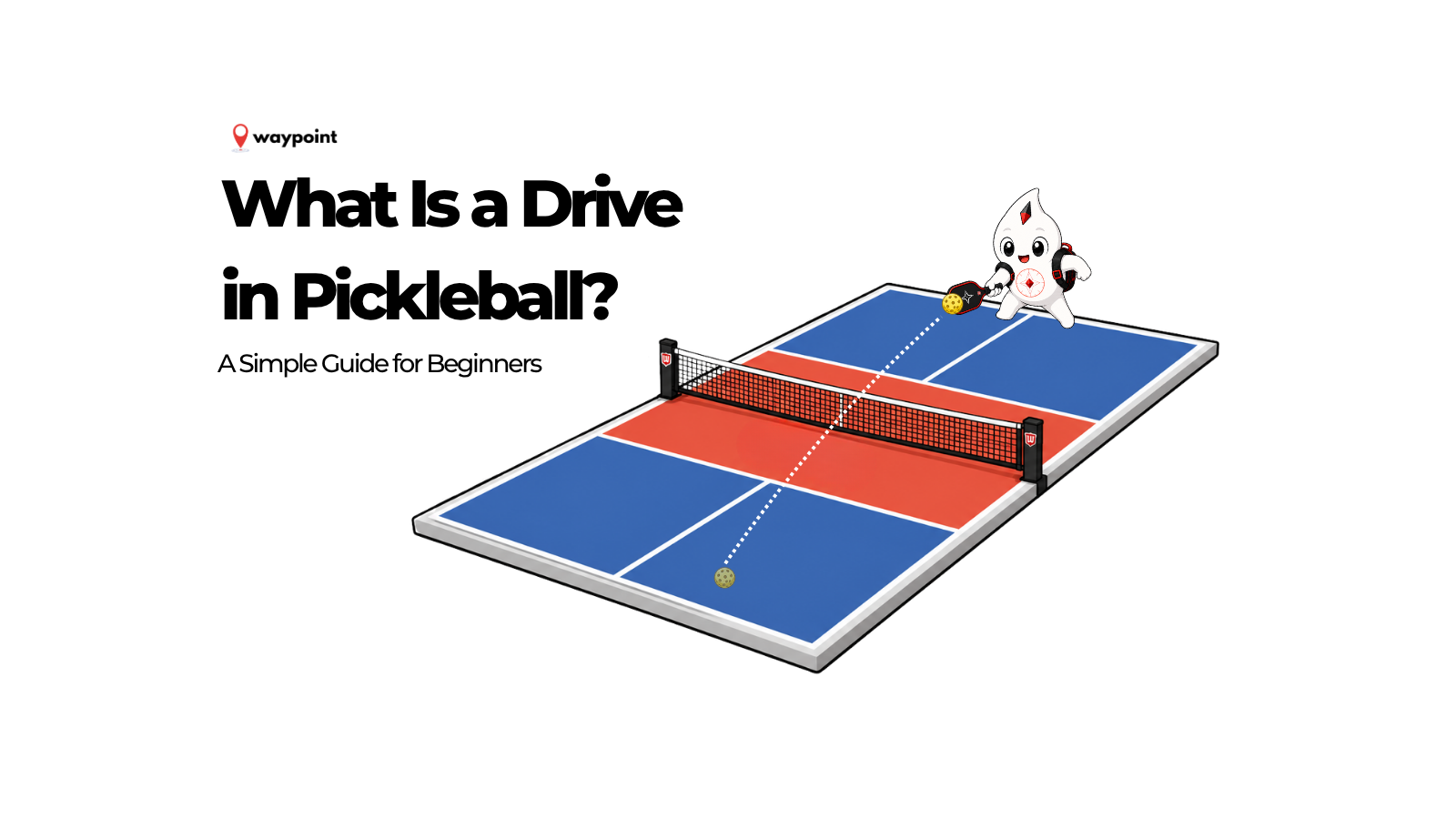

If you have watched a fast pickleball rally, you have probably seen players hit the ball firmly from one side of the court to the other. This shot is called a drive.
A drive can put pressure on your opponent and give them less time to react. However, a good drive is not only about power. Placement, timing, and control are just as important.
What Is a Drive in Pickleball?
A drive is a fast and firm shot that travels low over the net.
It is usually hit after the ball bounces and is often played from the baseline or the middle of the court. A drive can be hit using either your forehand or backhand.
Unlike a dink, which is soft and intended to land inside the kitchen, a drive uses more pace to put your opponent under pressure.
The goal is not always to win the point immediately. A well-placed drive can force a difficult return and create an easier opportunity on the next shot.
Why Do Players Use Drives?
Players use drives to speed up the rally and make their opponents react quickly.
A good drive may:
- Force an opponent to block the ball
- Create a weak or high return
- Target an opponent who is still moving
- Find space between two players
- Set up a softer shot on the next ball
A drive can be especially useful when your opponent gives you a ball that bounces high enough to attack comfortably. Players may also use a drive before playing a drop shot on the following ball.
However, hitting every ball hard can make your game predictable. Drives work best when they are mixed with softer shots such as dinks, drops, and resets.
When Should You Hit a Drive?
A drive is usually a good choice when the ball bounces high and you have enough time to prepare.
For example, you may choose to drive when:
- The ball bounces around knee height or higher
- Your opponent’s shot lands short
- You are balanced and can step towards the ball
- You see an open space or a difficult target for your opponent
A high or short ball gives you more room to hit forward while still keeping the shot inside the court. USA Pickleball’s player education also recommends drives when the return has a high bounce and the player can move into the shot with control.
A low ball is usually more difficult to drive because you need to lift it over the net. Trying to hit it too hard may send it into the net or beyond the baseline.
Where Should a Drive Go?
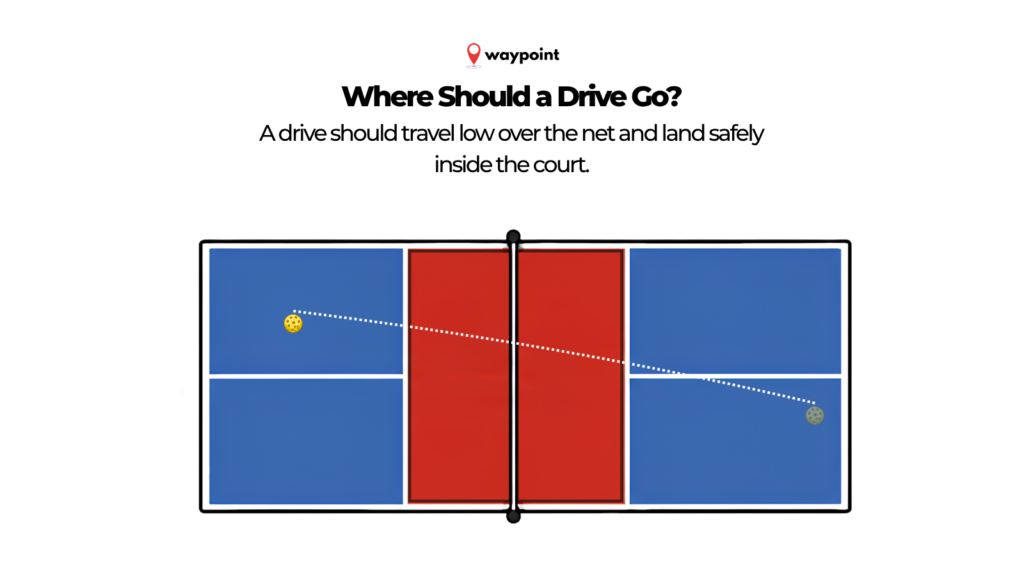
A drive should travel low over the net and land safely inside the court.
You can aim towards:
- The middle, especially during doubles
- An opponent’s backhand
- The feet of a player standing near the kitchen
- An open part of the court
- The opponent who is still moving after hitting the previous shot
The middle is often a useful target because it gives you more space than aiming close to a sideline. It may also cause confusion between doubles partners.
You do not always need to aim for a perfect winner. A controlled drive towards a difficult area can be more effective than a harder shot aimed too close to the line. Official third-shot guidance also lists the middle, the backhand, and the moving returner as useful targets.
How to Hit a Drive
A drive should feel strong and controlled.
Start by turning slightly to the side and preparing your paddle behind the ball. Keep your knees bent and move your feet until the ball is in a comfortable position.
Make contact in front of your body, then swing forward towards your target.
Focus on these basics:
- Move into position before swinging.
- Keep your eyes on the ball.
- Contact the ball in front of your body.
- Use a compact backswing.
- Transfer your weight forward.
- Follow through towards your target.
- Get ready for the next shot.
A shorter backswing can make the drive easier to control, while a complete follow-through helps the ball travel smoothly through the court.
Beginners do not need to hit at full strength. Start at a comfortable speed and increase the pace only when you can keep the ball inside the court consistently.
Do You Need Topspin?
No. You can learn a basic drive without adding a lot of spin.
However, many players eventually use topspin on their drives. Topspin is created by brushing up the back of the ball with a low-to-high swing. It helps the ball move forward before dropping towards the court.
When you are first learning, focus on clean contact and control. Spin becomes more useful once your basic swing feels consistent.
Common Beginner Mistakes
Swinging as Hard as Possible
A drive does not need maximum power. Swinging too hard can reduce your control and send the ball into the net or beyond the baseline.
Start with a controlled swing and focus on hitting the centre of the paddle.
Using a Large Backswing
A large backswing takes more time and makes it harder to adjust.
A compact preparation gives you better control and helps you react more quickly.
Driving Every Ball
Not every ball should be attacked.
If the ball stays low or lands close to your feet, a softer drop or reset may be safer than trying to drive it.
Contacting the Ball Too Late
Waiting until the ball moves beside or behind your body can make the shot difficult to control.
Try to meet the ball in front of you so you can direct it towards your target.
Aiming Too Close to the Lines
Beginners often aim for the corners because they want to hit a winner.
Leave some space between your target and the sideline or baseline. Keeping the ball in play is usually more valuable than attempting a perfect shot.
Watching the Drive Instead of Preparing
After hitting the ball, return your paddle to a ready position.
Your opponent may block the drive quickly, so you need to be prepared for the next shot.
Drive vs Other Shots
A drive is often confused with a dink or a drop shot because all three are common shots in pickleball. The biggest difference is how they are used.
A drive is a fast and firm shot that puts pressure on your opponent.
A dink is a soft shot played near the kitchen line. It lands inside your opponent’s kitchen and is used to slow down the rally and create better opportunities.
A drop shot is also a soft shot, but it is usually played from deeper in the court. Its goal is to land gently inside the opponent’s kitchen, giving you time to move towards the kitchen line.
Here’s an easy way to remember them:
- Drive: Fast shot used to apply pressure.
- Dink: Soft shot used to control the rally.
- Drop Shot: Soft shot used to help you move forward.
There isn’t one shot that’s always better than the others. The best choice depends on the height of the ball, where you are on the court, and where your opponents are standing.
What Is a Third Shot Drive?
The third shot is the serving team’s first shot after the serve and return.
A third shot drive is a fast shot played by the serving team on that third contact. It is often used to pressure opponents who have moved towards the kitchen line.
A successful third shot drive may force a weak block, allowing the serving team to play a softer fifth shot and begin moving forward.
However, players should not automatically rush towards the kitchen after every drive. First, watch the opponent’s return and move forward only when it is safe to do so.
Quick Recap
A drive is a fast and firm pickleball shot that usually travels low over the net.
Players use drives to put opponents under pressure, create difficult returns, and prepare for the next shot. A drive can be played from either the forehand or backhand side.
The most important part of a drive is not how hard you hit it. Good footwork, clean contact, safe placement, and control will make the shot much more useful.
Once you can keep your drives inside the court consistently, you can begin experimenting with more speed, direction, and topspin.
Continue Your Journey
Love pickleball?
Discover more beginner guides, player stories, travel inspiration, and the latest from the community.
Website
🌍 https://waypoint.fan
Instagram
📸 @waypoint.fan
Every journey starts with a Waypoint.